WeRide (WRD): Commercial Partnerships Drive Robotaxi Revenue and ADAS Licensing
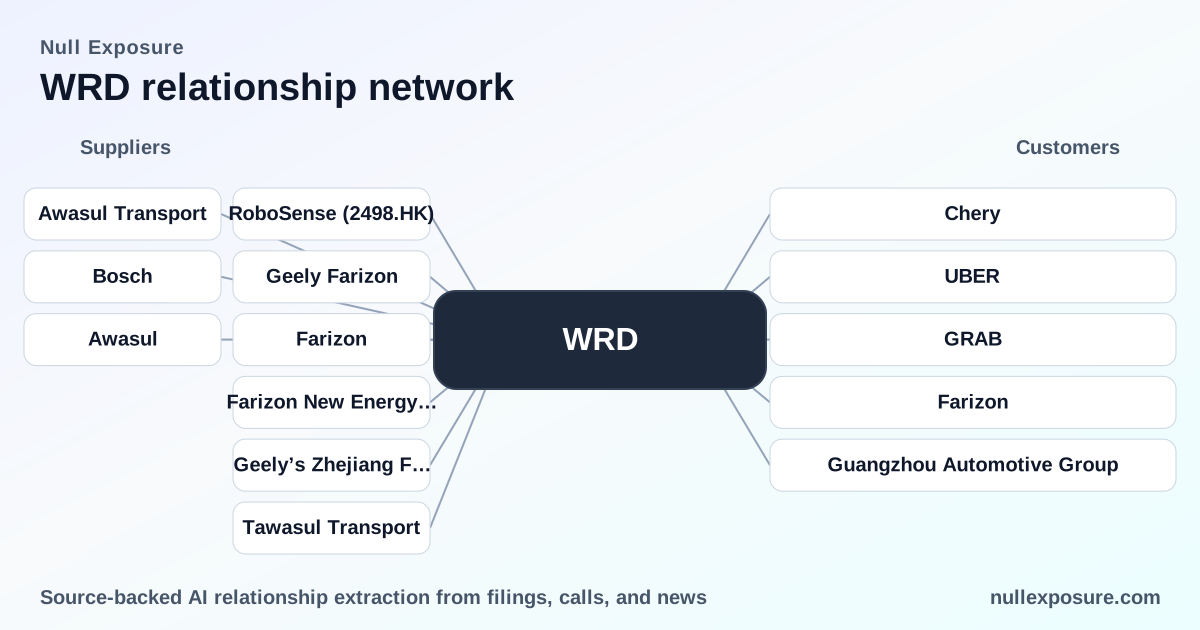
WeRide operates a two‑pronged commercial model: it runs fare‑charging robotaxi and shuttle services through platform partners (notably Uber and Grab), and licenses its WRD ADAS/ autonomy stack into OEMs and co‑developed vehicles (GAC Aion, Chery, others). Revenue flows come from ride fares and platform distribution agreements, plus hardware/software design‑win revenue and recurring software updates for production vehicles. For investors, the key takeaway is that distribution and scale are driven through a small set of strategic partners, while product monetization expands through OEM design wins. Learn more at https://nullexposure.com/.
Why this matters to investors: commercialization over R&D
WeRide moved decisively from pilots to fare‑charging, city‑level operations in 2025–2026. That shift changes the growth profile: operating leverage from ride volume and recurring ADAS production revenue becomes the driver rather than pure R&D milestones. The company’s contracting posture is partnership‑centric—outsourced distribution to large mobility platforms and OEM co‑development—creating both scalable channels and concentrated counterparty risk.
If you want a map of counterparties and commercial roles, see our customer summary below or visit https://nullexposure.com/ for deeper relationship analytics.
Operating model signals and company‑level constraints
There are no explicit constraint records in the source payload, which itself is a signal: public reporting emphasizes partnerships and design wins rather than long, exclusive supply contracts disclosed to investors. From the customer evidence we derive these characteristics:
- Contracting posture: alliance‑first — WeRide sells services via ride‑hailing partners and supplies ADAS stacks to OEMs rather than vertically integrating distribution.
- Concentration: material concentration risk exists around platform partners (Uber, Grab) and several lead OEM groups (GAC, Chery).
- Criticality: WeRide’s technology is mission‑critical for driverless operations and a significant feature for OEM customers adopting WRD 3.0.
- Maturity: transitioning from pilot deployments to commercial fare‑charging operations in multiple jurisdictions — moving into volume economics and platform revenue sharing.
These signals together imply a growth model that scales with partner distribution while being sensitive to partner economics, regulatory approvals, and OEM production ramps.
Customer relationship map: what each partner delivers
Uber / Uber Technologies, Inc. (UBER)
WeRide has converted pilots into commercial, fare‑charging robotaxi operations through the Uber app in Dubai and Abu Dhabi, and announced plans to scale to at least 1,200 robotaxis across Abu Dhabi, Dubai, and Riyadh by 2027. This is both a distribution channel and a committed demand pool: Uber provides guaranteed rider access and scale while WeRide supplies the robotaxi fleet and autonomy software. (Sources: GlobeNewswire Feb 6, 2026; WeRide 2025 Q3 earnings call; TechCrunch Mar 31, 2026.)
Grab / Grab Holdings Limited (GRAB)
WeRide and Grab launched Singapore’s first autonomous public ride service in Punggol, with WeRide GXR and Robobus models operated under Grab’s Ai.R service and regulatory approvals from Singapore’s Land Transport Authority. The Grab partnership functions as a regional platform channel for community rollouts in tightly regulated urban environments. (Sources: GlobeNewswire Apr 1, 2026; WeRide 2025 Q3 earnings call.)
GAC Aion
GAC Aion publicly launched pre‑sales for the Aion N60, the first mass‑production passenger vehicle co‑developed with WeRide and powered by WeRide Driving (WRD 3.0), signaling a production design win and a route to OEM software/hardware revenue. This is an early example of monetization through vehicle sales and software licensing. (Sources: SAHM Capital / press release Apr 16, 2026; Finviz coverage Apr 16, 2026.)
GAC Group / GAC (Guangzhou Automobile Group)
WeRide is working across brands under GAC Group to integrate WRD platforms into multiple vehicle segments, positioning the company as a major ADAS supplier within a state‑level OEM ecosystem. These engagements create a pipeline of potential volume revenue as WRD 3.0 secures additional production design wins. (Sources: SAHM Capital Apr 2026; company commentary included in news summaries.)
Guangzhou Automotive Group (explicit call mention)
WeRide’s 2025 Q3 earnings call identifies Guangzhou Automotive Group as having selected WeRide as a major ADAS system provider, confirming supplier status and aligning WeRide with a large OEM customer relationship. (Source: WeRide 2025 Q3 earnings call.)
Chery
WeRide references product collaboration with Chery — including specific model references such as the EXEED ES and ET models in public commentary — and company statements show the Chery collaboration advancing WePilot / WRD platform integration and management alignment. This represents additional OEM design‑win exposure across China’s passenger vehicle market. (Sources: WeRide 2025 Q3 earnings call; InsiderMonkey commentary Mar 2026.)
Farizon
Media reporting links WeRide’s GXR upgrades and GEN8 autonomous suite to broader fleet initiatives involving Farizon (a Geely‑affiliated mobility brand), indicating technology adoption beyond a single OEM family and reinforcing that WeRide’s sensor and stack upgrades are being integrated by third‑party vehicle programs. (Source: CleanTechnica Mar 9, 2026.)
What to watch next: risks and upside catalysts
- Key upside: accelerated ADAS production ramps (WRD 3.0) across the near‑30 model pipeline, and volume robotaxi scale via Uber/Grab that unlocks fare revenue and unit economics improvements. Design wins converting to production units are the primary revenue catalyst.
- Concentration risk: a small number of platform partners and OEM groups account for distribution and potential volume; partner economics and shareholder decisions (for example, Uber’s increased stake and distribution commitment) materially influence WeRide’s scaling speed. (Source: TechCrunch Mar 2026; SAHM Capital Apr 2026.)
- Regulatory exposure: city‑level permits and LTA approvals are prerequisites for fare‑charging operations; success in regulated urban rollouts is already demonstrated but must replicate across jurisdictions to achieve scale. (Sources: WeRide press releases and news coverage Mar–Apr 2026.)
- Capital intensity and margins: running robotaxi fleets and supporting OEM production requires capital and service infrastructure; margins will improve only as utilization and software licensing scale.
Bottom line: partner distribution is the product
WeRide’s commercial profile is distribution‑led, with Uber and Grab supplying rider access while GAC, GAC Aion, Chery and others anchor product revenue through WRD 3.0 design wins. Investors should value both the demonstrated ability to move from pilots to fare charging and the concentration risk inherent in partnership‑heavy growth. For a focused view of counterparties and to model partner concentration, visit https://nullexposure.com/.
Bold takeaways:
- WeRide monetizes via ride fares (platform partners) and ADAS/OEM production revenue.
- Uber and Grab are strategic distribution channels; GAC and Chery are OEM production pathways.
- Scale depends on converting design wins into production units and expanding paid robotaxi markets under partner contracts.