Western Copper and Gold (WRN): Underwriter Dependence and Capital Strategy Drive Near-Term Valuation
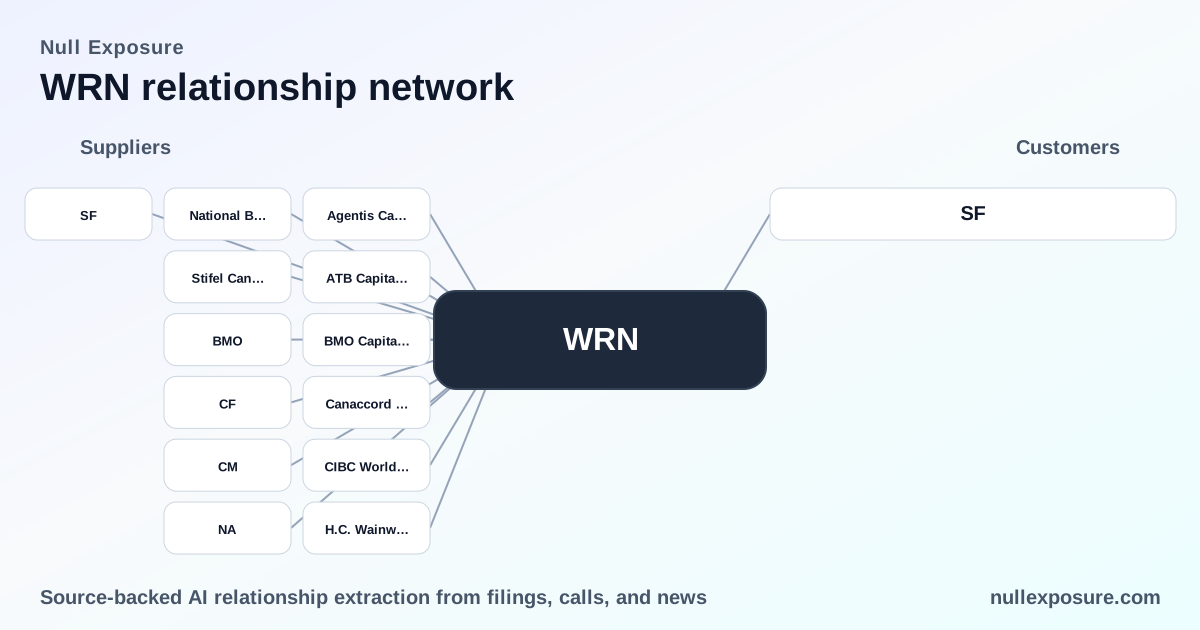
Western Copper and Gold Corporation is an exploration-stage miner that develops Canadian mineral assets and monetizes progress through equity financings and project advancement rather than operating revenue. The company funds exploration and development via bought‑deal underwritten equity offerings, making its near-term project delivery and valuation highly sensitive to capital markets access and lead underwriter relationships. For investors, underwriting partnerships — their size, structure, and concentration — are the primary commercial signal to monitor.
If you want a concise view of partner activity and financing flow for WRN, see more at https://nullexposure.com/.
What the recent relationships tell investors about WRN’s financing posture
Western Copper and Gold is demonstrably reliant on marketed equity capital to fund development, and the data shows the company executed multiple bought‑deal transactions with a consistent underwriting lead. Bought‑deal structures represent a firm underwriting commitment and therefore reduce execution risk for the issuer, but they concentrate counterparty exposure and create immediate share dilution. Given WRN’s exploration-stage profile — zero reported revenue and negative operating metrics — these underwriting relationships are functionally the company’s lifeline to advance projects toward feasibility and eventual production.
- Contracting posture: WRN uses bought‑deal underwritings (firm commitments) rather than standby or private placements, indicating a willingness to accept underwritten certainty in exchange for financing fees and dilution.
- Counterparty concentration: The same underwriter appears across multiple announcements, suggesting concentrated dependence on a lead syndicate rather than diversified placement channels.
- Criticality: These financings are critical to operational continuity and project timelines given WRN’s lack of operating revenue and negative EBITDA.
- Maturity and risk profile: WRN remains exploration-stage with high financing risk and potential dilution; underwritten bought deals lower placement risk but increase equity overhang.
Deal-by-deal relationship log (each item in the source results)
-
Stifel-related upsized bought deal — investingnews report (result 1): WRN entered an amended agreement with Stifel Canada and a syndicate of underwriters to purchase 19,277,500 common shares at C$4.15 per share for gross proceeds of approximately C$80,001,625, reflecting an upsized bought‑deal financing. According to Investing News (March 10, 2026), the amendment increased the original offering size and confirms the underwriter syndicate’s role in execution (https://investingnews.com/western-copper-and-gold-announces-upsized-c-80-million-bought-deal-financing/).
-
Stifel Canada underwriting announcement — investingnews report (result 2): The same investingnews item identifies Stifel Canada explicitly as the lead and agent on behalf of the underwriting syndicate for the upsized bought deal, reinforcing the lead-manager relationship with WRN. Investing News (March 10, 2026) details the underwriter’s bought‑deal commitment in the amended agreement (https://investingnews.com/western-copper-and-gold-announces-upsized-c-80-million-bought-deal-financing/).
-
Stifel Canada agreement for ~C$50M — Intellectia.ai capture (result 3): A separate notice records an earlier agreement with Stifel Canada for 12,048,400 common shares at C$4.15 per share for gross proceeds of approximately C$50,000,860, indicating an initial bought‑deal placement before the upsizing. The Intellectia.ai aggregation (May 4, 2026) reproduces the company statement of the 12,048,400‑share bought‑deal (https://intellectia.ai/en/stock/WRN/news).
-
SF named as underwriter for C$50M bought deal — investingnews report (result 4): An Investing News release documents the agreement for 12,048,400 common shares at C$4.15, yielding about C$50,000,860 in gross proceeds and attributes the underwriting to the syndicate led by the underwriter identified as SF in the release metadata. Investing News (March 10, 2026) provides the issuer’s announcement for that bought‑deal tranche (https://investingnews.com/western-copper-and-gold-announces-c-50-million-bought-deal-financing/).
-
Stifel Canada again cited for the C$50M offering — investingnews report (result 5): The same Investing News item also lists Stifel Canada as the underwriter for the 12,048,400‑share offering, duplicating the market notice and reinforcing the continuity of the lead underwriting role across WRN’s placements. See Investing News (March 10, 2026) for the company release (https://investingnews.com/western-copper-and-gold-announces-c-50-million-bought-deal-financing/).
Why these relationships matter to portfolio managers
- Dilution and timing: The equity raises are substantial relative to WRN’s free cash generation (which is nil), so each bought deal produces immediate dilution and influences short‑term share supply and price dynamics. The upsizing from C$50M to C$80M demonstrates both appetite and the need for larger capital injections to advance project milestones.
- Concentration risk: A recurring lead underwriter (Stifel Canada, referenced also as SF in filings) means a single syndicate’s distribution capacity and willingness to market WRN stock materially affects WRN’s ability to access capital at scale and on favorable terms.
- Execution certainty vs. cost: Bought‑deal underwritings deliver certainty of proceeds and reduce placement risk, but underwriter fees, price concessions, and dilution are the tradeoffs — a common pattern for junior developers needing predictable funding windows.
- Market signaling: Choosing a reputable underwriter and executing bought deals signals commitment to project advancement and can provide investors with a clearer runway for planned technical work or permitting milestones.
Investment implications and risk checklist
- Positive: Bought‑deal proceeds provide immediate liquidity to fund exploration and development, lower placement execution risk, and publicly validate demand from institutional syndicates.
- Negative: Heavy reliance on underwritten equity issuance concentrates counterparty exposure and compounds dilution risk for current shareholders; execution is tied to capital markets sentiment and the underwriter’s distribution capability.
- Monitoring items: Watch for announced uses of proceeds, any further increases or extensions of the syndicate, lockup arrangements, and whether WRN expands its financing counterparties beyond the current underwriter group.
For a summarized dashboard and deeper counterparty traceability, visit https://nullexposure.com/.
Bottom line: underwriting relationships are the primary operational lever
Western Copper and Gold’s recent activity shows a clear financing-first operating model: the company advances projects by contractually securing equity capital through bought‑deal underwritings led by Stifel Canada (noted in filings as “SF” in some announcements). For investors, the concentration of underwriting and the size of raised capital are the most actionable indicators of near-term project viability and valuation pressure. Monitor subsequent placements, syndicate composition, and stated uses of proceeds to evaluate dilution trajectory and execution risk.