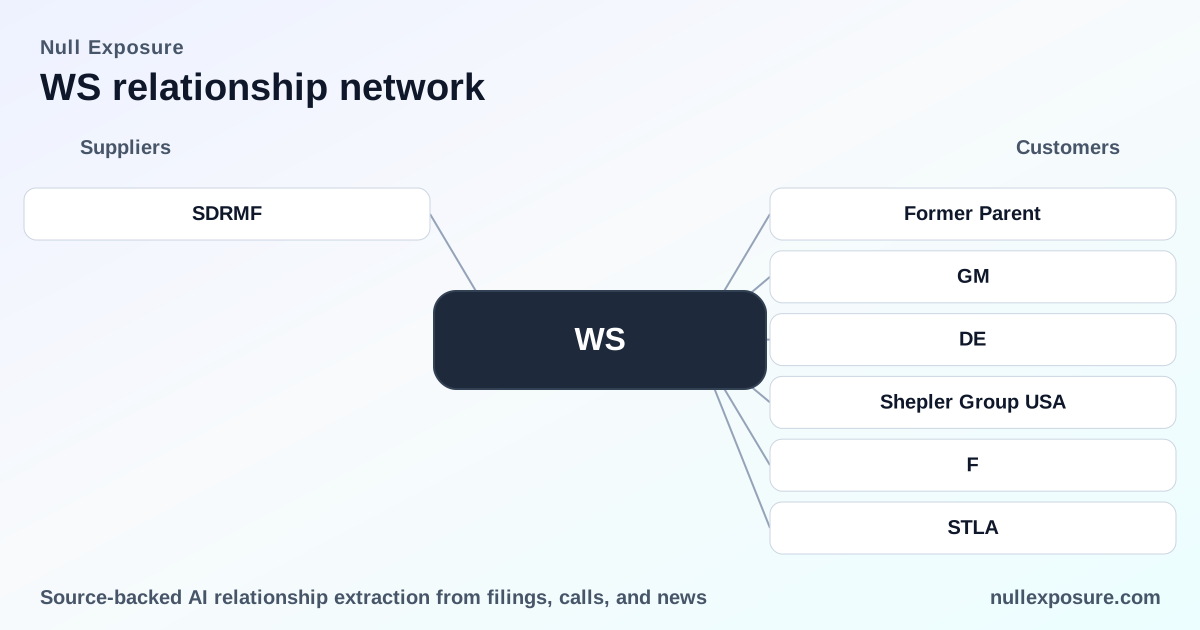
Worthington Steel (WS): Customer relationships that drive cash flow — and concentration risk
Worthington Steel monetizes as a North American precision steel processor through two primary revenue streams: direct sales of processed steel (where Worthington takes title and inventory risk) and fee-based toll processing for customer‑owned material. The company’s profitability is driven by scale in automotive and industrial end markets, long-term supply agreements, and repeatable supplier contracts with major OEMs; however, customer concentration and North American revenue concentration are material features of the model that directly affect margin levers. For investors evaluating WS’s customer relationships, the mix of long-duration supplier arrangements, high-quality OEM endorsements, and a top-three customer share of roughly one-third of sales are the dominant themes. For a full company profile, visit https://nullexposure.com/.
How to read the customer map: durable contracts, concentrated exposure, and dual monetization
Worthington operates as both a merchant seller of steel and a specialized service provider that processes customer-owned material under tolling arrangements. That hybrid reduces inventory costs on some volumes while retaining margin upside where Worthington owns product. Contracting posture is a blend: long-term supply agreements (notably post‑Separation deals) coexist with fee-for-service arrangements and OEM supplier programs. Geographic sales are heavily North American, which concentrates economic exposure to U.S., Canadian, and Mexican demand. Finally, the top three customers represent ~33% of net sales, a structural concentration that amplifies both upside from share gains and downside from any OEM cycle weakness.
Relationship-by-relationship: what each customer means for WS
Former Parent
Worthington’s post‑Separation commercial relationship with its Former Parent is governed by a long-term Steel Supply and Services Agreement, and sales to that entity are recorded in consolidated net sales. This arrangement reflects a formal, ongoing commercial channel that supports baseline volumes after the corporate separation. According to Worthington’s FY2025 Form 10‑K (filed May 2025), net sales to the Former Parent are subject to that long‑term agreement.
DE (supplier recognition)
Worthington is a longstanding supplier to Deere & Company and has been recognized at the Partner level in John Deere’s Achieving Excellence Program for 13 consecutive years, indicating deep, quality‑focused supplier status with an important industrial OEM. Management discussed this supplier rating on the company’s 2025 Q4 earnings call (March 2026).
John Deere
The John Deere listing in investor materials reiterates that Worthington is a high‑tier supplier to Deere, an industrial OEM that relies on consistent metallurgical quality and service. The company emphasized this on its FY2025 Q4 earnings call (March 2026).
General Motors (earnings‑call recognition)
Worthington received General Motors’ Supplier of the Year for 2024, the fourth award in five years, underscoring sustained performance and strategic placement within GM’s supply chain. Management highlighted this recognition in the FY2025 Q4 earnings call (March 2026).
GM (duplicate earnings‑call entry)
The second GM entry repeats the Supplier‑of‑the‑Year disclosure in the FY2025 Q4 earnings call; it reinforces the point that GM is a repeat and meaningful customer across multiple reporting references, cited on the March 2026 earnings call.
Stellantis (KeyBanc estimate)
Equity research coverage summarized on Investing.com notes that KeyBanc estimates Stellantis represents approximately 15% of Worthington’s total sales and is the company’s highest‑margin customer, indicating both revenue concentration and favorable margin mix tied to this OEM. This assessment was reported in KeyBanc’s initiation coverage, as posted on Investing.com (May 4, 2026).
Shepler Group USA
Worthington received the 2025 Supplier of the Year award from Shepler Group USA, a signpost of quality and service in that customer relationship and a contributor to reputation among specialty fleet and transport customers. This award was reported in a company press summary on The Globe and Mail (March 10, 2026).
F (Ford reference in outlook)
TradingView coverage of Worthington’s filings and outlook mentions Ford among the major automakers whose production schedules drive growth in Worthington’s automotive segment, framing Ford as a material demand contributor to future revenue. This mention is included in the March 10, 2026 TradingView report.
Ford
A separate Ford entry from the same TradingView synopsis reiterates that Ford’s production schedules are a growth driver for Worthington’s automotive segment, cited in the company’s FY2026 outlook commentary summarized by TradingView (March 10, 2026).
General Motors (TradingView outlook)
TradingView’s report also lists General Motors among the OEMs supporting Worthington’s automotive outlook, confirming that GM is both an award‑winning supplier relationship and a driver of near‑term production demand as described in the March 10, 2026 TradingView summary.
Stellantis North America
TradingView separately called out Stellantis North America as a key contributor to Worthington’s automotive segment outlook, aligning with KeyBanc’s estimate and underscoring Stellantis’s role in both revenue and margin composition (TradingView, March 10, 2026).
(Collectively: these entries show multiple confirmations across filings, calls and sell‑side notes that the auto OEMs — Stellantis, GM, Ford — plus industrial OEMs like John Deere, are central to revenue and margin.)
Operating‑model constraints and investor implications
- Geography (North America concentration): Worthington’s net sales are predominantly U.S., with Canada and Mexico as meaningful secondary markets; the FY2025 geographic sales table shows the U.S. accounted for the majority of net sales. That concentration links WS’s fate to North American industrial cycles and trade/regulatory conditions (FY2025 Form 10‑K).
- Customer concentration (material): The top three customers accounted for roughly 33% of net sales in fiscal 2025, a structural concentration that amplifies exposure to OEM production swings and single‑customer negotiation leverage (FY2025 disclosures).
- Dual role (seller and service provider): The company both sells steel directly (accepting inventory risk) and toll processes customer‑owned material under fee arrangements, which creates a mix of margin profiles and working‑capital dynamics; tolling provides fee revenue without inventory carrying costs while direct sales offer gross margin capture (Form 10‑K excerpts).
- Contracting posture and maturity: Long‑term supply agreements and multi‑year supplier‑award histories (13 consecutive years with Deere; repeated GM awards) indicate mature, durable relationships rather than one‑off spot transactions; this supports revenue visibility but also entrenches customer concentration risk.
- Core product orientation: Steel processing and related value‑added services are the firm’s core product — a capital‑intensive, operationally rooted business where customer retention hinges on quality, delivery reliability, and engineering support.
Investment takeaways
- Positive: Repeat supplier awards and long‑term agreements with blue‑chip OEMs create reliable revenue corridors and support margin stability when utilization is healthy. Stellantis as a high‑margin, ~15% customer is a meaningful margin lever.
- Risk: Customer concentration and North American cyclicality are key drawdowns — a downturn at an OEM customer or a shift in procurement strategy would materially affect WS’s top‑line and operating leverage.
- Operational nuance: The hybrid monetization model (inventory exposure on direct sales vs. fee‑for‑service tolling) gives management levers to optimize working capital and margins but also complicates topline comparability across cycles.
For investors focused on customer dynamics, Worthington’s profile is clear: deep, durable OEM relationships that underpin current cash flow, counterbalanced by concentration and regional exposure that elevate downside risk. For a broader set of relationship analyses and comparable company maps, explore more at https://nullexposure.com/.