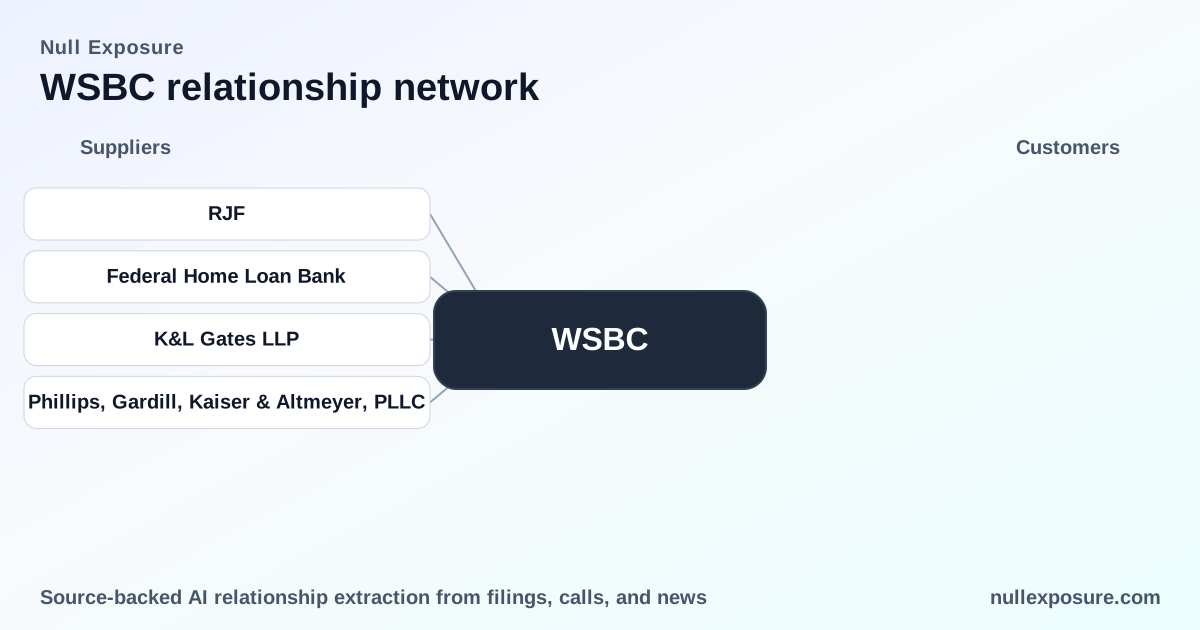
WesBanco (WSBC) — customer relationships and what they tell investors about credit posture
WesBanco is a regional bank holding company that earns the bulk of its revenue from traditional community banking activities — net interest income from loans funded by deposits and certificates of deposit, supplemented by fee income from trust & investment services, mortgage banking (originations and secondary-market sales), brokerage and insurance. Its monetization model is interest-rate and deposit-funding driven: deposit spreads, mortgage pipeline gains and trust fees power earnings, while commercial loan credit and deposit rolloff profile drive risk to capital. For a rapid map of customer-level activity and covenant movements, see https://nullexposure.com/.
Why a single customer amendment matters: the investor thesis up front
A change-in-terms on a corporate line of credit is not an isolated PR item for regional banks; it is a window into credit underwriting, covenant flexibility and commercial-lender risk management. WesBanco’s role as lender, servicer and occasional counterparty to interest-rate risk products makes these customer-level developments material to credit quality and near-term liquidity. The Avalon Holdings amendment discussed below is a concrete example of how the bank manages commercial relationships under current market conditions.
One partnership in the set — Avalon Holdings (AWX)
On September 24, 2025, Avalon Holdings Corporation amended the terms of its line-of-credit agreement with Wesbanco Bank, Inc., modifying an existing agreement originally executed on September 23, 2024. This change reflects active credit management and renegotiation of commercial lending terms between Wesbanco and a corporate borrower. (Source: TipRanks company announcement, published May 2026 — https://www.tipranks.com/news/company-announcements/avalon-holdings-amends-credit-line-agreement)
What the Avalon amendment signals in plain English
- The amendment demonstrates active portfolio management by WesBanco’s commercial lending group and willingness to adjust covenants or pricing to preserve the credit relationship. (TipRanks, FY2025 notice)
- For investors, the event is a monitoring trigger: track whether amendments are one-off adjustments or part of a pattern of covenant relaxations across the commercial book.
Company-level operating constraints and how they shape customer relationships
The relationship data is sparse, but the bank’s public filings provide several company-level signals that determine how customer relationships behave in practice:
- Short-term funding runway: Certificates of deposit totaling roughly $1.6 billion scheduled to mature within one year (Dec 31, 2024) signal rollover risk and sensitivity to short-term market rates; this constrains how aggressively the bank can restructure commercial facilities.
- Public funds exposure: Uninsured public funds collateralized by investment securities totaled about $1.5 billion (Dec 31, 2024), indicating a material governmental-deposit presence that affects liquidity management and pricing on deposits.
- Regional concentration: WesBanco operates 181 branches and 188 ATMs across West Virginia, Ohio, western Pennsylvania, Kentucky, southern Indiana and Maryland, and all revenue is domestic; this geographic concentration increases correlation of borrower performance with local economic cycles.
- Sector concentration and criticality: Multi-family apartment lending is the bank’s single largest commercial loan category, growing from $1.5 billion to $1.7 billion and representing 83.9% of total risk-based capital (Dec 31, 2024) — a critical concentration that elevates portfolio sensitivity to housing-market and rent-cycle dynamics.
- Service posture: WesBanco operates as both lender and service provider — it executes interest-rate swaps and caps for commercial customers, administers trust assets and sells originated mortgages into the secondary market, which embeds market-risk and operational dependencies into customer relationships.
- Active relationship stage: Deposits remain the primary funding source and are actively offered through WesBanco’s delivery network, confirming ongoing, operational customer engagement rather than dormant or one-off relationships.
These constraints are derived from WesBanco’s regulatory and annual filings (statements referencing December 31, 2024 positions and segment disclosures).
How these signals change the interpretation of the Avalon amendment
- Liquidity and pricing context: With substantial CDs maturing within the year, the bank has limited flexibility to extend large, long-dated concessions to borrowers without funding cost consequences; therefore, an amendment with Avalon is likely tailored to balance borrower relief and funding discipline.
- Concentration overlay: The bank’s heavy exposure to multi-family apartments means commercial amendments are evaluated through a concentrated-loan lens; underwriting standards for commercial borrowers in adjacent sectors become more conservative when capital is heavily allocated to one risk pool.
- Service and market risk implications: Because WesBanco also provides interest-rate risk management to customers and sells mortgage originations to the secondary market, covenant adjustments can affect not only credit metrics but hedging positions and pipeline economics.
Practical takeaways for investors and operators
- Monitor amendment cadence: One covenant modification is informational; a sequence of amendments across multiple borrowers signals potential loosening of underwriting or broader borrower stress. Track regulatory filings and borrower-specific notices for patterns.
- Watch deposit rollovers and public funds: The bank’s short-term CD maturities and large public-fund deposits create refinancing and repricing risk that can constrain credit policy; a pickup in deposit beta would compress net interest margin and raise the cost of holding or extending credit.
- Stress-test multi-family exposure: Given that multi-family loans represent a large share of risk-based capital, investors should prioritize scenario analysis tied to regional rent trends, occupancy rates and refinance windows for those assets.
- Operational risk from hedging and mortgage sales: Changes in commercial loan terms can influence hedging programs and secondary-market delivery pipelines; reconcile loan book adjustments with hedge positions disclosed in filings.
Risks that deserve active surveillance
- Concentration risk in multi-family lending — this is the most significant idiosyncratic risk to capital and earnings stability.
- Funding rollover and deposit mix — short-term CD maturities and public funds dependence increase sensitivity to rate moves and local fiscal flows.
- Credit amendment frequency — repeated term changes across clients would indicate a looser tone in commercial credit or worsening borrower metrics.
Bottom line for investors
WesBanco operates a traditional, deposit-funded regional banking model with significant exposure to multi-family commercial real estate and active engagement in fee-based trust and mortgage businesses. The Avalon Holdings amendment is a useful data point that underscores active loan portfolio management but does not, on its own, change the bank’s structural risk profile. Investors should prioritize monitoring: (1) amendment frequency across the commercial portfolio, (2) deposit rollover dynamics and public-fund behavior, and (3) the health of the multi-family book.
For a practical dashboard that aggregates borrower amendments and covenant events across regional financial institutions, visit https://nullexposure.com/ and explore the customer-relationship mapping tools.