WillScot Mobile Mini (WSC): Customer relationships, disposals and what investors should know
WillScot Mobile Mini runs a leased-equipment business that monetizes a large, geographically distributed fleet of modular buildings and portable storage through short-term, repeatable rental contracts and pre-negotiated national-account agreements. The company generates recurring cash flow from a rental book managed across roughly 260 branches in North America, and supplements core leasing with services and adjacent products that capture higher-margin installations and add-ons. For investors, the combination of centralized fleet management, low customer concentration, and short billing cycles creates a business with predictable unit economics but greater sensitivity to utilization and fleet deployment. For firm-level analysis and commercial diligence, see NullExposure for ongoing coverage: https://nullexposure.com/
How WillScot’s commercial model actually works — concise investor takeaways
WillScot leases turnkey space solutions to customers across construction, industrial, energy and government segments. Revenue is generated primarily as recurring rental income from modular space (leased fleet) and portable storage units, billed on short cycles and frequently renewed month-to-month after initial terms. According to company disclosures for the year ended December 31, 2024, over 90% of new lease orders use standard lease agreements, pre‑negotiated master leases, or national account frameworks, which reduces sales friction and standardizes pricing across large customers.
Key operating characteristics that drive valuation and risk:
- Contracting posture: Predominantly framework agreements combined with short-term billing (28‑day or monthly cycles) — this improves speed-to-market and upsell potential but requires consistent utilization management.
- Concentration: Revenue concentration is low; per the company, no single customer accounted for more than 2% of revenues for 2024, indicating broad diversification across ~85,000 customers.
- Criticality: WillScot is the buyer/lessor in the commercial relationship; customers depend on the rented units but switching costs for customers are moderate because contracts renew monthly, making retention operationally important.
- Maturity & footprint: The fleet is active and materially deployed—approximately 59% of modular units and 55% of portable storage units were on rent as of December 31, 2024—supporting steady cash flow when utilization is maintained.
- Geography: Operations are concentrated in North America (United States, Canada, Mexico) through ~260 branches and drop lots.
All of the above come from WillScot’s public disclosures for the year ended December 31, 2024 and related corporate filings.
Concrete partner and disposition activity investors should note
The following relationships and transactions are captured in recent reporting and provide insight into WillScot’s strategy of portfolio optimization and market focus.
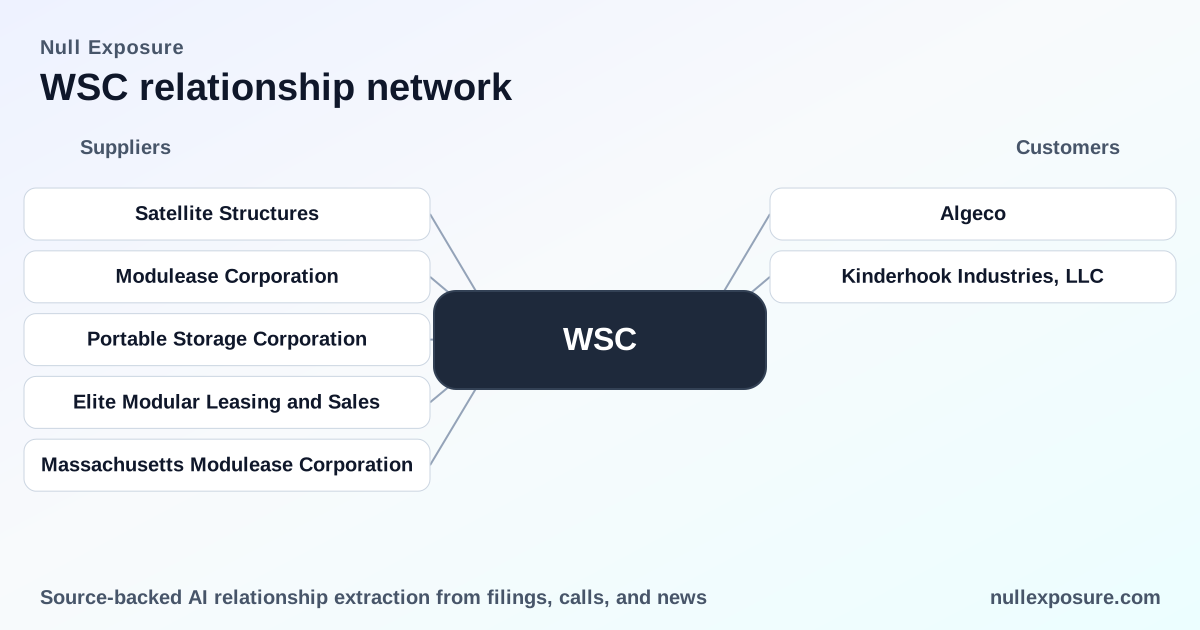
Algeco — buyer of WillScot’s UK storage arm
WillScot sold its UK storage business to Algeco for £335 million (approximately €390 million), divesting non-core international storage assets to a major European modular space operator. International Rental News reported the transaction on March 10, 2026, and ScottishConstructionNow covered the deal on May 4, 2026, noting Algeco’s view that the acquisition strengthens its market leadership and fosters operational synergies with the combined businesses. (International Rental News, March 10, 2026; ScottishConstructionNow, May 4, 2026)
Kinderhook Industries — purchaser of Tank & Pump segment (closed 2022)
WillScot completed the sale of its Tank & Pump segment to Kinderhook Industries, a U.S.-based private equity firm, in the third quarter of 2022 as part of company portfolio rationalization. International Rental News referenced this completed sale while covering subsequent disposals, underscoring that management has actively reshaped the asset base to concentrate on core modular and storage leasing. (International Rental News, March 10, 2026, referencing the Q3 2022 closing)
Why these relationships matter for investors
The Algeco and Kinderhook transactions are consistent with a disciplined strategic pivot: WillScot is monetizing non-core or regionally exposed assets and redeploying capital toward its North American leasing franchise. The UK disposal to Algeco reduces international footprint and currency/market risk, while the Tank & Pump divestiture to Kinderhook reflects earlier portfolio pruning completed in 2022.
These moves support three investor-relevant outcomes:
- Capital redeployment to fleet and high-return adjacencies — proceeds can be used to enhance domestic fleet utilization or invest in higher-margin services and climate-controlled or clearspan products.
- Simplified operating footprint — reducing exposure outside North America lowers execution complexity across regulatory, logistics, and servicing functions.
- Proof of active portfolio management — management is willing to sell businesses that dilute return metrics in favor of scaling the core rental platform.
Financial and operating context for valuation
WillScot’s most recent reported figures show TTM revenue of $2.28 billion and adjusted EBITDA of $600.9 million, with operating margin at about 27.7% and a small net loss on the bottom line, reflecting a combination of capital structure and non-operating items. The company runs a highly diversified customer base, which lowers single-counterparty exposure but increases sensitivity to utilization and macro construction cycles given short-term billing. Analysts’ consensus target price and coverage are moderate: the median target stands near $23.45 with a mix of Buy and Hold opinions.
Risks and monitoring checklist for commercial due diligence
- Short-term billing and month-to-month renewals create revenue agility but increase exposure to rapid demand shocks; monitor utilization and occupancy rates monthly.
- Framework agreements reduce acquisition friction for large customers but require competitive pricing discipline; track average revenue per unit and national-account renewal metrics.
- Low customer concentration is favorable, but branch-level bottlenecks or regional downturns could still compress utilization; watch branch-level fleet deployment plans.
- Disposals like the UK storage sale reduce geographic diversification; evaluate how proceeds are being redeployed and the timeline to achieve targeted returns.
For a concise, regularly updated view of WSC’s commercial footprint and partner activity, visit NullExposure’s coverage hub: https://nullexposure.com/
Bottom line
WillScot Mobile Mini operates as a recurring-revenue leasing business with standardized contracting, low counterparty concentration, and a North America–focused branch network. Recent disposals to Algeco and Kinderhook confirm management’s intent to concentrate on higher-return leasing operations and simplify the operating footprint. Investors should value the business for its cash-generation potential tied to utilization and fleet deployment while monitoring short-term contract dynamics that amplify sensitivity to cyclical demand.