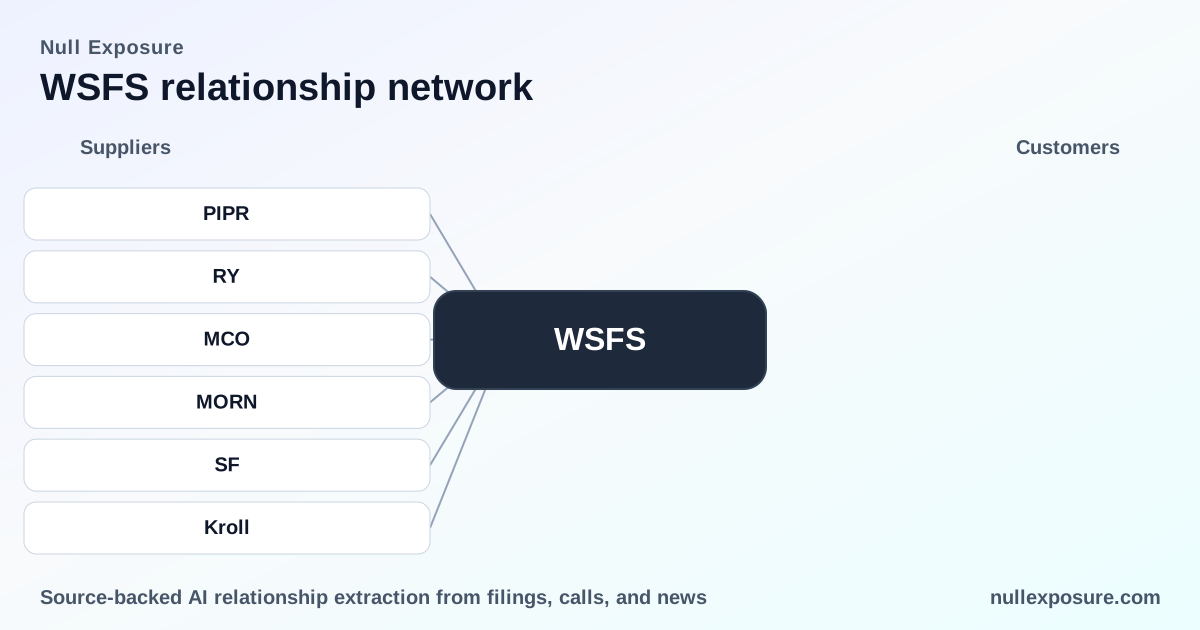
WSFS Financial: How customer relationships and contract signals shape risk and revenue
WSFS Financial operates as a regional bank and diversified financial services provider: it earns core revenue from commercial and consumer lending, deposit spreads, treasury services, wealth management fees, and a cash logistics business (Cash Connect™). WSFS monetizes through interest income on loans and leases, fee income from deposit and treasury products, wealth management advisory fees, and service income from ATM and smart-safe operations. For investors, the right question is how client contracting patterns and discrete commercial relationships — both active and terminated — influence earnings stability and credit exposure.
If you want an ongoing view of WSFS counterparties and contract signals, visit https://nullexposure.com/ for continuous updates and research.
How WSFS actually makes money and where customer relationships fit
WSFS runs three reportable segments: WSFS Bank (loans, deposits, treasury), Cash Connect™ (ATM vault cash and smart safes), and Wealth Management (advice, trust, investment management and related credit products). This structure creates multiple customer-facing revenue streams: transaction and service fees through Cash Connect and Wealth Management, and interest margin through the core bank. Recent financial metrics show a profitable regional franchise (profit margin ~29.2%, return on equity ~11.5% on the latest twelve months), with loan and deposit flows driving most variability in earnings.
One-line coverage of every customer relationship in the public results
Karyopharm Therapeutics (KPTI) — Wilmington Savings Fund Society acted as Administrative Agent and among lenders in an amendment to Karyopharm’s credit agreement during FY2026. TradingView reported the amendment on March 10, 2026, noting WSFS’s role as Administrative Agent and lender for the facility (TradingView, March 2026: https://www.tradingview.com/news/tradingview:52521ca52c7b2:0-karyopharm-therapeutics-amends-credit-agreement-to-defer-2026-payments-tied-to-25m-equity-raise/).
What the contract signals tell us about WSFS’ operating posture
WSFS’ disclosures and the extracted contract constraints form a consistent operating picture:
- Mixed tenor exposure: The company reports both long-term contractual commitments (leases with up to 21-year terms) and a large stock of short-duration credit commitments (roughly $4.2 billion of generally one-year commitments at end-2024). This implies WSFS underwrites a blend of durable contractual obligations alongside a rotating book of short-term credit facilities, which balances long-dated operational commitments against flexible lending capacity.
- Customer breadth and regional concentration: WSFS explicitly serves individuals, small businesses, and institutional clients primarily across the Greater Philadelphia/Delaware corridor (with branches in PA, DE, NJ and smaller footprints in FL, NV, VA). Geography is concentrated in the Mid-Atlantic with national reach for Cash Connect services.
- Service-provider posture: The firm positions itself as a service provider across lending, treasury, wealth management, and cash logistics. Cash Connect’s national ATM and smart-safe operations generate fee income and expose WSFS to non-bank commercial counterparties.
- Active and terminated relationships coexist: Public disclosures highlight both ongoing client activity across 114 offices and a material one-time charge tied to the termination of a longstanding Cash Connect client in Q4 2024 (a $4.7 million charge). This demonstrates that client churn can produce discrete earnings hits but is not presented as systemic.
- Segment diversification with niche exposures: WSFS’ NewLane Finance business underwrites small-business equipment leases (including technology and software), introducing exposure to specialty equipment finance dynamics and potential credit cycle sensitivity in small-business segments.
These constraints are company-level signals about how WSFS contracts and where risk sits; they are not assigned to any single customer unless the text explicitly names that counterparty.
Practical implications for investors and operators
- Revenue resilience from multiple flows: The combination of interest margin plus recurring fee streams from Cash Connect and Wealth Management produces diversified revenue lines. That diversification reduces single-channel dependency but does not eliminate credit-cycle sensitivity in lending portfolios.
- Contract-duration mismatch risk: Long-term lease obligations and short-term credit commitments create a maturity mix that requires active liquidity and funding management; the bank’s ability to roll short-term commitments and manage long-dated operational leases is critical.
- Concentration and regional credit risk: Heavy operational focus in the Greater Philadelphia/Delaware region increases exposure to localized economic cycles, while nationwide Cash Connect contracts add a different, geographically dispersed counterparty set.
- Operational risk from client termination: The recorded one-time charge from terminating a longstanding Cash Connect client underscores operational and contract-dispute risk that can produce outsized quarter-level volatility in non-interest income.
Quick read: Where to focus your diligence
- Review the mix and seasoning of the loan book and the proportion of commitments that convert to funded loans versus unused lines.
- Scrutinize Cash Connect customer concentration and contract termination clauses; the prior termination generated a multi-million-dollar charge.
- Monitor NewLane Finance exposures to small-business equipment leasing, especially in technology and software categories, for sensitivity to capital spending cycles.
- Track WSFS liquidity metrics given the sizable short-term credit commitments that require ongoing funding capacity.
If you want a structured counterparty map and contract-signal analysis for WSFS and peer regional banks, explore the company-level relationship intelligence at https://nullexposure.com/.
Bottom line: a regional bank with layered counterparty dynamics
WSFS operates a diversified financial-services platform that monetizes through interest margin, advisory and trust fees, and cash logistics service fees. The company balances long-term operational commitments with a large stock of short-term lending commitments and serves a mix of individuals, small businesses and institutional clients concentrated in the Mid-Atlantic while servicing ATM clients nationally. Key investor risks are maturity mismatch, regional concentration, and discrete operational contract risk — all manageable but material for valuation and scenario analysis.