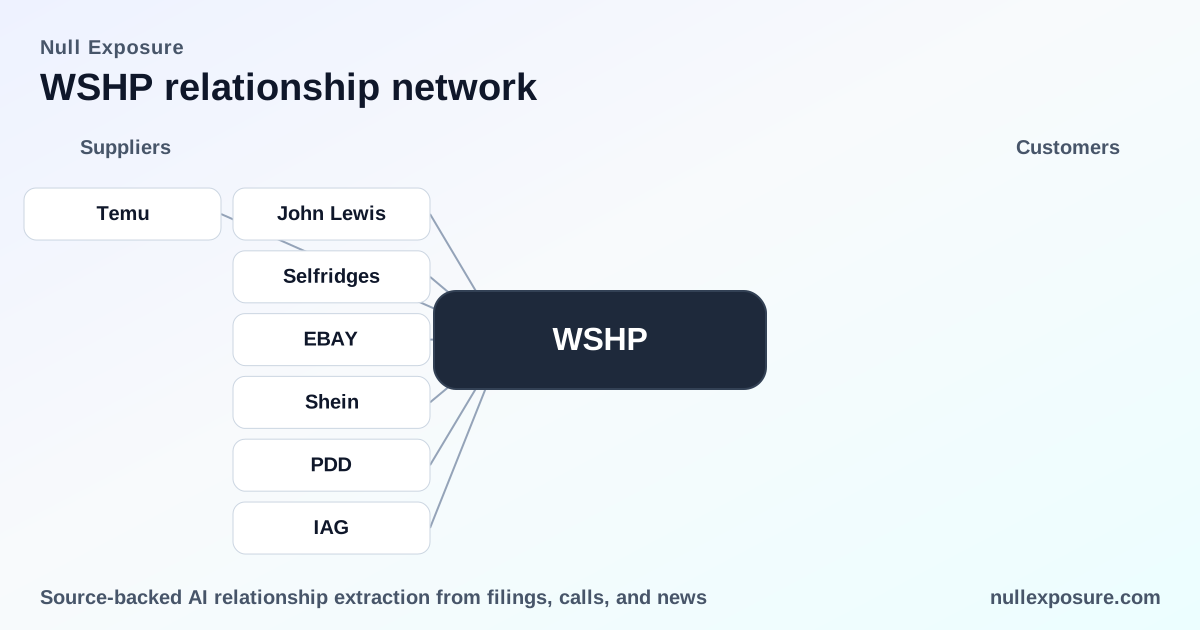
WSHP customer map: a pilot-stage ad marketplace gaining marquee retail tenants
WeShop operates a digital shopping platform that monetizes primarily by selling advertising and tenancy to large retailers; during its Pilot the company secured repeat paid placements from major brands and integrated affiliate and partner services to drive conversion and measurement. Investors should treat WeShop as a validation-stage media commerce play with meaningful brand adoption but extreme financial immaturity and concentration risk, as reflected in its modest revenue base and negative EBITDA. For a concise dossier of WeShop customer relationships and contract signals, visit https://nullexposure.com/.
Why the customer list matters to investors
WeShop’s customer roster in its Form F‑1 reads like a marketing-purchase scorecard: global retail and travel names that paid for tenancy or advertising during the Pilot provide early commercial validation and proof that advertisers will pay for placement on the platform. The company’s monetization is straightforward—tenancy and advertising fees—and is supplemented by affiliate/partner integrations (publisher agreements and partner-user agreements) that broaden attribution and distribution.
At the same time, WeShop’s financial metrics present a stark counterpoint: RevenueTTM of $422,860 paired with EBITDA of -$61.1M indicates ramping marketing and development expense far outstrips monetization today, and insider ownership of ~87.6% signals founder control and limited institutional coverage. This mix makes customer retention and concentration the single most important determinant of near-term value creation.
The relationship roll‑call: who paid, what they did
Below are each of the customer and partner names extracted from WeShop’s SEC filing, with a one- to two-sentence plain-English summary and the source.
-
eBay — eBay is listed among top-performing retailers that repeatedly paid to advertise on WeShop during the Pilot, signaling ongoing paid tenancy from a major marketplace advertiser. Source: WeShop Form F‑1, SEC (FY2025): https://www.sec.gov/Archives/edgar/data/2048271/000149315225018485/formf-1.htm
-
eBay Partner Network — WeShop cites a partnership with the eBay Partner Network as an example of the platform’s ability to drive sustainable advertiser growth. Source: WeShop Form F‑1, SEC (FY2025): https://www.sec.gov/Archives/edgar/data/2048271/000149315225018485/formf-1.htm
-
TEMU — TEMU is named among the major retailers that paid for tenancy and advertising during the Pilot, representing interest from large cross-border value retailers. Source: WeShop Form F‑1, SEC (FY2025): https://www.sec.gov/Archives/edgar/data/2048271/000149315225018485/formf-1.htm
-
Harvey Nichols — Harvey Nichols participated as a paid tenant in the Pilot, adding a premium UK fashion retailer to WeShop’s advertiser mix. Source: WeShop Form F‑1, SEC (FY2025): https://www.sec.gov/Archives/edgar/data/2048271/000149315225018485/formf-1.htm
-
JustEat — JustEat is listed as one of the Pilot tenants that paid for tenancy, indicating WeShop’s appeal to food-delivery and services advertisers. Source: WeShop Form F‑1, SEC (FY2025): https://www.sec.gov/Archives/edgar/data/2048271/000149315225018485/formf-1.htm
-
Nike (NKE) — Nike is reported among retailers that paid for Pilot tenancy, giving WeShop a leading global apparel brand on its advertising roster. Source: WeShop Form F‑1, SEC (FY2025): https://www.sec.gov/Archives/edgar/data/2048271/000149315225018485/formf-1.htm
-
Look Fantastic — Look Fantastic was a paid tenant during the Pilot, representing beauty vertical participation in WeShop’s early commercial tests. Source: WeShop Form F‑1, SEC (FY2025): https://www.sec.gov/Archives/edgar/data/2048271/000149315225018485/formf-1.htm
-
Ali Express — Ali Express is included among Pilot tenants that paid for tenancy, marking engagement from large Asian marketplace sellers. Source: WeShop Form F‑1, SEC (FY2025): https://www.sec.gov/Archives/edgar/data/2048271/000149315225018485/formf-1.htm
-
Superdrug — Superdrug is named as a paid Pilot tenant, adding another pharmacy/beauty retailer to WeShop’s advertiser list. Source: WeShop Form F‑1, SEC (FY2025): https://www.sec.gov/Archives/edgar/data/2048271/000149315225018485/formf-1.htm
-
Boots — Boots repeatedly paid to advertise on the platform and is listed among top retailers that committed paid tenancy, anchoring WeShop’s presence in pharmacy/health retail. Source: WeShop Form F‑1, SEC (FY2025): https://www.sec.gov/Archives/edgar/data/2048271/000149315225018485/formf-1.htm
-
John Lewis — John Lewis is cited as a top-performing retailer that repeatedly paid for advertising, representing established UK department store spend. Source: WeShop Form F‑1, SEC (FY2025): https://www.sec.gov/Archives/edgar/data/2048271/000149315225018485/formf-1.htm
-
Lastminute.com — Lastminute.com participated as a paid tenant in the Pilot, demonstrating travel vertical adoption. Source: WeShop Form F‑1, SEC (FY2025): https://www.sec.gov/Archives/edgar/data/2048271/000149315225018485/formf-1.htm
-
Booking.com (BKNG) — Booking.com is identified among retailers that consistently paid for advertising during the Pilot, reinforcing travel-sector monetization. Source: WeShop Form F‑1, SEC (FY2025): https://www.sec.gov/Archives/edgar/data/2048271/000149315225018485/formf-1.htm
-
SHEIN — SHEIN is listed as a repeat paying retailer on the platform during the Pilot, reflecting participation from fast-fashion marketplaces. Source: WeShop Form F‑1, SEC (FY2025): https://www.sec.gov/Archives/edgar/data/2048271/000149315225018485/formf-1.htm
-
TUI (TUI/TUIBF) — TUI not only paid for advertising but WeShop reports average conversion rates of around 11% for TUI, a concrete performance metric supporting ad effectiveness in travel. Source: WeShop Form F‑1, SEC (FY2025): https://www.sec.gov/Archives/edgar/data/2048271/000149315225018485/formf-1.htm
-
Dunelm (DNLM / DNEMF) — Dunelm is among the retailers named as repeated advertisers and Pilot tenants, representing home goods retail. Source: WeShop Form F‑1, SEC (FY2025): https://www.sec.gov/Archives/edgar/data/2048271/000149315225018485/formf-1.htm
-
First Choice (FCBK) — First Choice is included among the Pilot tenants that paid for tenancy, further broadening travel-sector adoption. Source: WeShop Form F‑1, SEC (FY2025): https://www.sec.gov/Archives/edgar/data/2048271/000149315225018485/formf-1.htm
-
Very (VGFC) — Very is listed as a paid tenant during the Pilot, adding a UK general merchandise advertiser to the roster. Source: WeShop Form F‑1, SEC (FY2025): https://www.sec.gov/Archives/edgar/data/2048271/000149315225018485/formf-1.htm
-
Impact Radius — WeShop references a Partner User Agreement with Impact Radius dated February 22, 2021, indicating a formalized partner/integration for referral or affiliate tracking. Source: WeShop Form F‑1, SEC (FY2025): https://www.sec.gov/Archives/edgar/data/2048271/000149315225018485/formf-1.htm
-
Awin AG — WeShop discloses a Publisher Service Agreement with Awin AG dated March 25, 2014, signaling longstanding affiliate network relationships for publisher monetization and tracking. Source: WeShop Form F‑1, SEC (FY2025): https://www.sec.gov/Archives/edgar/data/2048271/000149315225018485/formf-1.htm
Operating signals and constraints investors should read into
-
Contracting posture: WeShop sells tenancy and ad inventory to large retailers and executes publisher/partner agreements (Awin, Impact Radius), indicating a mixed direct-sell and affiliate-distribution go‑to‑market model. This positions the company as both a marketplace media owner and an affiliate integrator.
-
Concentration and customer criticality: The Pilot list shows high reliance on a small set of high-profile advertisers for validation and revenue. If a handful of top retailers reduce spend, the revenue base—which is currently small—would be materially affected.
-
Maturity: The company self-identifies as development-stage with Pilot commercial traction; that is consistent with the financials: RevenueTTM $422,860; GrossProfitTTM negative $614,693; EBITDA -$61,103,448—indicators of early commercial scale and heavy investment in rollout.
-
Financial and governance signals: Insider ownership ~87.6% and institutional ownership ~0.04% indicate founder control and limited external investor diversification; valuation multiples (Price/Sales ~211.7; EV/Revenue ~95.75) imply the market is pricing significant future growth into current equity.
Investment implications and risks
-
Key positive: marquee retailers and travel brands validated paid tenancy and advertising during the Pilot, and partner agreements with Awin and Impact Radius provide scalable affiliate distribution and measurement capability—these are real commercial proofs for a media-commerce monetization model.
-
Key risks: the business is financially immature, highly concentrated, and founder-controlled, creating dependency on successful expansion of advertiser spend beyond the Pilot and improved monetization to absorb fixed costs. Reported conversion performance (TUI ~11%) is a useful performance benchmark, but execution risk on scaling that across categories and geographies is the primary gating factor.
For an executive summary view of WeShop’s customer relationships and comparable signals across other small-cap ad-tech plays, see https://nullexposure.com/.
Bold, repeatable advertiser relationships plus affiliate integrations give WeShop a credible go‑to‑market playbook; investors must weigh that commercial validation against the company’s current revenue scale, negative operating cash flow, and concentrated customer base when forming a view on upside versus execution risk.