Whitestone REIT (WSR): Tenant Relationships and the Buyout That Repriced the Rent Roll
Whitestone REIT operates and monetizes as an owner-operator of open‑air, community‑anchored shopping centers concentrated in Texas and Arizona. The company generates recurring cash flow by leasing retail, dining and service space to a mix of national anchors and local small businesses while actively managing merchandising and leasing to raise center productivity and occupancy. Whitestone’s value is a hybrid of stable anchor cashflows and value‑added upside from tenant mix and lease renewals — a profile that attracted a $1.7bn take‑private bid from Ares in 2026.
Explore more on portfolio intelligence at https://nullexposure.com/.
Why the tenant mix matters to investors
Whitestone’s revenue model combines long‑dated anchor leases that underpin valuation multiples with shorter-term leases to local operators that fuel NOI growth through active merchandising. The company reports a broadly occupied portfolio (about 94% as of year‑end 2024) with roughly 1,400 tenants and 10–20% of GLA rolling each year, which delivers both recurring rent and frequent re‑positioning opportunities. These structural characteristics create predictable base rents but also expose cash flow to small‑business operational cycles and local demand — a tradeoff that private buyers value when they can apply asset management to lift yields.
Deal catalyst: Ares takes Whitestone private
Ares Management agreed to acquire Whitestone for $19.00 per share in an all‑cash transaction valued at approximately $1.7 billion, a decisive event that removes the stock from public markets and consolidates control under private real estate funds. According to a GlobeNewswire press release and contemporaneous reporting in April 2026, Ares will acquire all outstanding common shares and operating partnership units — a transaction that crystallizes Whitestone’s portfolio value for investors. (GlobeNewswire, April 9, 2026; Bisnow, April 13, 2026.)
What the company‑level signals tell investors
- Contracting posture: Whitestone explicitly runs a mixed lease book — the firm states lease terms range from under one year for smaller tenants to more than 15 years for larger tenants, and it recognizes noncancelable operating leases on a straight‑line basis, signaling a deliberate balance between short‑term flexibility and long‑term anchor stability.
- Counterparty concentration and risk: Management intentionally targets smaller, neighborhood‑oriented tenants for much of its GLA, which increases churn and tenant default sensitivity but supports higher rollover and merchandising opportunity; anchors supply ballast.
- Geographic concentration: The portfolio is tightly regional — 55 properties (~4.9 million sq. ft.) concentrated in Texas and Arizona metropolitan areas (Austin, DFW, Houston, Phoenix and San Antonio) — producing localized revenue exposure and execution leverage in those markets.
- Role and stage: Whitestone acts as landlord, marketer and asset manager — it is an active service provider to tenants and a seller of leased retail space income; the relationship set is predominantly active with high occupancy.
- Reporting and segmentation: The firm evaluates performance at the portfolio level and reports as a single GAAP segment, which favors centralized asset management but reduces geographic revenue granularity.
These are company‑level constraints derived from Whitestone’s disclosures and should be read as structural characteristics rather than ascribed to any single tenant.
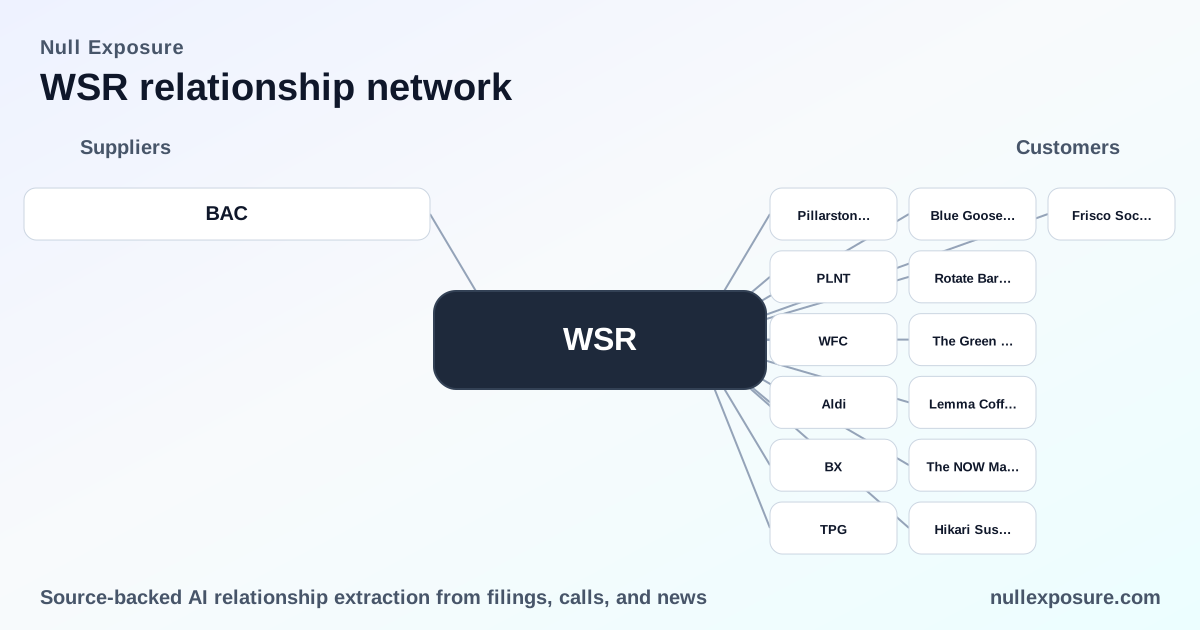
Tenant and counterparty roll call — what each relationship signals
The following list covers the tenant and counterparty relationships referenced in recent public reporting and press coverage. Each entry is a short plain‑English note with the cited source.
Ninfa's
Whitestone added Ninfa’s to an upgraded dining and retail roster at its Whole Foods‑anchored center as part of a repositioning effort to match local demographics. (Sahm Capital press release, April 1, 2026.)
Frost Bank
Frost Bank is listed as an anchor at BLVD Place, a 217,074‑square‑foot asset in Uptown Houston that benefits from major traffic counts and freeway adjacency. (Sahm Capital press release, April 1, 2026.)
Cactus Club Café
Cactus Club Café is part of a curated dining lineup Whitestone deployed to enhance tenant mix at a Whole Foods‑anchored center. (Markets Business Insider / Sahm Capital, April 2026.)
Ares Management / Ares Management Corp. / Ares Management Corporation
Ares agreed to acquire Whitestone in an all‑cash transaction valued at approximately $1.7 billion, taking the REIT private at $19.00 per share; multiple press reports cover the definitive merger agreement and deal rationale. (GlobeNewswire, April 9, 2026; Bisnow, April 13, 2026; The Globe and Mail, April 2026.)
Parkhill
Whitestone signed an approximately 5,800‑square‑foot lease with Parkhill for a Houston office presence at BLVD Place, reflecting the REIT’s strategy to attract non‑retail service tenants to mixed‑use assets. (Markets Business Insider release; GlobeNewswire dividend/press release, April 2026.)
Whole Foods
Whole Foods is an anchor tenant for BLVD Place in Uptown Houston, providing stable foot traffic and an anchor rent profile that supports adjacent specialty retail. (Sahm Capital; Houston Chronicle, April 2026.)
True Food Kitchen
True Food Kitchen is included among the upgraded dining operators Whitestone has targeted to reposition an anchored center’s consumer offering. (Sahm Capital / Markets Business Insider, April 2026.)
Rooftop Cinema Club
Rooftop Cinema Club was named among experiential tenants Whitestone added to diversify leisure and night‑time footfall at an anchored center. (Sahm Capital / Markets Business Insider, April 2026.)
North Italia
North Italia is one of the higher‑profile restaurant tenants Whitestone added while upgrading a Whole Foods‑anchored center’s tenant mix. (Sahm Capital / Markets Business Insider, April 2026.)
Pillarstone Capital REIT Operating Partnership, L.P.
Whitestone received a $33.4 million payment from Pillarstone following a bankruptcy court‑approved settlement under Rule 9019, a one‑time cash receipt that affected FY2025 results. (GlobeNewswire release, December 15, 2025.)
WFC / Wells Fargo
Wells Fargo (referenced in tenant lists and reported with the ticker WFC) appears among service and financial tenants at properties like World Cup Plaza in Frisco, contributing to necessity and service tenant stability. (GlobeNewswire acquisition announcement for World Cup Plaza, November 7, 2025.)
Planet Fitness / PLNT
Planet Fitness is identified as a top‑performing tenant at the Aldi‑anchored Garden Oaks Shopping Center, supporting occupancy and recurring service revenue. (WhatNow Houston, March 2026.)
ALDI / Aldi
ALDI anchors the Garden Oaks Shopping Center in North Houston, representing a necessity retailer that stabilizes shopper traffic for co‑tenants. (WhatNow Houston; Houston Chronicle coverage of the acquisition, March–April 2026.)
Blackstone / BX / BX-N
Blackstone surfaced as a bidder in Whitestone’s strategic review process prior to the Ares deal, indicating private equity interest in the retail‑centric portfolio. (Bisnow; Bitget reporting; The Globe and Mail, March–April 2026.)
TPG / TPG-Q
TPG also emerged among private equity suitors during the sale process, reflecting competitive bid interest from global asset managers. (Bisnow; Bitget; The Globe and Mail, March–April 2026.)
Blue Goose Cantina
Blue Goose Cantina is one of the neighborhood food and beverage tenants at World Cup Plaza, exemplifying Whitestone’s mix of local dining concepts. (GlobeNewswire World Cup Plaza acquisition release, November 7, 2025.)
The Green Gator
The Green Gator is listed among service and restaurant tenants at World Cup Plaza, reinforcing the community‑center positioning. (GlobeNewswire, November 2025.)
Lemma Coffee Roasters
Lemma Coffee Roasters is included in the tenant roster at World Cup Plaza, representing small‑format specialty retail. (GlobeNewswire, November 2025.)
Hikari Sushi & Grill
Hikari Sushi & Grill appears among dining tenants at World Cup Plaza, contributing to localized food service demand. (GlobeNewswire, November 2025.)
Rotate Bar & Kitchen
Rotate Bar & Kitchen is another restaurant tenant at World Cup Plaza cited in the acquisition disclosure. (GlobeNewswire, November 2025.)
The NOW Massage
The NOW Massage is a service‑oriented tenant at World Cup Plaza, illustrative of Whitestone’s inclusion of wellness and personal services in its centers. (GlobeNewswire, November 2025.)
Frisco Soccer Association
Frisco Soccer Association is listed as a community tenant at World Cup Plaza, signaling non‑retail community uses in certain centers. (GlobeNewswire, November 2025.)
Investment implications and risks
- Value drivers: Anchor tenants and limited geographic concentration create clear underwriting lines for both stable NOI and portfolio repricing through private capital.
- Operational lever: Frequent lease roll and small‑business tenancy provide upside via merchandising but require active leasing and tenant support.
- Risk profile: Concentration in Texas and Arizona amplifies macro‑regional risk and retail‑sector cyclicality; exposure to small businesses increases downside during local economic stress.
- Corporate action impact: The Ares acquisition for $1.7bn crystallizes market valuation and removes public liquidity premia, shifting investor focus from dividend yield to asset‑level performance under private ownership.
For a structured view of tenant exposure and counterparties across Whitestone’s portfolio, visit https://nullexposure.com/ for detailed relationship analytics and comparative intelligence.
Bold takeaway: Whitestone’s cash flows are a blend of durable anchor rents and active, higher‑turnover local tenancy — a risk/reward profile that private equity priced at $1.7bn in 2026.