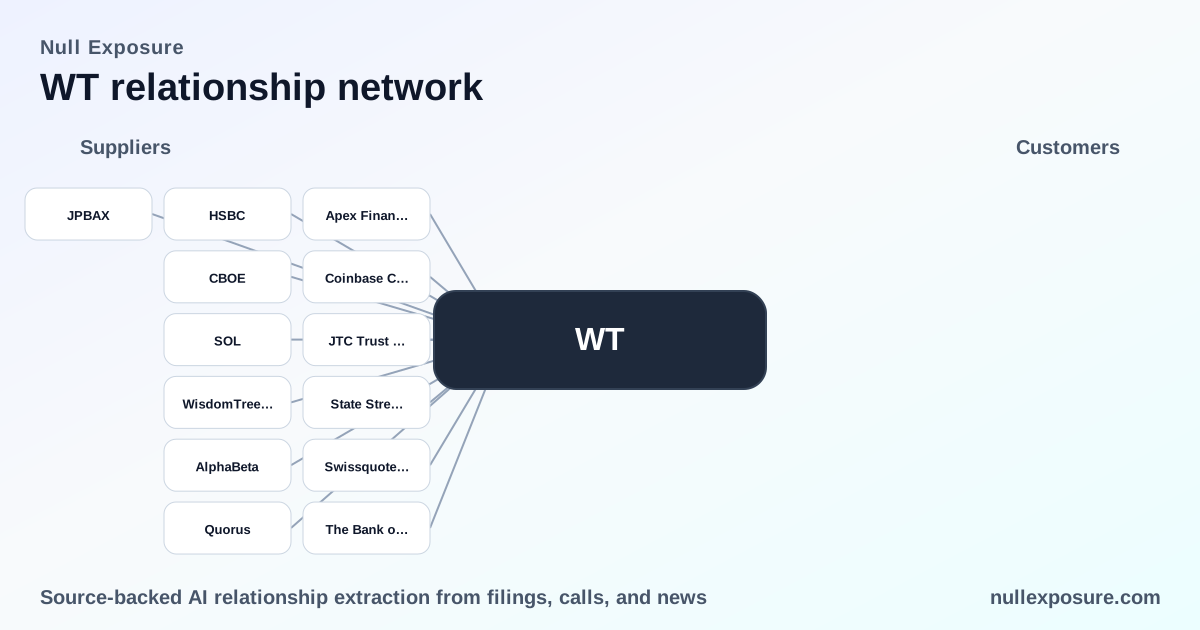
WisdomTree (WT) — Customer Relationships and What They Mean for Revenue Quality
WisdomTree operates as an ETF/ETP sponsor and asset manager that monetizes primarily through advisory fees calculated as a percentage of average daily net assets (AUM). The firm distributes products through traditional institutional channels while expanding into blockchain-enabled retail products and structured solutions, creating a revenue mix that is usage-based, AUM-sensitive, and heavily concentrated in a small number of flagship funds. For a deeper institutional view of these customer links and how they drive commercial outcomes, see Null Exposure’s research hub: https://nullexposure.com/.
How to read these customer ties: the operating model in plain English
WisdomTree’s customer relationships reflect an asset-manager economic model where revenue streams are directly tied to client asset balances and distribution reach. Company disclosures and recent commentary signal several structural characteristics important to investors:
- Contracting posture — usage-based economics. Advisory fees are billed as a percentage of ETPs’ average daily net assets, so revenue scales with flows and market valuation rather than fixed recurring invoices.
- Counterparty diversity — large enterprises and individual retail. Distribution spans banks, broker-dealers, RIAs and institutional investors, while digital products (tokenized funds, WisdomTree Prime wallet) broaden reach into individual retail and SMB channels.
- Geographic footprint — North America with expanding EMEA and global listings. Revenues are materially driven by the U.S., but European listings and subsidiaries contribute meaningfully to cross-border distribution.
- Concentration and criticality — revenue concentration in a handful of funds. Company filings state that 55% of AUM was concentrated in ten ETPs at year-end 2024, and advisory fees are the primary revenue source, highlighting elevated fund-level concentration risk.
- Maturity and activity — active commercialization and new product launches. Public launches and partnerships show the firm is in an active growth and product-innovation phase rather than a static incumbent model.
These signals translate into high operating leverage to market moves and distribution performance, with upside from inflows and product acceptance and downside if flows reverse or a concentrated fund underperforms.
Customer relationships on the record — three links worth tracking
GDT (WisdomTree Efficient TIPS Plus Gold Fund) — product shelf expansion and exchange listing
WisdomTree launched the WisdomTree Efficient TIPS Plus Gold Fund (ticker GDT) along with the WisdomTree Efficient Long/Short U.S. Equity Fund (WTLS) on the CBOE, pricing the funds with expense ratios of 0.30% and 0.88% respectively, expanding its capital‑efficient product lineup. According to a company announcement reported on Yahoo Finance on March 9, 2026, these listings broaden WisdomTree’s ETF offering and aim to capture investors seeking cost‑efficient, differentiated exposures.
Takeaway: New CBOE listings increase distribution touchpoints and AUM potential but also place pressure on product performance and marketing to generate advisory fee revenue. (Source: Yahoo Finance, March 9, 2026.)
Stable C — tokenized money market distribution to underbanked SMBs
WisdomTree has positioned a tokenized money market fund as a distribution vehicle for small- and medium-sized businesses through partnerships such as Stable C; executives highlighted that Stable C targets payments use cases for underbanked SMBs and can deliver higher yields than traditional small business savings options. Management discussed this relationship on the Q1 2026 earnings call transcript summarized by InsiderMonkey on May 4, 2026.
Takeaway: The Stable C relationship signals direct-to-SMB distribution of digital funds and supports WisdomTree’s strategy to monetize digital wallets and tokenized products, introducing a new retail/SMB revenue vector. (Source: InsiderMonkey earnings call transcript, May 4, 2026.)
Halo Investing — structured income and defined‑outcome solutions for advisors
WisdomTree and Halo Investing jointly launched the Halo WisdomTree Structured Income Strategy, a defined‑outcome separately managed account that combines WisdomTree model portfolios with Halo structured notes to deliver targeted income with buffered downside for advisor platforms. Simply Wall St covered this product development as part of WisdomTree’s FY2026 strategic updates (May 2026).
Takeaway: The Halo partnership leverages WisdomTree’s advisory capabilities into the structured‑products channel, diversifying fee sources beyond passive ETFs toward bespoke, advisor-distributed solutions. (Source: Simply Wall St community update, May 2026.)
What these relationships imply for revenue quality and risk
Collectively, the three relationships demonstrate a deliberate diversification of distribution channels and product mechanics:
- Revenue linkage: Advisory fees remain the dominant revenue engine; usage-based charging ties revenue directly to AUM performance across both traditional ETFs and nascent tokenized products.
- Concentration risk persists: With 55% of AUM concentrated in ten ETPs as disclosed in company filings (year‑end 2024), new launches and partnerships must convert to material flows to materially change revenue concentration dynamics.
- Distribution breadth and customer mix: Partnerships with Halo and Stable C expand reach into advisors and SMBs respectively, while CBOE listings extend market access for institutional and retail intermediaries.
- Regulatory and product execution risk: Tokenized funds and structured‑note solutions introduce operational and regulatory complexity that requires robust risk management and custodial arrangements to protect advisory-fee realization.
- Revenue cyclicality: Usage‑based fees create cyclicality linked to market valuations and flows; the firm’s profitability and margins will move with AUM trends and product adoption.
Key risk signal: advisory fees are both material and usage-based; therefore, short-term volatility in AUM, underperformance in concentrated funds, or slow adoption of new tokenized/structured products will directly depress revenue growth and margins.
A practical monitoring checklist for investors
- Track AUM trends and flows into the newly launched CBOE funds (GDT and WTLS) and whether they materially reduce concentration in the top ten ETPs.
- Monitor adoption metrics and regulatory developments for the tokenized money market fund and WisdomTree Prime distribution in the U.S.
- Assess revenue diversification from structured solutions with Halo and whether fees from SMAs become material to total advisory revenues.
- Watch expense ratios and product economics versus peers to evaluate competitiveness in attracting sustained inflows.
- Review quarterly disclosures for any changes in revenue recognition, related-party advisory agreements, and geographic revenue splits (U.S. vs. EMEA).
For ongoing coverage on how customer links translate into revenue outcomes, visit Null Exposure’s research hub: https://nullexposure.com/.
Bottom line
WisdomTree’s customer relationships reflect a firm executing on a dual strategy: defend and grow traditional ETF advisory revenues while expanding into digital, tokenized, and structured-product niches. That strategy increases potential upside through new distribution channels but preserves material concentration and usage‑based revenue risk. Active monitoring of fund flows, product adoption, and regulatory progress will determine whether these relationships shift WisdomTree from concentrated AUM dependence to a more diversified and stable fee base.