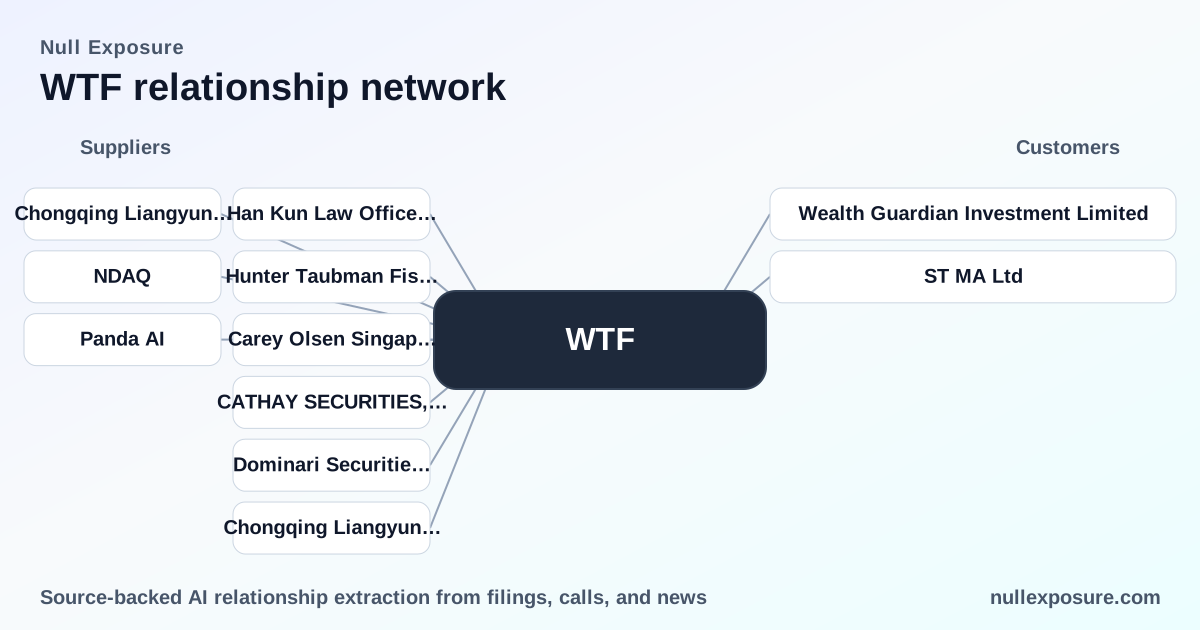
Waton Financial (WTF): Customer Concentration and Related‑Party Revenue That Moves the Earnings Needle
Waton Financial monetizes a three‑leg business: brokerage and commission fees, margin financing interest, and software licensing/support for its Broker Cloud platform. The company packages trading and margin services for institutional and retail clients while licensing technology to affiliated brokers; revenue flows come from transaction volumes, interest on financed balances, and recurring software fees. For an investor, the single most important underwriting input is the company’s customer mix: a related‑party broker has historically supplied a dominant share of sales, which concentrates revenue and cash‑flow risk. Learn more at https://nullexposure.com/.
The investment thesis in one paragraph
Waton is a hybrid capital‑markets operator and fintech vendor whose profitability scales with client trading activity and financed balances. When a handful of customers generate the bulk of commissions and interest, operating leverage is high but contingent on client retention and trading volumes. Valuation should therefore discount for concentration risk and the non‑recurring nature of large software deployments, while recognizing that software licensing provides a path to higher gross margins if customer diversification progresses.
Key metrics that matter right now
- Revenue (TTM): $10.0M; Gross profit: $5.6M — margins are reasonable but the base is small.
- EPS (TTM): -$0.39; Profitability is negative, reflecting scale and operating leverage.
- Market cap ~ $177.5M with Price/Revenue ~ 17.7x, implying high growth expectations that the current customer footprint must justify.
- Insider ownership is concentrated (86.8%) and institutional ownership minimal (0.36%), which amplifies governance and liquidity considerations.
How customer relationships shape the operating model
Waton’s contracting posture and revenue profile are dominated by concentrated, related‑party business. Company‑level signals show a high degree of revenue concentration, which translates into four investment implications:
- Concentration: a single customer historically represented the majority of revenue in multiple reporting periods, creating single‑counterparty risk to sales and margins.
- Contracting posture: the prevalence of related‑party activity implies negotiated commercial terms that are not arms‑length, increasing the potential for revenue transfer pricing and cash‑flow timing quirks.
- Criticality: when a dominant customer reduces volumes, brokerage and interest income decline quickly because both transaction fees and financed balances are volume‑sensitive.
- Maturity: the relationship has been persistent across fiscal years, making the dependency structural rather than transitory.
These are company‑level operating characteristics derived from the reported revenue split and related‑party disclosures; they should be treated as primary valuation and risk drivers for WTF.
Relationship-by-relationship breakdown
Below are concise, plain‑English summaries of every customer relationship referenced in public reporting and press coverage.
Wealth Guardian Investment Limited (WGI) — core related‑party customer
WGI is identified in the company’s SEC prospectus as a related‑party broker that has historically supplied a very large share of Waton’s revenue through brokerage, margin financing and software licensing, accounting for approximately 39.5% and 81.5% of total revenues in the fiscal years ended March 31, 2024 and 2023, and 68.0% and 98.2% of revenue for the six‑month periods ended September 30, 2024 and 2023; the filing also details that WGI’s activity contributed both commission and interest income. According to the SEC prospectus filed in FY2025, WGI’s role is material and recurring through WSI/WTI service arrangements (SEC prospectus, FY2025).
WGI (reported with ticker WGIH in some extracts)
Regulatory disclosure alternately references WGI with an inferred ticker (WGIH), reiterating that WGI contributed roughly 47.8% and 72.4% of total revenues in the six months ended September 30, 2024 and 2023 and 27.6% and 33.0% in fiscal years 2024 and 2023, highlighting the variability of its share but underscoring persistent materiality. The SEC prospectus contains the detailed percentage splits supporting these figures (SEC prospectus, FY2025).
Wealth Guardian Investment Limited — third‑party media confirmation
Independent reporting in the Chinese financial press repeated the company disclosure that WGI accounted for 39.5% and 81.5% of total revenue in FY2024 and FY2023, reinforcing the consistency of the company’s own assertions across filings and trade media (STCN report, 2026).
MOG Digitech Holdings Limited — product deployment client
Waton announced a tokenized AI investor‑relations officer delivered to MOG Digitech Holdings Limited in November 2025, indicating a marketing‑oriented software deployment and a relationship that expands the company’s fintech product footprint beyond pure brokerage services. Press coverage of the November 6, 2025 deployment shows Waton pursuing revenue diversification through product sales and digital services (marketbeat / quiverquant coverage, Nov 2025).
ST MA Ltd — short‑term receivable counterparty
Waton’s interim financial results disclose a receivable balance due from ST MA Ltd of approximately $447,570 for the first six months of fiscal 2026, signaling a current‑asset exposure to a named counterparty rather than material recurring revenue. The receivable is reported in the company’s January 29, 2026 interim results and accompanying press releases (GlobeNewswire press release, Jan 29, 2026; Sahm Capital summary, Jan 29, 2026).
What investors should infer and next steps
- Primary risk: customer concentration and related‑party dependence. The historical revenue splits establish that a single related party has been the economic driver of most revenue in multiple reporting periods; this is the dominant valuation risk for WTF.
- Secondary opportunity: product expansion beyond brokerage. Deployments like the tokenized AI IR officer illustrate management’s path to diversify revenue sources through licensing and digital services, which could raise gross margins if adopted at scale.
- Governance and liquidity concerns matter. High insider ownership and low institutional float amplify execution and disclosure risk; investors should require clear, verifiable commercial contracts and a timeline for customer diversification.
If you are evaluating WT F for a portfolio position, insist on transparent counterparty agreements and an explicit plan to reduce revenue concentration over time. For a deeper operational and customer‑risk dossier, visit https://nullexposure.com/ for targeted intelligence and primary‑source linkage.
Bold takeaway: Waton’s near‑term financial profile is driven by a single, related‑party client; diversification execution, not product promise, will determine whether current valuation multiples are defendable.