Wintergreen Acquisition Corp. (WTG): Sponsor-funded shell with concentrated counterparty exposure
Wintergreen Acquisition Corp. operates as a blank-check acquisition vehicle: it monetizes by raising IPO proceeds through public unit sales and sponsor placements, maintaining those proceeds in trust while sourcing a business combination; sponsor capital and placement transactions are the primary near-term funding mechanics that determine its runway and transaction readiness. For investor due diligence on customer and sponsor relationships, the dominant signal is sponsor support—both the timing and size of private placements drive liquidity and strategic optionality. For deeper customer mapping and counterparty intelligence, visit https://nullexposure.com/.
How Wintergreen generates value and where the money flows
Wintergreen is a classic Special Purpose Acquisition Company (SPAC) structured to collect cash from unit purchasers and store that capital until a target is acquired or capital is returned to public shareholders. The company records zero operating revenue and zero gross profit on its balance sheet; value realization depends on identifying and closing a business combination or on the economics of pre-close sponsor arrangements. Market capitalization (~$75.3 million) reflects public prices for a vehicle with no operating business but with sponsor-backed liquidity and the option to deploy trust funds into a merger.
Key operational facts investors should internalize:
- Monetization is transactional: revenue streams are nonexistent; returns come from successful consummation of a merger or from residual returns after redemptions.
- Sponsor economics matter: private placements and sponsor units supply working capital and underwriting credibility; their size and contractual terms determine the SPAC’s ability to negotiate with targets.
- Concentration and governance are central risks: insider holdings (reported 32.16%) and institutional holdings (reported 70.36%) are material ownership signals that shape governance dynamics and redemption behavior in a business-combination vote.
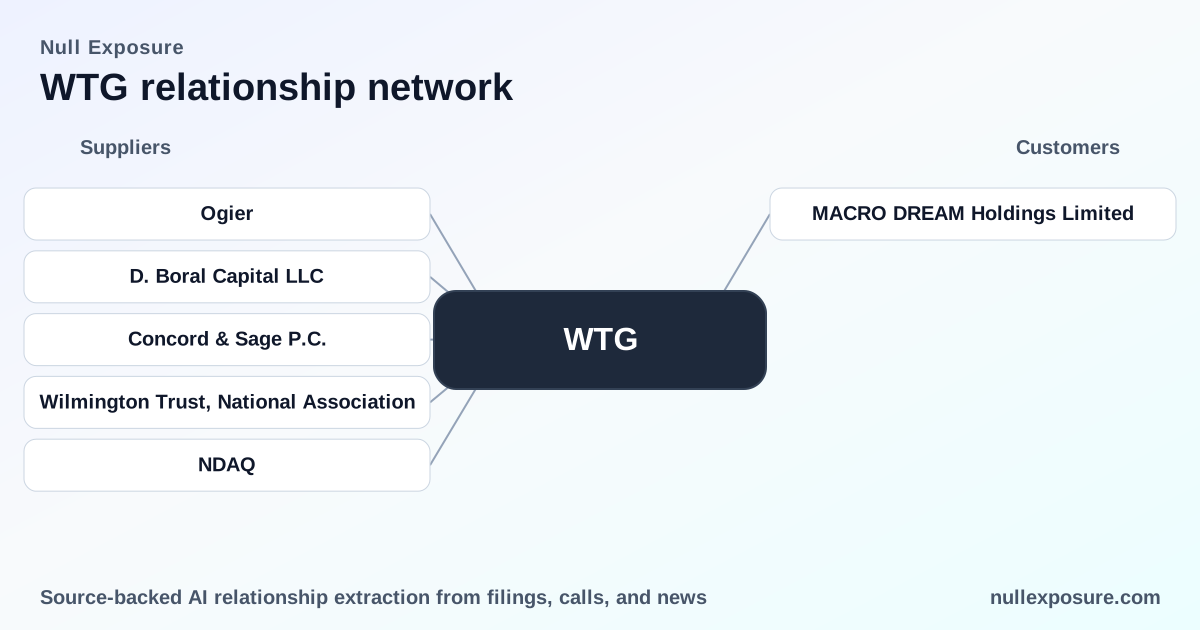
Customer/sponsor relationship: MACRO DREAM Holdings Limited
MACRO DREAM Holdings Limited provided sponsor support through a private placement concurrent with Wintergreen’s IPO. According to a Holland Sentinel press release (March 10, 2026), Wintergreen completed a private placement of 253,875 placement units to its sponsor, MACRO DREAM Holdings Limited, for $2,538,750 in connection with its $56.0 million initial public offering. Source: Holland Sentinel press release, March 10, 2026 (press release detailing IPO and related private placement).
This single documented relationship is functionally the company’s primary counterparty on funding and sponsor governance; the placement illustrates the typical SPAC mechanic where sponsors purchase units at a fixed price to backstop offering proceeds and cover transaction expenses.
What the sponsor placement implies for operations and negotiating posture
Sponsor placements like the one from MACRO DREAM perform several operational roles that investors must treat as core to valuation and risk:
- Immediate liquidity: the $2.54 million private placement increases non-trust working capital available for transaction sourcing, due diligence, and paying sponsor/administrative fees.
- Alignment and control: sponsor ownership creates a concentrated influence over deal selection, timing, and vote outcomes; insider and sponsor economics often dominate post-IPO strategy.
- Negotiation leverage: a sponsor that has committed capital is able to underwrite a target acquisition more credibly, improving the SPAC’s ability to close a deal on favorable terms.
These are company-level characteristics of the SPAC model rather than attributes of an operating customer relationship; nonetheless, they are the operative dynamics investors evaluate when assessing whether sponsor-funded SPACs can execute a value-creating combination.
Reported metrics that matter to customer-relationship analysis
Use the following reported statistics as the baseline for counterparty risk assessment (latest quarter: 2025-12-31):
- Market capitalization: $75.26 million
- Shares outstanding: 7,303,600; float: 3,564,500
- Reported ownership: Insiders 32.16%, Institutions 70.36%
- Financials: Revenue TTM $0; Profit and operating margins 0; EPS 0.20; Book value per share: 0.728
Major takeaway: Wintergreen carries zero operating revenue and depends on sponsor and market support to preserve optionality; ownership figures imply concentrated economic and voting power that directly affects the company’s negotiating posture.
Constraints and company-level signals for dealmakers
The relationship dataset for Wintergreen does not include explicit contractual constraints or third-party caveats. As a company-level signal, this absence translates into three practical consequences for investors and counterparties:
- Limited public visibility into contractual terms. Without disclosed contract specifics, investors must assume standard SPAC sponsor mechanics govern economics (sponsor promote, private placement rights, and potential backstop funding), and require direct confirmation when diligence progresses.
- Concentration of counterparty risk. The sponsor placement is the principal external funding relationship reported, so funding concentration is high and sponsor actions will be critical to transaction completion or failure.
- Maturity and time pressure. SPACs have finite windows to complete combinations; sponsor funding cadence and any undisclosed bridge financing determine practical runway.
Treat these signals as operational constraints on Wintergreen’s ability to transact and on the negotiating latitude it has with potential targets.
Risk checklist for investors and operators evaluating WTG relationships
- Confirm the legal terms of the sponsor private placement (price mechanics, lock-ups, conversion terms) before valuing deal optionality.
- Validate the timing and amount of cash held in trust and the remaining SPAC life; sponsor placements rarely substitute for long-term operating cash flow.
- Reconcile reported ownership percentages and investigate classification anomalies (reported insiders + institutions >100%), as such anomalies affect governance forecasts and redemption outcomes.
- Monitor public filings and press releases for additional sponsor commitments or contingent financing that alter the effective concentration of counterparty exposure.
For a structured, sourced map of Wintergreen’s counterparty footprint and sponsor arrangements, visit https://nullexposure.com/ to view our analyst-level relationship profiles.
Bottom line
Wintergreen Acquisition Corp. is a sponsor-backed SPAC with no operating revenue; its strategic value and downside protection are determined by sponsor funding and the company’s ability to convert IPO proceeds into a successful business combination. The documented relationship with MACRO DREAM Holdings Limited—255,875 units for $2.54 million—illustrates the essential funding dynamic: sponsor placements are the operational lifeblood of the vehicle, and their size, timing, and contractual mechanics are the principal levers for investors and counterparties assessing execution risk.