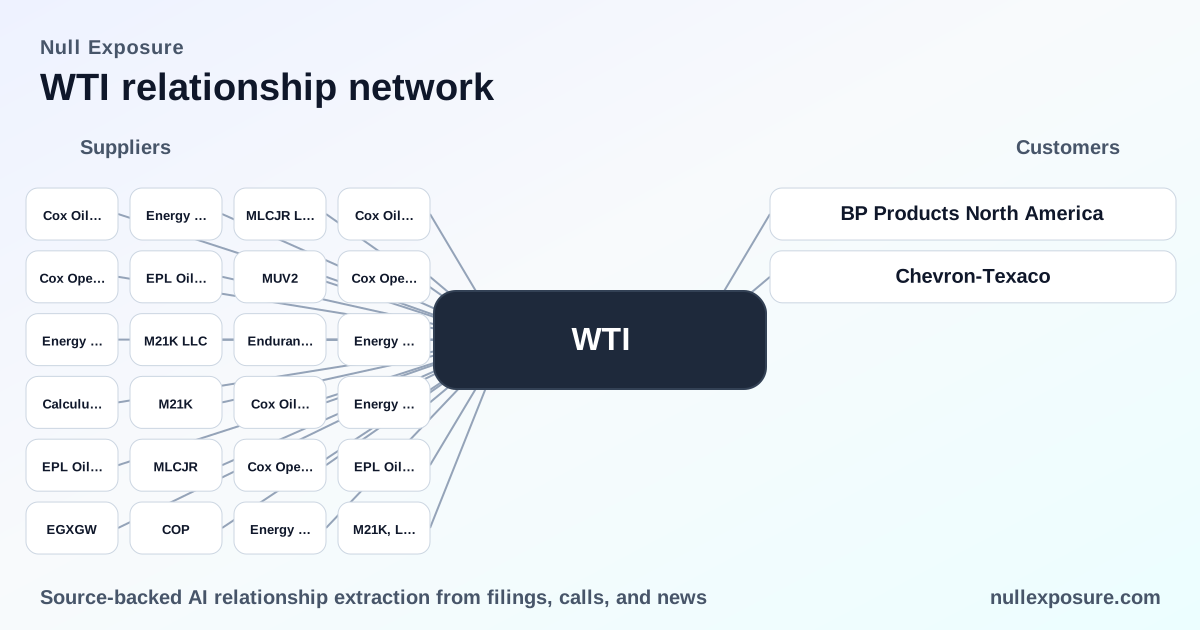
W&T Offshore (WTI): customer map, revenue concentration and commercial posture
W&T Offshore is an upstream oil and gas producer that monetizes by producing and selling crude oil, NGLs and natural gas from offshore Gulf of Mexico assets; the company recognizes revenue at the point control transfers to buyers and contracts predominantly on short-term terms, selling directly into the market or to major downstream counterparts. For investors, the commercial profile is defined by high counterparty concentration (one buyer accounted for ~44% of receipts in 2024), short contract tenors, and a single‑segment operating model focused on Gulf production — a combination that creates strong operational optionality but meaningful revenue concentration risk. Learn more about how we extract and structure relationship signals at https://nullexposure.com/.
How W&T makes money and how its commercial model behaves
W&T’s revenue is straightforward: production → sale → cash at transfer of control. The Form 10‑K describes the business as a single reportable segment focused on acquisition, development and production offshore in the Gulf of Mexico; revenues derive from sales of oil, NGLs and natural gas. The company sells product to third‑party customers and records revenue when collectability is probable and control has transferred.
Company-level signals from the 10‑K establish the commercial posture:
- Short‑term contracting is the dominant pattern: a significant number of product sales are under contracts of one year or less, which increases pricing and marketing flexibility but limits long‑dated revenue visibility.
- Large enterprise counterparties form the customer mix; W&T sells to majors, well‑established oil and pipeline companies, and independents.
- Geographic concentration is acute: substantially all operations and sales stem from offshore Gulf of Mexico production, exposing W&T to regional operational and logistical dynamics.
- The company asserts replacement customers can be obtained quickly and therefore believes loss of specific customers would not be material, a management view that reduces perceived counterparty lock‑in but does not eliminate concentration risk at current volumes.
These operating characteristics together produce a commercial model that is flexible and market‑exposed, with revenues tied to commodity realizations and the credit and purchasing behavior of a small number of large buyers. The 2024 Form 10‑K provides the underlying context for these signals.
Customer relationships: who buys W&T’s production
Below I cover every customer relationship extracted from filings and calls. Each relationship is presented with a concise plain‑English summary and the primary source.
BP Products North America
BP accounted for a substantial share of W&T’s receipts — roughly 44% of receipts from oil, NGLs and natural gas in 2024. This makes BP the single largest commercial outlet for W&T’s marketed production, creating concentrated revenue exposure to a major downstream counterparty. According to W&T Offshore’s 2024 Form 10‑K, approximately 44% of receipts were received from BP Products North America in FY2024.
Chevron‑Texaco
Chevron‑Texaco was the second material buyer, representing approximately 12% of receipts from oil, NGLs and natural gas in 2024, giving Chevron a clear but smaller role in W&T’s cash flows compared with BP. The 2024 Form 10‑K states Chevron‑Texaco accounted for about 12% of receipts in FY2024.
Cox (marketing/production partner)
W&T referenced facility and production enhancements pursued with Cox and a new marketing agreement for Mobile Bay during the Q4 2025 earnings call transcript, indicating an active operational and commercial collaboration on specific infrastructure and marketing for Mobile Bay production. The Q4 2025 transcript (earnings call transcript hosted by InsiderMonkey) records discussion about enhancements with Cox and the new marketing agreement for Mobile Bay production (Q4 2025 earnings call transcript).
What the relationship map implies for investors and operators
The customer list and company signals lead to several clear implications:
- Concentration risk is real and measurable. With ~56% of receipts tied to two counterparties in 2024, revenue volatility from either pricing or counterparty behavior is amplified. Investors should model downside scenarios where a large buyer alters volume, timing, or netbacks.
- Short contract tenors increase market exposure but preserve flexibility. The predominance of one‑year or shorter sales contracts gives W&T the ability to reprice volumes quickly in a rising commodity market, but it also means revenue is sensitive to near‑term market conditions and counterparty willingness to transact.
- Counterparties are creditworthy large enterprises, reducing counterparty credit risk but concentrating commercial dependence. Selling to majors and established midstream players lowers the probability of non‑payment, though it does not eliminate demand or price risk.
- Geographic concentration centralizes operational risk. Gulf of Mexico operations simplify logistics and allow focused operational management, but storm seasons, regional pipeline outages or local bottlenecks can materially affect production and receipts.
- Management’s immateriality assertion should be stress‑tested. The 10‑K states replacement customers could be obtained in a short period on similar terms, which is a reasonable commercial posture in a fungible commodity market — yet the practical friction of matching volumes, timing and logistics for a major buyer like BP should be incorporated into scenario analysis.
Commercial maturity and bargaining dynamics
W&T’s single‑segment Gulf focus and short contract terms indicate a mature, transaction‑driven marketing approach rather than long‑dated, relationship‑locked offtake arrangements. That maturity supports nimble responses to market price moves and operational changes, but it also means W&T’s revenue is a function of current market spreads, buyer demand and logistical access.
Investors valuing W&T should therefore place emphasis on:
- near‑term price decks and counterparty demand,
- operational uptime in the Gulf,
- and the company’s ability to re‑market volumes quickly if a large buyer reduces purchases.
Key takeaways and recommended next steps
- BP is the dominant buyer (≈44% of receipts in 2024); Chevron provides a secondary but meaningful share (≈12%). This concentration is the single largest commercial risk signal in the customer map.
- Sales are predominantly short‑term, sold into large enterprise buyers from Gulf production, which preserves flexibility but increases sensitivity to near‑term market moves.
- Operational focus on the Gulf of Mexico concentrates both strengths (operational scale, single segment focus) and risks (regional weather, pipeline/access events).
If you are tracking commercial exposure or underwriting W&T’s cash flows, prioritize modeling scenarios that stress BP purchase volumes and Gulf operational disruptions. For actionable relationship intelligence and ongoing tracking of changes to W&T’s customer footprint, visit https://nullexposure.com/ for our coverage and updates.