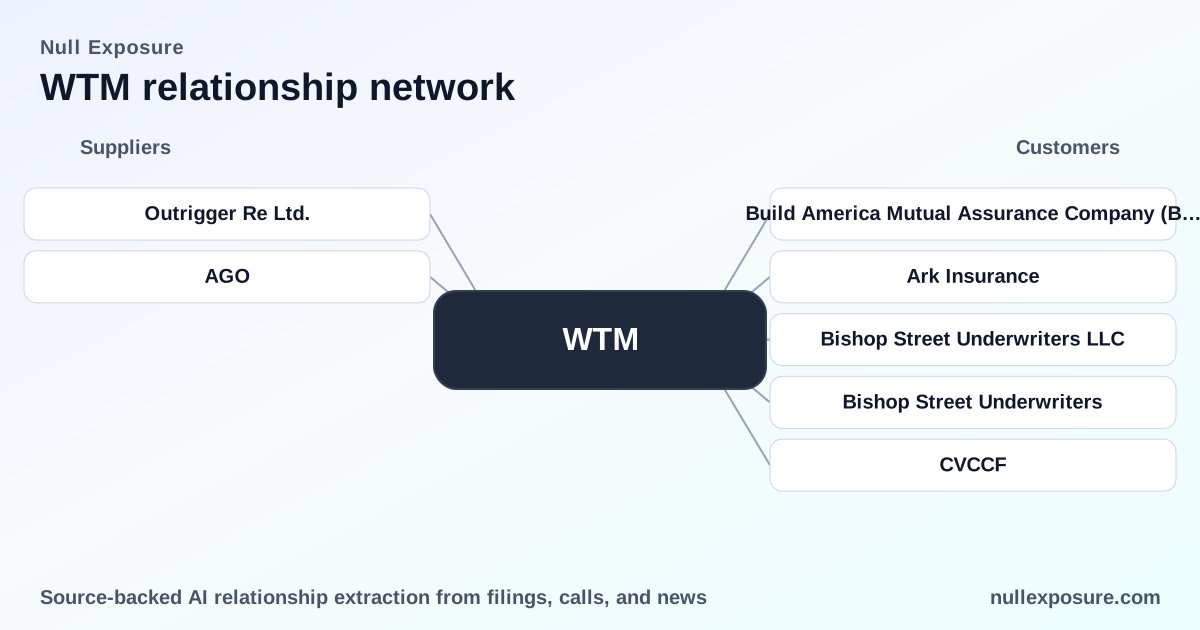
White Mountains (WTM): Customer relationships that drive capital recycling and niche underwriting returns
White Mountains is a Bermuda-headquartered insurance holding company that monetizes through underwriting and investment income, plus periodic capital recycling of operating businesses and minority investments. The firm operates specialty insurance and reinsurance franchises, provides capital solutions through Kudu, and runs distribution assets such as Bamboo that generate fee-like economics — all of which convert underwriting skill and balance-sheet flexibility into repeatable cash returns. For investors, the company’s customer and counterparty relationships reveal a deliberate mix of capital provision, reinsurance concentration, and distribution monetization that underpin earnings variability and liquidity events. Learn more at https://nullexposure.com/.
Why relationships matter: an investor lens on contracting posture and concentration
White Mountains runs a hybrid business model: capital provider + operating insurer + distribution asset owner. That translates into three investor-relevant operating-model characteristics:
- Contracting posture: The company often contracts as a capital partner — providing structured funding, reinsurance-first-loss protection, and equity stakes — rather than being a plain-vanilla policy seller. This elevates counterparty negotiation leverage and creates non-linear downside protections.
- Concentration and criticality: Several relationships show exposure to a small set of strategic counterparties (e.g., distribution platform Bamboo and specialty insurers like Ark), which concentrates economic outcomes but also creates concentrated optionality when those assets are recycled.
- Maturity and optionality: Transactions include both mature portfolio sales (controlling interest sale in Bamboo) and early-stage capital commitments (structured capital to Bishop Street), implying a portfolio that balances near-term cash realization and longer-term upside.
These signals are company-level: White Mountains is structured to be both a seller/underwriter and a strategic service/capital provider across its businesses.
Geography and counterparty profile — where the revenue comes from
White Mountains’ operations are broadly global with a strong North American tilt. Public disclosures and reporting indicate meaningful revenue from the United States and the UK, while Ark’s underwriting footprint is explicitly worldwide, with focus in the US, Europe and Asia. This mix supports diversified premium flows but concentrates underwriting risk in specialty, excess & surplus, and marine/energy niches.
Detailed customer relationships: what each link means for WTM
Bishop Street Underwriters LLC / Bishop Street Underwriters
White Mountains provided a $125 million structured capital investment to Bishop Street Underwriters, signaling active balance-sheet deployment into private specialty underwriting platforms and growth capital. A MarketScreener brief in March 2026 and subsequent press coverage in May 2026 reported the transaction and the funding amount. (Sources: MarketScreener, March–May 2026; Investing.com, May 2026.)
Ark Insurance
White Mountains continues commercial ties with Ark Insurance through reinsurance and renewal arrangements, including Outrigger Re renewals for 2026 that sustain specialty property and casualty flows. The company disclosed Ark renewals and underwriting scope in a March 2026 corporate update. (Source: MarketScreener, March 2026.)
Build America Mutual Assurance Company (BAM) / HG Global / HG Re (as related counterparties)
Through HG Global and its reinsurance unit HG Re, White Mountains provides first-loss reinsurance protection that was specifically established to support BAM’s municipal bond insurance product, limiting BAM’s exposure on certain policies up to stipulated first-loss percentages. The company’s SEC-related commentary and TradingView reporting of the 10‑K emphasize this targeted reinsurance arrangement in FY2026. (Source: TradingView summary of WTM 10‑K, March 2026.)
CVC Capital Partners / CVCCF (as purchaser of Bamboo)
White Mountains completed the sale of a controlling interest in Bamboo to affiliates of CVC Capital Partners, receiving net cash proceeds ($848 million reported) while retaining a roughly 15% fully diluted equity stake; Bamboo had produced noteworthy managed premiums and MGA adjusted EBITDA to the sale date. Multiple contemporaneous press accounts and company communications recorded the transaction details and retained minority position in FY2025–FY2026. (Sources: IntelligentInsurer, Bernews, InsuranceBusinessMag, March–May 2026; Investing.com, March–May 2026.)
Note on duplicate names in public reporting: several outlets referenced CVC using alternate tickers (CVCCF) or fund descriptors; those entries all describe the same transaction — the sale of Bamboo and White Mountains’ retained minority stake. (Sources: InsuranceBusinessMag, March 2026; Investing.com, March 2026.)
What these relationships tell you about earnings drivers and risk
- Capital recycling is a primary earnings mechanic. The Bamboo sale to CVC generated significant cash and a retained minority stake that preserves upside, illustrating a repeatable model: build or back distribution/underwriting platforms, scale them, then monetize through sale while keeping optionality. A company statement and press coverage in FY2025–FY2026 documented the $848 million net cash proceeds and the retained stake. (Source: InsuranceBusinessMag, March 2026.)
- White Mountains acts as a strategic capital provider. The $125 million structured investment into Bishop Street Underwriters demonstrates active deployment into speciality underwriting capacity and sponsor-backed platforms, reinforcing the company’s role as a liquidity partner for insurance operators. (Source: MarketScreener / ReinsuranceNews reporting, Feb–May 2026.)
- Reinsurance relationships are purpose-built and limited in scope. The HG Re first-loss arrangement for BAM is an example of targeted reinsurance exposure rather than broad quota-share risk transfer; this concentrates counterparty credit and actuarial risk in discrete programs. (Source: TradingView summary of WTM 10‑K, March 2026.)
Company-level constraints and strategic implications
Public evidence frames several company-level signals investors should weight:
- Counterparty profile: White Mountains deals with large-enterprise counterparties in its specialty lines and distribution channels, indicating sophisticated, institutional counterparties that support complex deals (company-level signal derived from underwriting descriptions).
- Segment mix: The firm combines distribution (Bamboo) and services/capital solutions (Kudu, HG Re) as core segments, creating both fee-like and underwriting-return revenue streams; Bamboo’s capital-light, data-enabled distribution model is explicitly tied to the distribution segment. (Source: company disclosures and press reporting, FY2024–FY2026.)
- Geographic reach: Revenue and underwriting footprints show heavy North American exposure with significant UK/Bermuda presence and underwriting activity in Europe and Asia for certain specialty lines — this amplifies macro and catastrophe exposures by region. (Source: company revenue tables and Ark underwriting descriptions in filings.)
Bottom line for investors
White Mountains runs a capital-first insurance holding strategy: it underwrites niche risks while actively deploying and recycling capital through minority and controlling sales of operating assets. That mix creates high optionality with episodic cash realizations, but also concentrates certain operational risks in a handful of strategic counterparties and geographies. For investors allocating to specialty insurance platforms, White Mountains’ relationships — from the Bishop Street capital injection to the Bamboo sale to CVC and tailored reinsurance for BAM — are central to forecasting cash flow timing and capital adequacy.
For a concise briefing on how these relationships fit into broader counterparty risk frameworks and to track new transactions, visit https://nullexposure.com/.
Key takeaway: White Mountains converts underwriting skill and balance-sheet scale into structured capital investments and strategic exits — a model that supports strong returns when executed, but requires active monitoring of counterparties, regional exposures, and timing of monetization events.