UTime Limited (WTO): Customer Relationships Reveal a Hardware-Sales Growth Playbook — with Conversion Risk
UTime Limited designs, manufactures and sells mobile phones and adjacent consumer electronics and monetizes through direct device sales, B2B hardware supply agreements executed by its Shenzhen and Hong Kong subsidiaries, and strategic partnerships to enter server, EV-charging and wearable-health channels. Recent announcements show a deliberate shift from pure consumer handsets toward higher-ticket B2B product lines, but the commercial reality hinges on converting intent agreements into binding orders and integrating those revenues into an otherwise loss-making income statement. For a concise investor dossier and ongoing monitoring tools, visit the NullExposure homepage: https://nullexposure.com/.
Executive snapshot: how UTime makes money and where the dollar weight sits
UTime’s core business is device manufacturing and distribution. The company’s public filings list TTM revenue of $212.1 million and a gross profit of $16.47 million, while adjusted operating performance is weak — EBITDA is deeply negative at -$511.5 million and the company reports a negative EPS. Those figures signal a business model that relies on volume product sales with thin gross margins, and that it is currently funding expansion or restructuring through capital markets rather than operating cash flow. Institutional ownership is substantial (roughly 58%), which creates an investor base sensitive to headline commercial wins and execution on order conversion.
What the headlines say — the customer relationships that matter now
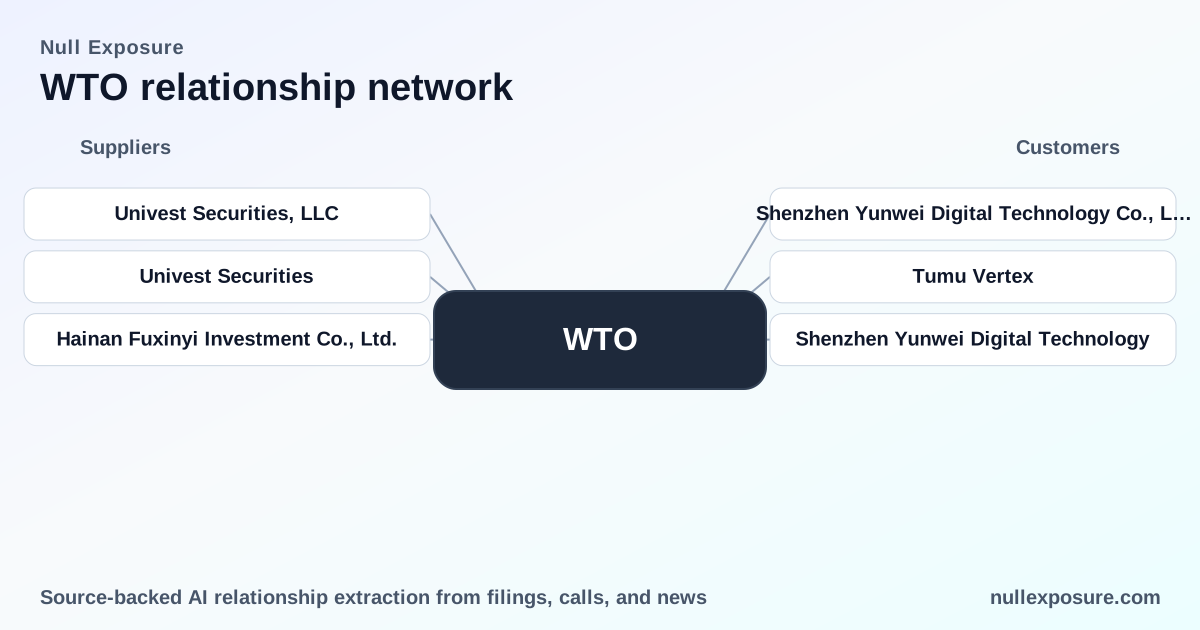
Below I cover every customer relationship surfaced in the public reporting set, summarizing the commercial facts and citing the original source.
Shenzhen Yunwei Digital Technology Co., Ltd. — a headline $50 million intent for smart servers
UTime’s Shenzhen subsidiary, Shenzhen Liandai Technology, signed an Intentional Order Cooperation Agreement with Shenzhen Yunwei Digital for the potential supply of 500,000 GM800 smart servers, an arrangement reported as having an estimated contract value of approximately $50 million. According to a GlobeNewswire release dated February 3, 2026, the agreement communicates an expressed procurement intent rather than an immediate firm purchase order. (GlobeNewswire, Feb 3, 2026)
Jiuzi Holdings Inc. (subsidiary) — strategic partnership for EV chargers
UTime announced a strategic partnership to supply up to 10,000 smart EV chargers to a subsidiary of Jiuzi Holdings Inc. (NASDAQ: JZXN), positioning the company in the EV-infrastructure channel as a hardware supplier. This arrangement was reported in market headlines in early May 2026 aggregated by Finviz. (Finviz aggregated news, May 4, 2026)
Tumu Vertex / Tumu Vertex LLC — near $10 million wearable-health procurement
UTime’s Hong Kong subsidiary secured an order reported at approximately $10 million from Tumu Vertex for 50,000 smart health devices — a mix that includes blood-pressure watches and smart rings — representing a direct procurement agreement for wearable-health products. This placement was reported by investing and market wires in early May 2026. (Investing.com / TipRanks coverage, May 2026)
Operating-model signals and company-level constraints investors should track
Even though there are no formal constraint excerpts attached to the relationship data set, the public facts imply several company-level operating characteristics:
- Contracting posture: UTime deploys a mix of non-binding intent/cooperation agreements and explicit procurement contracts executed through subsidiaries. This hybrid posture supports rapid market entry while preserving flexibility, but creates a two-tier revenue pipeline: announced intents that carry conversion risk and signed procurement orders that drive revenue recognition.
- Concentration and revenue impact: Recent deals are high-ticket but concentrated — a small number of large transactions can swing quarterly revenue materially for a $212M TTM revenue company. That creates both upside on conversion and downside if orders fail to materialize.
- Customer criticality: The reported deals target industrial customers (data center/server buyers, EV charging networks, healthcare wearables resellers) that are strategically important to UTime’s diversification away from consumer handsets; successful execution against these partners would materially shift product mix and margin profile.
- Maturity and execution risk: The company’s negative EBITDA and negative EPS indicate capital-intensive scaling; converting intent agreements into repeatable procurement will require sustained manufacturing execution, working capital, and likely continued access to financing.
Investment implications — upside drivers and principal risks
- Upside: If the Yunwei $50M intent and the Tumu Vertex ~$10M procurement convert into firm, recurring orders, UTime will realize a meaningful revenue uplift and demonstrate product diversification to investors. The Jiuzi EV-charger partnership opens a new vertical that commands higher price-per-unit than low-end handsets.
- Risk: The most immediate risk is order-conversion and timing. Intent/cooperation agreements are explicit in language and public releases; they are not the same as firm backlogged contracts. Given UTime’s poor operating profitability, failure to convert would expose liquidity pressure and dilute operating leverage. The concentration of large, discrete deals amplifies quarter-to-quarter volatility.
- Balance sheet and governance considerations: With high institutional ownership and elevated public attention on headline deals, governance and disclosure around order terms, payment schedules, and warranty/returns will determine how much of a announced book actually flows to the top line. Monitor receivables, advances, and inventory turn for signs of healthy conversion versus speculative backlog reporting.
How to monitor these relationships going forward
- Track formal filings and subsequent company press releases that convert “intent” language into firm purchase orders or invoices; those are the revenue triggers.
- Watch cash-flow statements and working-capital lines: execution of large hardware contracts will create measurable changes in receivables, inventory, and supplier payables.
- Observe partner confirmations or public statements from the counterparties (e.g., Shenzhen Yunwei Digital, Jiuzi subsidiary, Tumu Vertex) for independent corroboration of order size and delivery schedules.
For deeper deal-level tracking and alerts on conversion events, see our research hub: https://nullexposure.com/.
Bottom line
UTime is repositioning from consumer handset volumes toward higher-ticket B2B hardware supply deals. The commercial narrative is attractive — diversification into servers, EV chargers and healthcare wearables — but the investment thesis depends entirely on execution: converting intent into binding orders, managing working capital through large shipments, and improving operating margins. Investors should prize corroborated order confirmations and cash-flow improvement over single press releases when sizing upside and downside.
Key takeaway: headline agreements provide material upside to a company with low current profitability, but those headlines are not yet a substitute for demonstrated order conversion and cash-flow improvement.