Essential Utilities (WTRG) — Customer Relationships and Strategic Implications
Essential Utilities operates regulated water, wastewater and natural gas businesses under the Aqua and Peoples brands and monetizes through regulated tariffs and metered, usage-based billing for roughly 5.5 million end‑users across the United States. The core earnings stream is predictable utility rate revenue (largely residential) supplemented by non‑regulated service offerings such as service‑line protection and repair, producing steady cash flow and defensive credit characteristics for investors. For a consolidated view of customer exposures and relationship signals, see https://nullexposure.com/.
How the customer base actually pays the bills
Essential’s customer economics are dominated by metered, usage‑based retail billing and a high share of residential customers. According to the company, “substantially all of our water utility customers are metered,” enabling direct consumption billing, and residential water and wastewater customers composed about 67% of water and wastewater revenues in 2024. This structure yields revenue tied to consumption and approved rate schedules, so near‑term cash flow tracks both weather/usage patterns and regulatory outcomes rather than discretionary spend cycles.
Geography is a major operating constraint: the utility footprint is concentrated in the U.S., with 66% of utility customers located in Pennsylvania and the remainder primarily across Ohio, North Carolina, Texas and Illinois. Those state concentrations make regulatory regimes and state public utility commissions a central determinant of revenue growth and investment recovery. Essential also runs non‑regulated gas-related services (service line protection, repair, and marketing), which provide modest diversification but are recognized as services delivered over time rather than discrete third‑party product sales.
What management discussed on the 2025 Q4 call — named counterparties and context
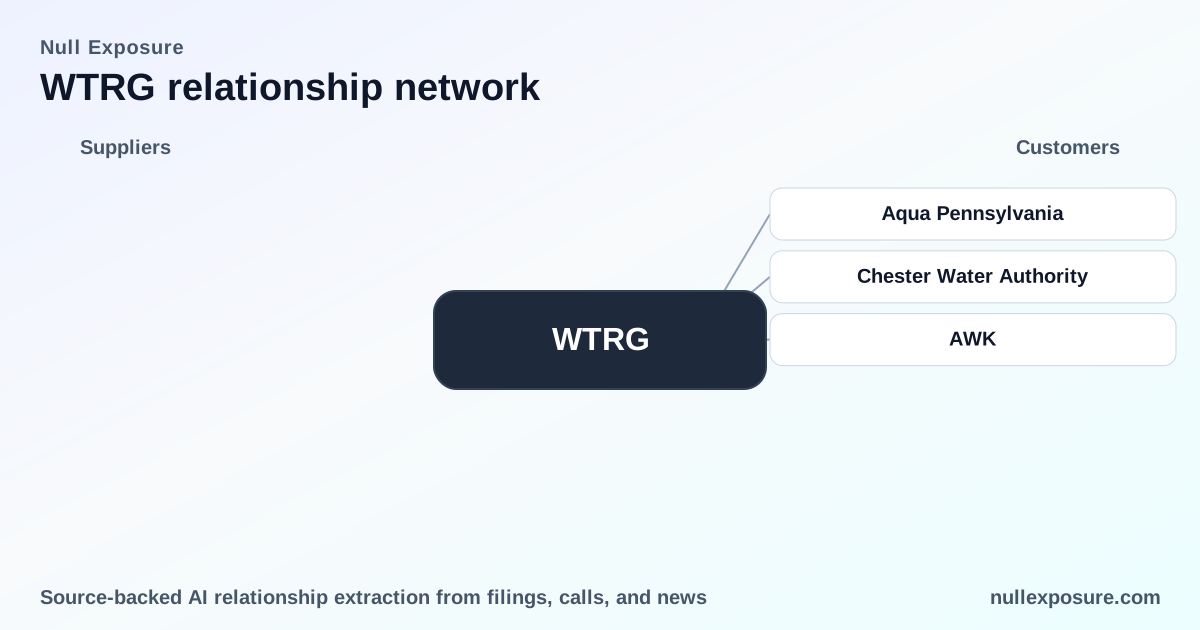
Below are every customer or counterparty mentioned in the company’s 2025 Q4 earnings call transcript, each accompanied by a plain‑English summary and the source.
Aqua Pennsylvania — local asset consolidation and regulatory approval
Management noted that the Pennsylvania Public Utility Commission approved Aqua Pennsylvania’s acquisition of the Greenville Municipal Water Authority assets last month, illustrating continued local consolidation activity in Essential’s core state and the practical pace of PUC approvals. (2025 Q4 earnings call, March 2026).
Chester Water Authority — municipal issues in management commentary
Executives referenced recent developments involving the city of Chester and the Chester Water Authority as part of broader regional operational commentary, signaling management attention on municipal relationships and local governance issues that can affect service continuity and acquisition opportunities. (2025 Q4 earnings call, March 2026).
American Water (AWK) — strategic alignment language
Management explicitly compared American Water’s commitment to Essential’s, stating that the two companies’ shared focus “makes our combination only more compelling,” which indicates management is discussing strategic combinations or aligning positioning with peers in the regulated water space. (2025 Q4 earnings call, March 2026).
AWK — duplicate mention of American Water
American Water (listed again under its ticker AWK) was cited with identical language about shared commitments and the compelling nature of a combination, reinforcing the management narrative tying Essential to AWK as a strategic peer and potential partner or comparator. (2025 Q4 earnings call, March 2026).
Contracting posture, concentration and criticality — constraints that shape investor risk
The relationship constraints extracted from filings and disclosures reveal several company‑level operating characteristics investors should treat as structural:
-
Contracting posture: Usage‑based, regulated sellers. The company bills based on metered consumption for the vast majority of water customers, creating revenue streams that are sensitive to consumption trends and regulated rate recovery rather than commercial contract churn. (Company disclosure on metered customers).
-
Counterparty mix: Predominantly individual/residential. Residential customers accounted for roughly 67% of water/wastewater revenue in 2024, which translates into a large low‑ARPU, high‑recency customer base with predictable payment behavior but exposure to small changes in household consumption patterns. (2024 revenue breakdown).
-
Geographic concentration: North America, dominated by Pennsylvania. The footprint is principally U.S. states with 66% of customers in Pennsylvania, concentrating regulatory and political risk in a single jurisdiction while still offering scale advantages for operational efficiency. (As of December 31, 2024 company filings).
-
Role and stage: Active seller of essential services. Essential is the provider (seller) of critical municipal services in markets where it operates, and these relationships are active—meaning ongoing service delivery, rate cases and infrastructure investments drive the economics. (Company operating descriptions).
-
Segment mix: Regulated services augmented by non‑regulated service offerings. Alongside traditional regulated water/wastewater and gas, the company earns service revenues from third‑party water/sewer service‑line protection and repairs; these are recurring service streams recognized over time and provide modest margin diversification. (Service line protection disclosure).
Together these constraints describe a business with stable cash generation and regulatory sensitivity: billing is recurring and usage‑driven, but growth and returns depend on constructive regulatory outcomes and local utility economics.
Investment takeaways and tactical implications
-
Stability with regulatory dependency. Essential’s revenue base is defensive because customers pay for essential water services through metered bills, but rate case outcomes and state PUCs are the primary growth levers. Investors should underwrite regulatory cycles when modeling forward growth and capital recovery.
-
Concentration risk in Pennsylvania. With two‑thirds of customers in one state, political or economic stress in Pennsylvania would have outsized impact on fundamentals; diversification across other states tempers but does not eliminate that exposure.
-
Residential weighting reduces churn but limits upside. Heavy residential exposure reduces commercial volatility but caps elasticity; upside will come from authorized rate increases, consolidation of municipal systems, or expansion of ancillary services.
-
M&A and peer alignment are on management’s agenda. Management’s repeated reference to American Water and consolidation actions by Aqua Pennsylvania highlight that strategic transactions and local asset consolidation are active considerations for growing rate base. Monitoring regulatory outcomes on local acquisitions is essential.
For deeper signal extraction and ongoing tracking of WTRG’s customer relationships and regulatory mentions, visit https://nullexposure.com/.
Bottom line
Essential Utilities runs a classic regulated utility business: metered, usage‑based revenues with high residential exposure and concentrated geography. The company’s stated customer relationships and the call references to municipal asset deals and peer alignment define a playbook where steady cash flow meets regulatory execution and selective M&A to drive long‑term value. Investors should focus models on rate case timing, Pennsylvania regulatory dynamics, and the pace of local consolidation when evaluating WTRG.