Select Energy Services (WTTR): Customer Relationships and Strategic Revenue Signals
Select Energy Services operates and monetizes through three complementary channels: water-management services, fixed water infrastructure, and chemical technologies sold to the onshore oil & gas industry in the U.S. Revenue is generated primarily as services are performed (flowback, transfer, treatment, recycling, and produced-water handling) while the Water Infrastructure footprint creates longer-duration, production-linked cash flows; the Chemical Technologies business adds a manufactured-products revenue stream to completions economics. For a detailed customer relationship view and timelines, see our portal at https://nullexposure.com/.
How the company contracts and where the money comes from
Select’s commercial posture is a hybrid that combines transactional short-term work with framework MSAs and a growing stock of long-term infrastructure contracts. Operationally, the firm sells services that are booked when performed and supplements that with manufactured chemical product sales to completion service providers. The net effect is a revenue mix that is operationally aligned to drilling and completion cadence, but increasingly supported by infrastructure-derived recurring cash flow.
- Short-term service flow underpins near-term revenue volatility. The Water Services segment dominates reported revenue and is tied to the timing of well completions and produced-water cycles.
- Framework MSAs reduce transaction friction. Select routinely operates under master service agreements, improving retention and terms consistency with major E&P customers and pressure pumpers.
- Infrastructure builds scale and contract duration. Water Infrastructure assets convert some revenues into longer-lived, production-related streams that stabilize the business over time.
- Geography and counterparty profile concentrate exposure on U.S. E&P majors and large independents, which is positive for credit quality but ties performance to U.S. onshore activity.
For additional visibility across relationships and counterparties, visit https://nullexposure.com/ for our relationship timelines.
Operating constraints and company-level signals investors should internalize
Select’s public disclosures and reporting generate a coherent set of company-level constraints that shape revenue predictability and risk:
- Contracting mix: Most Water Services and Chemical Technologies agreements are short-term (<1 year), but the company operates MSAs with many counterparties and is actively growing long-term Water Infrastructure contracts to stabilize cash flows.
- Counterparty type and concentration: Customers are predominantly large enterprises — integrated and independent oil & gas producers — and no single customer accounted for 10% or more of consolidated revenues in 2024, indicating low revenue concentration.
- Geography: Operations are focused in North America (U.S.), reinforcing cyclicality tied to U.S. drilling.
- Role across the value chain: Select acts primarily as a service provider (water sourcing, recycling, transfer, and produced-water management), while also functioning as a manufacturer and seller of fracturing and completion chemicals.
- Spend and related-party signals: Related-party sales and purchases are modest in absolute terms (e.g., ~$0.7m in related-party sales and ~$24.7m in purchases in 2024), indicating limited related-party revenue importance relative to $1.4bn reported revenue.
These signals together imply a business with variable near-term cash flow driven by service activity, but a clear strategic emphasis on infrastructure investments to lengthen revenue duration.
Relationship evidence: what the market has reported lately
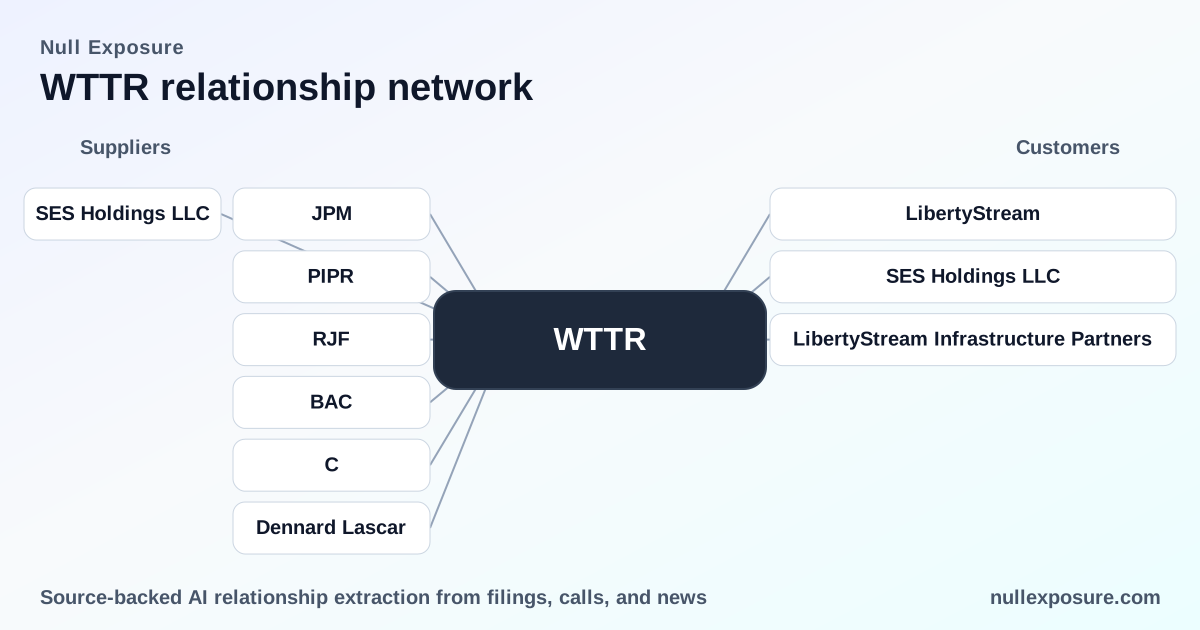
Below are every customer/partner relationship captured in the recent coverage, each summarized in plain English with the reporting source and date.
LibertyStream — water recycling used in lithium extraction
Select is partnering with LibertyStream to apply Select’s water recycling and pre-treatment capabilities to LibertyStream’s lithium extraction process, which reduces capital and operating costs and improves production efficiency. This was reported by Intellectia on March 10, 2026.
LibertyStream Infrastructure Partners — direct lithium extraction unit and presale
LibertyStream Infrastructure Partners is operating a Direct Lithium Extraction unit and a lithium carbonate refining facility on Select’s site and has secured a pre-sale for its first tonne of lithium carbonate scheduled for delivery in June 2026, creating a new commercial use-case for Select’s water assets. This detail was reported by Sahm Capital on May 4, 2026.
LibertyStream Infrastructure Partners — definitive agreement to build commercial lithium carbonate facilities
Select and LibertyStream Infrastructure Partners announced a definitive agreement to build commercial lithium carbonate production units in Texas, with the first 1,000-tonne facility slated for commissioning by December 2026, signaling an intent to convert water infrastructure into battery-material production capacity. MarketScreener reported this on March 10, 2026.
SES Holdings LLC — IPO proceeds to buy units and corporate use
Select priced a $175m IPO of Class A shares with estimated net proceeds of roughly $166.6m intended to purchase SES Holdings LLC units and for corporate purposes, indicating capital deployment toward ownership or investment in related holding structures. TradingView covered this on March 10, 2026.
What these relationships imply for revenue and capital allocation
The LibertyStream engagements convert existing water-handling assets into a new revenue stream tied to lithium production, which diversifies Select’s end markets beyond E&P completions and into energy transition materials. That has three immediate implications:
- Revenue diversification: Using water recycling assets for lithium extraction introduces non-E&P demand that is less correlated with rig counts, improving revenue optionality.
- Capital intensity and timing: Commercializing lithium extraction requires capital and commissioning timelines (first facility commissioning by December 2026; first tonne delivery June 2026 reported), which puts near-term capital allocation and execution risk front-and-center.
- Balance between short-term and long-term income: The company retains its short-term service revenue base while layering infrastructure-backed, longer-duration contracts and project-based income tied to lithium production.
At the same time, materiality constraints are favorable—no single customer topped 10% of revenue in 2024—so these new relationships are incremental rather than transformational in the immediate term.
Key risks and monitoring checklist
- Execution risk on lithium projects: monitor commissioning milestones (June and December 2026 dates in coverage) and any capital overruns.
- Demand correlation: while lithium work reduces drilling correlation, large exposure to U.S. E&P remains the primary revenue driver.
- Capital deployment: watch how IPO proceeds and any purchases of SES Holdings LLC units are used, and whether they shift the company toward more asset ownership versus pure services. (TradingView, March 10, 2026.)
Bottom line for investors
Select’s customer footprint is broad, U.S.-centric, and weighted toward large enterprise E&P customers, with a deliberate strategy to convert service assets into longer-term infrastructure and alternative industrial uses such as lithium extraction. The LibertyStream relationships create a visible pathway to diversify revenue and improve long-term cash flow durability, while the company’s contracting mix preserves flexibility to capture completions activity. For a granular timeline of Select’s customer agreements and to compare these relationships across other energy-service providers, explore our analysis at https://nullexposure.com/.