Willis Towers Watson (WTW): What its customer relationships mean for investors
Thesis — Willis Towers Watson operates as a global advisory, broking and solutions firm that monetizes through a mix of commissions, consulting fees and recurring service contracts, leveraging scale in employee benefits, risk & broking and data-driven products to sell multi-year engagements to large corporates and mid-market clients. For investors, the core investment thesis is stable fee capture from diversified, globally distributed counterparties combined with growth opportunities in analytics-led products such as climate transition services. Learn more or contact NullExposure for tailored research: https://nullexposure.com/
How WTW’s commercial mechanics shape revenue quality
WTW’s public disclosures and recent market signals present a clear commercial architecture:
- Revenue mix anchored in recurring flows. The Benefits Delivery & Outsourcing business includes multi-year service contracts and commission income that generate recurring revenue and predictable cash flow.
- Material portion of work is cancellable. WTW also runs a large book of shorter-term, cancellable engagements where remaining performance obligations are excluded from long-term tables, which creates some near-term revenue elasticity.
- Client base is global and top-heavy on large enterprises. The firm serves multinational corporations across 140+ countries and derives the majority of revenue from North America and EMEA markets.
- No single-client concentration risk. Filings confirm no individual client accounted for more than 10% of consolidated revenue across recent years, reducing single-counterparty exposure.
- Business model bias toward services and advice. WTW acts primarily as a service provider and seller of actuarial, consulting and broking services, often handling sensitive client data and requiring enterprise-grade controls.
These characteristics produce a hybrid revenue profile: high-margin advisory and broking revenue with significant recurring elements, counterbalanced by meaningful cancellable short-term contracts that reduce absolute visibility.
Client-by-client read: what the relationships reveal
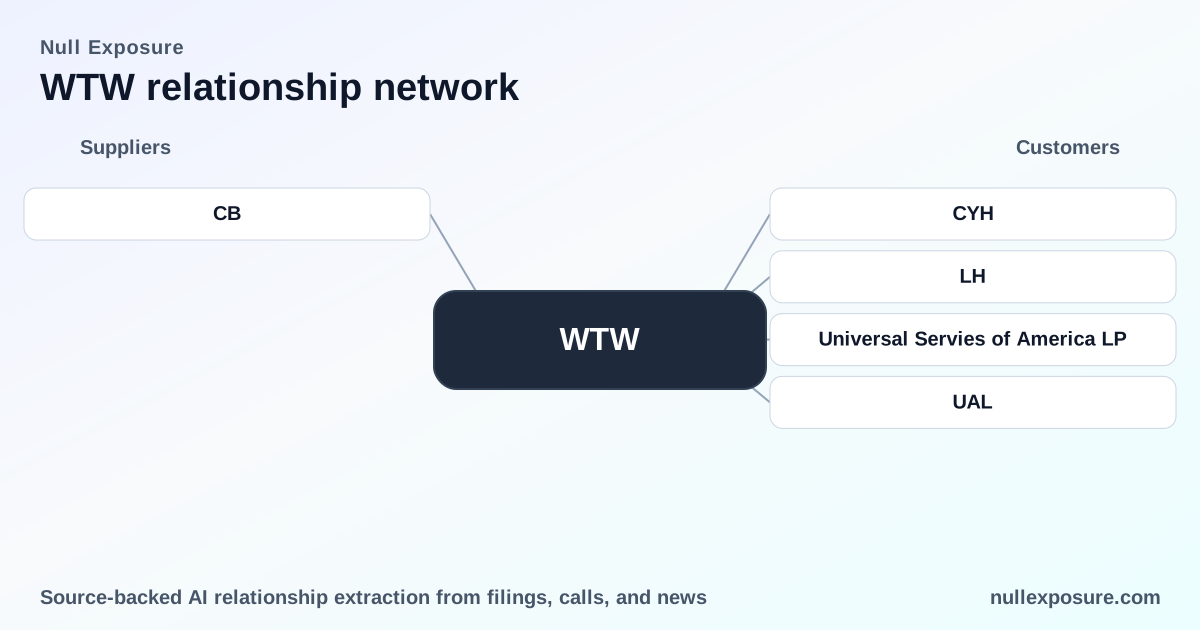
Below I summarize each customer relationship flagged in the public record and the specific source supporting the finding.
Cincinnati Financial Corp (CINF)
Willis Towers Watson was engaged by Cincinnati Financial’s committee to provide actuarial and consultative services for the design of the company’s retirement and employee benefit plans, indicating a traditional pension consulting engagement. Source: Cincinnati Financial preliminary proxy filing, FY2026 via StockTitan (filed March 2026).
BKV Corp (BKV)
WTW acted as an independent compensation consultant to BKV’s special committee, supporting director compensation analyses that led to board-approved meeting fees related to a potential transaction. This is a classic board advisory remit tied to a corporate transaction. Source: BKV preliminary merger information statement, FY2025 via StockTitan (filed March 2026).
CHS / Community Health Systems, Inc. (CYH) — entry 1
Plaintiffs in several ERISA complaints named Willis Towers Watson US LLC among benefits consulting firms alleged to have engaged in self-dealing that harmed plan enrollees, which introduces litigation and reputational risk tied to benefits arrangements. Source: PlanSponsor coverage of ERISA complaints, reported March 10, 2026.
Laboratory Corp. of America Holdings (LH)
Laboratory Corp. was named alongside other employers in ERISA actions that also identified benefits consultants including Willis Towers Watson US LLC, asserting conflicts of interest and harm to plan participants. Source: PlanSponsor report on ERISA complaints, March 10, 2026.
Arch Insurance International / Fidelis (ACGLN)
Arch Insurance International and Fidelis have adopted Willis Towers Watson’s Climate Transition Pathways (CTP), demonstrating demand for WTW’s climate analytics and transition-advisory products among specialty insurers. This is evidence of WTW selling analytics-led, subscription/engagement offerings to insurance buyers. Source: Bermuda Reinsurance Magazine, coverage dated May 2, 2026.
CHS / Community Health Systems, Inc. (CYH) — entry 2
A second listing reiterates that CHS was named in ERISA litigation that includes WTW as a benefits consultant defendant, reinforcing litigation exposure across multiple employer clients using third-party benefit advisers. Source: PlanSponsor article, March 10, 2026.
Universal Services of America LP
Universal Services of America LP was named as a defendant in ERISA complaints that also listed Willis Towers Watson US LLC among the benefits consulting firms alleged to have engaged in self-dealing, again highlighting legal and fiduciary risk associated with benefits administration clients. Source: PlanSponsor coverage, March 10, 2026.
United Airlines / Universal Services of America LP (UAL)
A complaint naming United Airlines / Universal Services of America LP also listed benefits consultants including WTW US LLC, indicating that large employer clients in transportation sectors have targeted benefit arrangements in litigation claims. Source: PlanSponsor article, March 10, 2026.
What the relationship set signals for investors
- Legal and reputational risk is front-and-center. Multiple ERISA complaints naming WTW US LLC as a defendant raise the prospect of litigation cost, remediation expense, and potential contract friction with large employer clients. The incidents are concentrated in FY2026 filings and media coverage, making near-term governance and controls the primary watch item.
- Analytics and product sales are a growth vector. Adoption of WTW’s Climate Transition Pathways by specialty insurers demonstrates expansion into higher-value, repeatable advisory products that support margins and cross-selling.
- Diversification cushions single-client shocks. Company filings confirm no client exceeds 10% of consolidated revenue, which means adverse developments with one or a small set of clients are unlikely to materially impair consolidated results.
- Contractual visibility is mixed. The coexistence of multi-year service contracts and cancellable short-term engagements produces both durable revenue lines and near-term elasticity; revenue predictability therefore depends on the balance of those portfolios and their renewal dynamics.
Investment implications and near-term watchlist
- Prioritize monitoring legal filings and any trustee or regulator findings tied to the ERISA complaints; outcomes determine potential liability quantum and client retention risk.
- Track sales traction and monetization of analytics products such as the Climate Transition Pathways, which improve revenue mix toward high-margin advisory services.
- Evaluate renewal trends and disclosure on remaining performance obligations over subsequent quarters to gauge revenue visibility given the mix of long-term and cancellable contracts.
- Note that WTW’s low beta and high institutional ownership position the stock as a steady, defensive exposure within financial services, but legal risk introduces an idiosyncratic catalyst.
For deeper, relationship-level monitoring and alerts on legal or contract changes, NullExposure provides curated coverage tailored to institutional needs — visit https://nullexposure.com/ for subscription details.
Bold takeaway: WTW combines predictable, recurring advisory economics with exposure to litigation and short-term cancellable work; investors should weigh durable fee streams from large global clients and analytics products against near-term legal and reputational uncertainty.