Willamette Valley Vineyards (WVVI): Distribution shifts refocus East Coast reach
Willamette Valley Vineyards produces and sells wine through two distinct channels—Direct Sales (tasting rooms, e-commerce, tasting events) and Distributor Sales (wholesale relationships)—and monetizes by blending higher-margin direct revenue with scaled, lower-margin wholesale volume. Recent roster moves on the East Coast shift the company’s distribution footprint into larger national wholesalers, a strategic step to increase shelf presence and wholesale velocity without expanding fixed overhead in new states. For a succinct overview of our coverage and sourcing approach, visit the Null Exposure homepage: https://nullexposure.com/.
Why the distribution changes matter to an investor
Willamette Valley Vineyards is a small-cap beverage producer with revenue of $37.2M (TTM) and market capitalization roughly $13.4M, which makes distribution partners a central operational lever. The company’s two-channel model creates a natural trade-off: Direct Sales deliver margin and customer data, while Distributor Sales deliver geographic scale and inventory turnover. Re-aligning East Coast distribution to established wholesalers reduces go-to-market friction and raises the probability of faster shelf adoption without incremental retail staffing or capital expenditure.
These contractual changes are not cosmetic. For a company of WVVI’s scale, who controls the wholesale relationship materially affects revenue concentration, cash collection terms, and promotional cadence. Institutional ownership is limited and insiders hold a meaningful stake, so distribution deals will have an outsized impact on near-term top-line outcomes and margin dynamics.
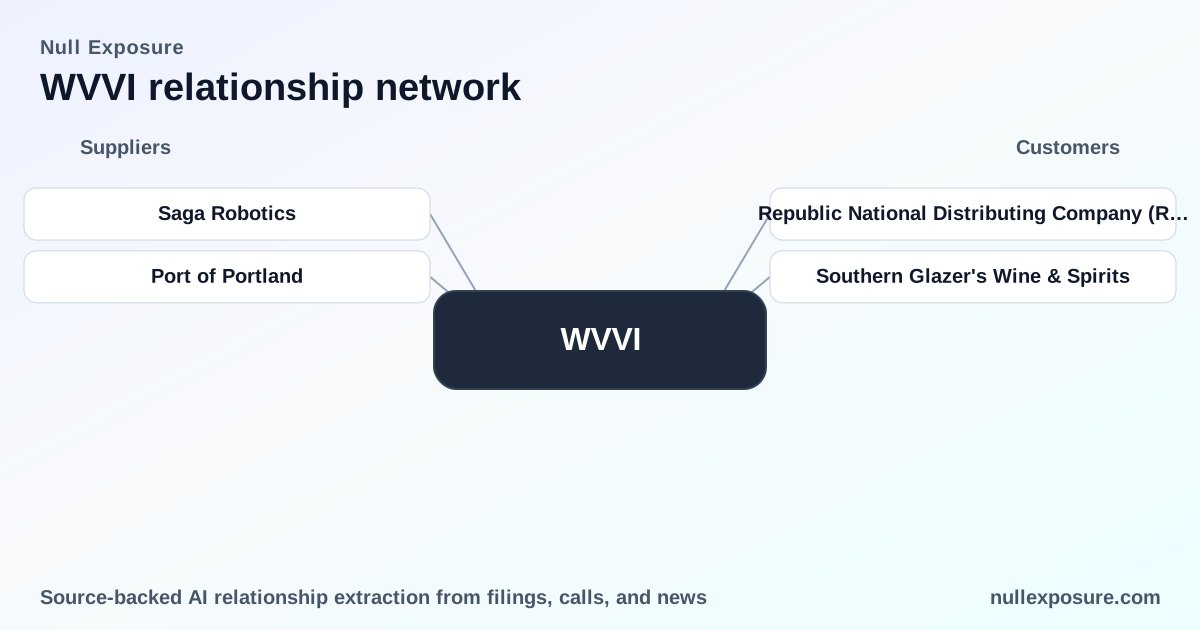
Relationship: Republic National Distributing Company (RNDC)
Willamette Valley Vineyards aligned its New York State and Mid‑Atlantic distribution with Republic National Distributing Company. According to a March 10, 2026 news release reported by Finviz, RNDC will now handle distribution coverage in those East Coast territories, positioning WVVI under a national wholesaler with broad market access in those states. (Finviz, March 10, 2026)
Relationship: Southern Glazer's Wine & Spirits
Willamette Valley Vineyards moved its Pennsylvania representation to Southern Glazer's Wine & Spirits effective immediately. The same March 10, 2026 Finviz report confirms the switch, signaling WVVI’s intent to consolidate Pennsylvania wholesale operations under a major national distributor. (Finviz, March 10, 2026)
How these partnerships fit into the company’s operating model
The company-level evidence shows three durable operating characteristics that frame the RNDC and Southern Glazer’s moves:
- Geographic reach is broad but export penetration is limited. The company distributes product in 49 U.S. states and the District of Columbia, with only two non-domestic customers referenced in filings—indicating a largely domestic revenue base and exposure concentrated in the national retail and on-premise markets.
- Distributor-centric sales are an explicit channel. Willamette Valley reports Distributor Sales as a defined category and uses independent distributors and wine brokers to reach targeted areas. That contractual posture creates supplier-like dependencies on wholesale partners for shelf access, pricing execution, and promotional support.
- Two-segment revenue mix creates margin segmentation. Management discloses Direct Sales and Distributor Sales as separate operating segments with different margins and selling strategies, so incremental volume booked through RNDC or Southern Glazer’s will likely show up at lower per-unit margins but higher overall throughput.
Together, these signals describe a company with a distribution-dependent go-to-market model: broad national coverage without heavy international scale, reliance on wholesalers for regional penetration, and a two-tier margin structure that requires active management of channel mix.
Financial context and concentration risks
Willamette Valley’s trailing numbers underline why distribution partners are strategically important. The company reports gross profit of $22.5M (TTM) against revenue of $37.2M, but EPS is negative at -$0.65 and operating margin is thin. Insiders control roughly 17.7% and institutional ownership is low (~13%), which concentrates outcome risk among a small investor base.
- Concentration risk: Dependence on distributor channels concentrates counterparty risk into a handful of wholesalers across key states; a termination or poor execution by a primary distributor would quickly pressure sales.
- Contracting posture: The use of independent distributors and brokers indicates arm’s-length wholesale agreements rather than vertically integrated retail access, so pricing power rests with wholesalers and retail customers in many markets.
- Criticality: For a small-cap winemaker, national wholesalers are critical infrastructure—they are the primary route to scale in dense on- and off-premise markets without significantly increasing fixed costs.
These financial constraints make execution on the RNDC and Southern Glazer’s relationships both strategically important and operationally sensitive.
Practical implications for investors and operators
- Short-term upside: Aligning New York, Mid‑Atlantic, and Pennsylvania with large wholesalers should accelerate shelf placement and promotional cadence in dense East Coast markets, supporting top-line growth if wholesalers execute placement and sell-through.
- Margin trade-off: Expect a higher proportion of Distributor Sales, which will depress aggregate margins relative to Direct Sales even as revenue scales; investors should watch the evolving channel mix in quarterly disclosures.
- Monitoring checklist: Investors and operators should track a small set of near-term metrics—East Coast case shipments, tasting-room vs. wholesale mix, promotional allowances, and payment terms—to detect whether the distributor relationships generate durable revenue lift or transient inventory builds.
For decision-ready research and access to our note coverage, visit the Null Exposure homepage: https://nullexposure.com/.
Bottom line: distribution moves are strategic but execution-dependent
Willamette Valley Vineyards has taken deliberate steps to consolidate East Coast distribution under national wholesalers. These are strategic plays to expand reach and volume without adding fixed costs, but they transfer execution risk to the distributor channel and will compress margins while the company pursues scale. Given WVVI’s modest market capitalization and negative EPS, wholesale partner execution is a high-leverage determinant of financial performance over the next several quarters. Investors should prioritize channel-mix disclosure and East Coast sell-through as primary signals of whether these relationships convert into durable revenue growth.