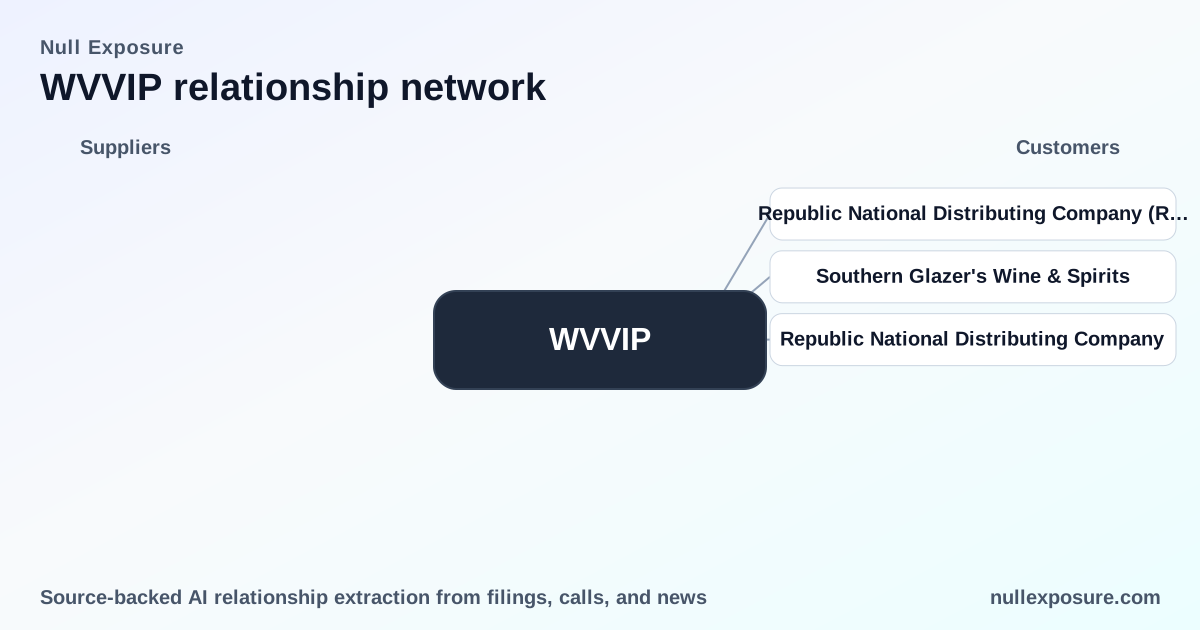
WVVIP: East‑Coast Distribution Reset Reframes Revenue Risk
Willamette Valley Vineyards (WVVIP) sells premium and super‑premium wines through two distinct channels: direct retail (tasting rooms, wine clubs, e‑commerce) and third‑party distributor sales. The company monetizes by capturing higher margins from direct channels while relying on wholesalers for scale in distant, high‑volume markets; distributor sales accounted for roughly 46.6% of revenue in 2024, and a single distributor historically represented about 16.1% of revenue, underlining both the importance and concentration of wholesale relationships. For investors, the March 2026 East‑Coast redistribution—shifting New York/Mid‑Atlantic to RNDC and Pennsylvania to Southern Glazer’s—is a deliberate commercial move to increase shelf presence and drive volume in critical markets, but it also concentrates operational exposure in two national wholesalers. Learn more about how these partner choices change distribution economics at the company level at https://nullexposure.com/.
Why the East‑Coast change matters for owners and operators
Willamette Valley has a two‑segment operating model: direct sales with higher margin capture and distributor sales that deliver scale and geographic reach. The March 2026 reorganization reallocates representation on the East Coast to two of the industry’s largest wholesalers, a strategic pivot designed to accelerate penetration where WVV’s brand has underperformed relative to West Coast distribution. This is a scale‑seeking move that trades some margin control for broader retail access and a simpler go‑to‑market in dense population centers.
In practical terms, aligning with national distributors streamlines logistics, reduces trade friction, and places WVV on more retail resets and restaurant lists faster than many smaller brokers can achieve. That increased velocity should lift top‑line growth if shelf allocation, pricing and on‑premise programming follow.
Two distribution partners now anchor East‑Coast expansion
Republic National Distributing Company (RNDC)
Willamette Valley assigned New York State and the Mid‑Atlantic distribution to RNDC to take advantage of RNDC’s substantial warehousing and retail coverage in highly competitive markets. According to the company press release distributed via PR Newswire and repeated in Seeking Alpha’s March 10, 2026 announcement, WVV explicitly aligned New York and the Mid‑Atlantic with RNDC to enhance consumer reach and brand presence on the East Coast. (PR Newswire / Seeking Alpha, March 2026)
Southern Glazer’s Wine & Spirits
The company transitioned Pennsylvania representation to Southern Glazer’s effective immediately as part of the same East‑Coast redistribution, positioning Southern Glazer’s trade relationships and restaurant channel strength to boost point‑of‑sale activity in that state. This change was disclosed in the March 10, 2026 corporate release and covered in syndicated financial news. (PR Newswire / Seeking Alpha, March 2026)
What every relationship here means for WVVIP investors
- Distribution concentration is real and relevant. Distributor sales are a critical revenue stream and the company has historically relied on a handful of major partners to reach distant markets. The March 2026 pivot centralizes East‑Coast distribution with two dominant wholesalers rather than multiple smaller brokers.
- Operational posture is transactional but strategic. WVV sells as the supplier; it contracts wholesalers to handle logistics, retail placement and trade execution. That contracting posture reduces capital intensity for WVV but increases execution dependency on partners’ sales operations.
- Maturity and segmentation are distinct. WVV’s operating model deliberately separates direct and distributor segments, a signal of organizational maturity: management understands the different margins, KPIs and channel priorities for each route to market.
Company‑level constraints that shape the relationship profile
The public record and recent filings show firm‑level characteristics that constrain partner value and risk:
- Geographic reach is national but export scale is tiny. The company’s products are distributed in 49 states plus D.C., with only two non‑domestic customers; this is a domestic‑first business where U.S. wholesaler relationships determine near‑term growth.
- Revenue concentration elevates counterparty importance. In 2024 one distributor represented approximately 16.1% of revenue and distributor/wine broker sales contributed about 46.6% of revenue; this makes distributor performance a material driver of cash flow and inventory turnover.
- Relationship role is seller‑led and active. WVV operates as the seller with two active operating segments—direct and distributor—indicating ongoing, operationally mature relationships rather than ad‑hoc or passively licensed arrangements.
- Segment divergence requires dual commercial playbooks. Management treats direct sales and distributor sales as separate operating segments, so success with RNDC and Southern Glazer’s will be measured by wholesale KPIs (case velocity, placement, price realization) rather than tasting‑room metrics.
Risks and upside investors must weigh
- Upside: The two wholesalers are national category leaders with the distribution muscle to accelerate trial and retail penetration in dense East‑Coast markets; successful execution should increase revenue and volume, improving fixed‑cost absorption for the wineries and potentially lifting gross margin over time as volume scales.
- Risk: Concentration into major wholesalers transfers execution risk—pricing pressure, allocation decisions, or national promotional programs run by RNDC or Southern Glazer’s can materially affect WVV’s realized price and inventory cadence. The 16.1% single‑distributor historical concentration is a reminder that a single partner’s decisions can disproportionately affect results.
Key operational risks to monitor in upcoming quarters include changes in distributor inventory turns, on‑premise listing counts, and any shifts in trade promotion intensity that compress net realized prices.
Practical metrics investors and operators should watch next
- Quarterly distributor revenue and case volume trends in New York, Mid‑Atlantic and Pennsylvania.
- Trade promotion spend as a percentage of wholesale revenue (if disclosed) or implied via gross margin movement.
- Placement and listing notices from RNDC and Southern Glazer’s trade reports and local distributor catalogs.
- Direct sales trends (tasting room and club metrics) to see if channel mix shifts toward wholesale dilute margin recovery.
Bottom line: a step toward scale with concentrated counterparty exposure
The March 2026 redistribution is a clear commercial decision: Willamette Valley Vineyards is trading broader broker diversity for the coverage and execution horsepower of RNDC and Southern Glazer’s in high‑value East‑Coast markets. That trade improves access and the potential for volume growth but raises counterparty concentration and execution dependence—factors investors must price into valuation and operational risk models. For a concise briefing on how partner concentration affects small‑cap consumer brands, consult our coverage at https://nullexposure.com/.
Investor takeaway: this move strengthens WVV’s pathway to scale in priority markets, but it also increases the importance of wholesale execution metrics—and therefore short‑term revenue volatility tied to two major distributors.