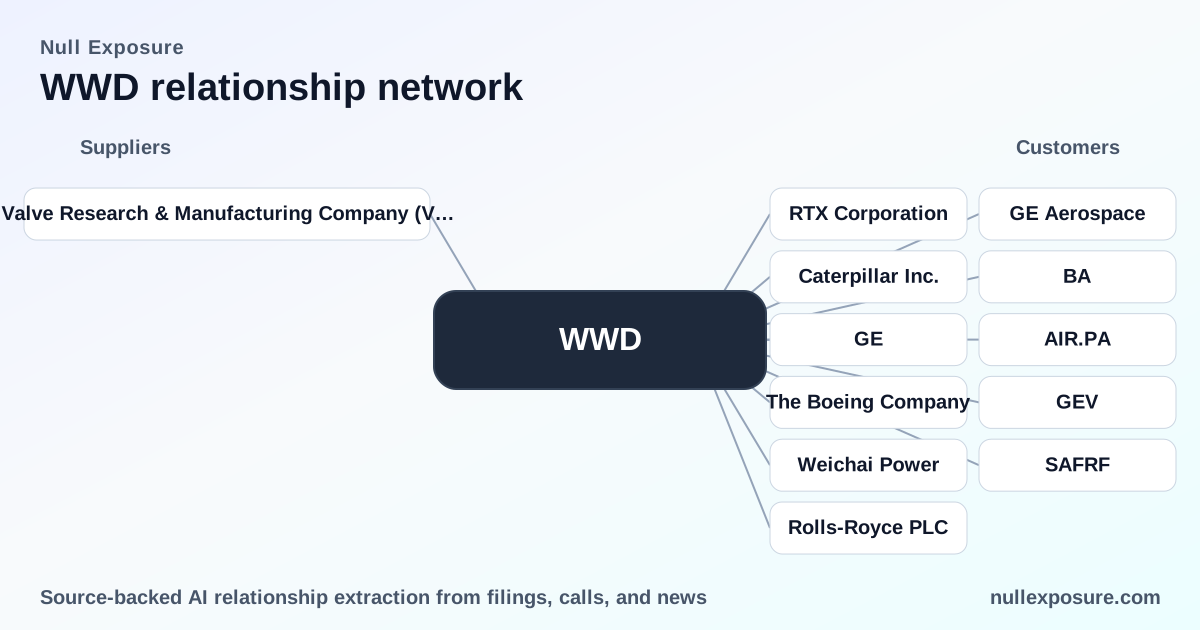
Woodward Inc. (WWD): Customer Map and Commercial Risk Profile
Woodward designs, manufactures, and services control solutions for aerospace and industrial customers and monetizes through the sale of manufactured products, aftermarket MRO, and services — with manufactured hardware representing the large majority of revenue. The company sells both directly and through long-term supply arrangements to OEMs, government entities, and distributors, and captures recurring aftermarket revenue via maintenance and service contracts.
For a concise portal to the source material and relationship data, visit https://nullexposure.com/.
What investors need to know up front
Woodward’s commercial model is OEM-plus-aftermarket: the firm sells engineered components and integrated systems to aircraft and industrial original equipment manufacturers, then monetizes installed base economics through MRO and services. Manufactured products account for roughly 81% of revenue, with MRO and services comprising the balance, making Woodward a capital-intensive supplier with an embedded aftermarket annuity stream. The company operates globally and combines direct principal sales with distribution partners, producing a mix of concentrated OEM exposure and diversified geographic demand.
Key operating signals: long-term supply posture, material government exposure, top-customer concentration at the portfolio level, and a predominantly hardware-driven business with an attached services franchise. See company-level evidence below.
Explore the company overview and documents at NullExposure.
Company-level constraints and what they imply
- Contracting posture — long-term supplier relationships. Woodward recognizes revenue on customer arrangements often within long-term supply frameworks, indicating contracts and purchase-order predictability and a supplier role that carries inventory and pricing discretion. (Source: Woodward FY2025 Form 10‑K.)
- Government exposure is material. Sales directly to or through U.S. government channels represented 20% of sales in FY2025 (17% in FY2024), which makes government programs an important demand vector and potential source of programmatic risk or stability, depending on budget cycles. (Source: Woodward FY2025 10‑K.)
- Geographic reach is global with regional pockets of strength. Woodward operates production and assembly in the U.S., Europe and Asia, and cites demand increases led by North America, Middle East, and Asia in FY2025 — signaling geographically diversified end-markets. (Source: Woodward FY2025 10‑K.)
- Concentration and materiality co-exist. While Woodward reports no single customer accounted for ≥10% of consolidated net sales in FY2025 or FY2024, the top five customers still represented ~36% of consolidated net sales in FY2025, a meaningful concentration that requires active account management. (Source: Woodward FY2025 10‑K.)
- Business mix is hardware-first with services attached. Manufactured products dominate revenue (reported 81%), with MRO and services forming a smaller but strategic portion of recurring revenues. This structure amplifies capital and execution risk on production while offering aftermarket margin resilience. (Source: Woodward FY2025 10‑K.)
- Role: principal seller and service provider. Woodward acts as the principal in transactions (sets prices, bears inventory risk) and also provides repair, maintenance and replacement services for its installed base. (Source: Woodward FY2025 10‑K.)
Relationship roll call — what each customer or partner means for investors
Below are every relationship identified in Woodward’s customer scope data, each with a concise, sourced description.
RTX Corporation
Woodward’s 10‑K lists RTX as a customer that accounted for more than 10% of net sales at the reportable-segment level for Aerospace in FY2025; historical disclosure shows RTX accounted for 10% of consolidated net sales in FY2023, indicating multi-year OEM significance. (Source: Woodward FY2025 Form 10‑K.)
The Boeing Company
Boeing is cited among aerospace customers that exceed 10% of segment net sales in FY2025 and is discussed repeatedly in earnings dialogue about aircraft production rates and initial provisioning demand — making Boeing a strategic OEM for Woodward’s aerospace systems. (Source: Woodward FY2025 10‑K; Q1 FY2026 earnings call transcript.)
Weichai Power
Weichai Power is listed among industrial customers in the 10‑K, reflecting Woodward’s exposure to engine and power-generation OEMs in APAC and other industrial markets. (Source: Woodward FY2025 Form 10‑K.)
GE
Woodward reports that sales to GE represented 12% of consolidated net sales for the year ended September 30, 2023, underscoring historical materiality of that relationship for consolidated revenue. (Source: Woodward FY2025 Form 10‑K.)
GE Aerospace
GE Aerospace appears specifically as a customer accounting for 10%+ of Aerospace segment net sales in FY2025, confirming continued OEM dependency on GE platforms for Woodward’s fuel, air and motion control products. (Source: Woodward FY2025 Form 10‑K.)
Caterpillar Inc.
Caterpillar is named among the Industrial segment’s larger customers, indicating exposure to heavy equipment and power systems demand cycles. (Source: Woodward FY2025 Form 10‑K.)
Rolls‑Royce PLC
Rolls‑Royce PLC is identified as a material Industrial customer and reflects Woodward’s participation in large turbomachinery and marine markets. (Source: Woodward FY2025 Form 10‑K.)
AIR / AAR Corp. (AIR)
AAR Corp. became Woodward’s multi‑year preferred distributor for high-demand consumable parts (filters, gaskets, seals) for engines like CFM LEAP, GEnx and CF34, shifting some commercial distribution to a single partner and expanding airline direct-servicing channels. (Source: PR Newswire / AAR press release, May 2026.)
AAR CORP.
Business media and company press also covered the AAR distribution agreement, confirming the same strategic distribution partnership and its expected role in aftermarket reach to commercial airlines. (Source: Business Insider / Markets press coverage, May 2026.)
Ontic Engineering and Manufacturing
Woodward agreed to sell its pilot controls product line to Ontic, transferring manufacturing of throttle quadrants, rudder pedals and related products — a strategic divestiture to refocus resources. (Source: InsiderMonkey news summary; local reporting cited in May 2026 press.)
ontic Engineering and Manufacturing Inc.
Local press coverage described the Niles, Illinois manufacturing assets included in the sale to ontic, reinforcing the operational de‑risking and portfolio simplification rationale behind the transaction. (Source: Loveland Reporter‑Herald / regional press, May 2026.)
Ontic Engineering
Multiple news outlets reported the sale of the pilot controls unit to Ontic, which Woodward positioned as a mutually beneficial move to refocus capital and management attention. (Source: Investing.com / company news coverage, May 2026.)
Ontic
Executives referenced the Ontic sale on recent earnings calls, pointing to the transaction as a way to redeploy resources toward higher‑priority aerospace and industrial systems. (Source: Woodward FY2026 earnings transcript, May 2026.)
Airbus
Airbus is discussed in Woodward’s earnings context with respect to production rates and new program ramp (A350 spoiler actuation systems), indicating Woodward supply exposure to Airbus platforms and program timing risks/opportunities. (Source: Q1 FY2026 earnings transcript; Alphastreet coverage, Mar 2026.)
BA (ticker BA)
Earnings commentary references Boeing (BA) production rates explicitly, signaling the direct link between OEM assembly pace and Woodward’s initial provisioning and aftermarket follow‑on sales. (Source: Q1 FY2026 earnings transcript; Alphastreet, Mar 2026.)
Boeing (alternate entry)
A separate entry reiterates Boeing’s role in delivery cadence and production-rate sensitivity for Woodward’s aerospace revenue flows. (Source: Woodward FY2025 10‑K / Q1 FY2026 call.)
GEV / GE Vernova
GE Vernova appears in the industrial customer roster, reflecting demand from energy-focused GE businesses for Woodward’s industrial control systems. (Source: Woodward FY2025 Form 10‑K.)
GE Vernova
Confirmatory listing of GE Vernova in the industrial customer set, underscoring overlap with broader GE relationships. (Source: Woodward FY2025 10‑K.)
Safran
Woodward announced the acquisition of Safran’s electromechanical actuation business, indicating both a competitive and acquisitive relationship that expands Woodward’s product footprint in actuation systems. (Source: Woodward FY2025 Form 10‑K.)
SAFRF
The tickered reference to Safran (SAFRF) appears in the same acquisition disclosure, providing the corporate context for the strategic asset purchase. (Source: Woodward FY2025 10‑K.)
Investment implications and final read
- Concentration with diversification: Woodward balances not having a single >10% consolidated customer in FY2025 against a top‑five concentration (~36%), making account-level execution and program continuity key earnings drivers. (Source: Woodward FY2025 10‑K.)
- Aftermarket optionality, but hardware risk dominates: The 81% manufactured-products weighting amplifies execution and capacity risks but also provides a recurring MRO runway. (Source: Woodward FY2025 10‑K.)
- Government business is material and stabilizing: With government‑related sales at 20% of revenue in FY2025, program funding cycles and regulatory dynamics are an immediate monitorable risk/benefit. (Source: Woodward FY2025 10‑K.)
- Recent portfolio moves reallocate risk: The sale of the pilot controls unit to Ontic and the AAR distribution deal both de‑risk certain manufacturing footprints and extend aftermarket reach via a distribution partner, shifting the operating model in ways investors should track for margin and cash conversion impacts. (Source: Press releases and earnings commentary, May 2026.)
For a centralized view of the relationship mappings, filings, and press coverage used in this review, visit https://nullexposure.com/.