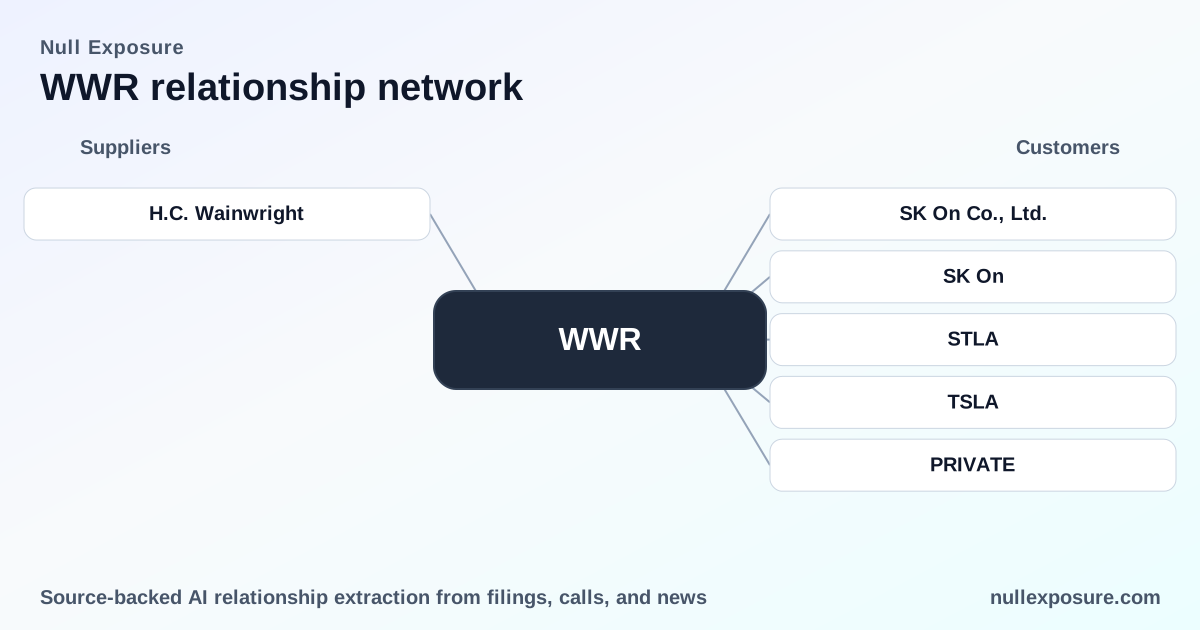
Westwater Resources (WWR) — How customer contracts define valuation upside and financing risk
Westwater Resources develops and plans to commercialize natural graphite anode materials from its Kellyton Graphite Plant in Alabama, monetizing through long‑term offtake and fines‑sales contracts with battery‑cell makers and industrial buyers; until commercial shipments commence, valuation depends on contract enforceability, project delivery and working‑capital access. For investors, the story is straightforward: the firm is a developer that sells processed graphite (seller of CSPG and fines), and its near‑term cash flow outlook is driven by the status and stability of a small set of commercial partners.
Learn more about how we track counterparty signals at https://nullexposure.com/
What the relationship map says about Westwater’s operating model
Westwater’s customer footprint conveys a clear operating posture. Contracts are structured long‑term and geographically focused on North America, reflecting an explicit strategy to supply U.S. battery plants and domestic industrial processors. The company’s public disclosures and call transcripts support that:
- Contracting posture — long‑term: Westwater negotiated multi‑year procurement/offtake arrangements that specify minimum purchase amounts and annual volumes, indicating a project finance and revenue model built on multi‑year commitments rather than spot sales. Evidence for this includes the 2024 Procurement Agreement with SK On and the July 2024 Offtake Agreement with FCA (Stellantis).
- Geography — North America concentration: Contracts tie Kellyton outputs to U.S. battery plants and U.S. processing facilities, which reduces export risk but increases exposure to U.S. EV OEM demand cycles.
- Materiality — critical to early production: Company statements indicate Phase I production capacity was largely pre‑committed by these deals, making a small number of customers critical to early revenue.
- Role and segment — seller in manufacturing supply chain: Westwater’s business is selling advanced graphite products (CSPG and fines) and the firm recognizes sales upon shipment, positioning it as a downstream raw‑material supplier to battery and steel/foundry inputs.
These are company‑level signals reinforced by contract excerpts and earnings commentary; they shape concentration and financing risk even before plant ramp.
Customer roll‑call: every counterparty mentioned in public sources
Below are concise, investor‑oriented summaries for every customer relationship referenced in the available reporting. Each entry cites the original public source.
SK On Co., Ltd. / SK On
Westwater executed a Procurement/Offtake Agreement with South Korea‑based SK On to supply up to 34,000 metric tons of natural graphite anode products over a multiyear period, intended to feed SK On’s U.S. battery manufacturing footprint. Subsequent public notices indicate SK On delivered termination notice effective March 31, 2026, creating a material loss of expected offtake. Source: MetalTechNews reporting on the 2024 agreement (Oct 29, 2025) and a TradingView item reporting the termination (reported 2026).
SK On (duplicate listings)
Multiple news reports repeat the same arrangement and the later termination notice; the consistency across outlets confirms the significance of SK On as a formerly contracted customer and the subsequent counterparty withdrawal. Source: MetalTechNews (2025) and TradingView (2026).
EU (enCore Energy Corp.)
In 2021 Westwater executed a Share Purchase Agreement selling its United States uranium assets to enCore Energy, representing a completed asset disposition rather than an ongoing supply relationship. This demonstrates Westwater’s willingness to transact non‑core assets as strategic moves to refocus on battery materials. Source: GlobeNewswire press release (Jan 5, 2021).
FCA US LLC
FCA US LLC (a Stellantis subsidiary) entered an offtake arrangement with Westwater in mid‑2024 intended to secure CSPG natural graphite anode volumes for 2026–2031; that agreement was subsequently terminated by FCA US LLC, increasing financing and commercialization risk for Westwater. Source: LeLezard reporting and the company’s earnings call commentary (Nov 3, 2025 termination, company commentary in early 2026).
Stellantis / STLA / Fiat Chrysler / Fiat Chrysler Automotive
Public commentaries and filings use variant names for the same Stellantis group counterparty: Stellantis (STLA), Fiat Chrysler and Fiat Chrysler Automotive. The company’s disclosures state an offtake with an FCA division that was later terminated; the termination has been repeatedly referenced in earnings commentary and market commentary noting incremental financing risk. Source: Marketscreener and the WWR earnings call (2025 Q3) plus LeLezard (2025).
Hiller Carbon
Westwater signed a Fines Offtake Agreement with Hiller Carbon for the majority of Kellyton’s fines capacity (graphite fines sold into pelletized steel/foundry feedstreams). As of the latest earnings call, management indicated the Hiller Carbon offtake remains in effect and is a core industrial buyer for Phase I output. Source: Company disclosures cited in LeLezard (2026) and the 2025 Q3 earnings call (March 2026).
PRIVATE (unnamed private buyer)
In earnings call remarks management referenced “another private” offtake remaining in effect alongside SK On and Hiller Carbon; this indicates at least one additional non‑public commercial arrangement but provides no public counterparty detail. Source: 2025 Q3 earnings call transcript (March 2026).
Tesla / TSLA
Press articles have referenced Tesla in the context of Alabama graphite benefiting U.S. automakers’ supply chains; these are market narratives about potential indirect exposure rather than a confirmed contractual relationship between Tesla and Westwater. No public offtake or procurement agreement with Tesla is recorded in the reporting set. Source: 1819 News coverage on Alabama graphite (Apr 2022).
TSLA (duplicate)
Duplicate reports repeat the same state‑level linkage about Alabama graphite and automakers, reinforcing that Tesla is a potential beneficiary in the supply chain narrative rather than an explicit customer to Westwater. Source: 1819 News (2022).
What investors should take away — risks and timing
- Concentration risk is high. A small number of large offtake partners historically covered a large share of Phase I capacity; terminations from major partners materially affect near‑term cash flow and financing.
- Contract terms were long‑term and U.S.‑focused, which supports project financing once contracts stick, but the recent counterparty terminations reveal execution and counterparty risk.
- Industrial fallback exists via Hiller Carbon and other fines buyers, which mitigates but does not eliminate the gap left by battery‑cell OEM terminations.
- Operational maturity is pre‑production. Revenue recognition occurs on shipment; to realize contracted revenue Westwater must complete ramp and satisfy product specs—milestone execution remains the primary value driver.
If you want structured, continuously updated counterparty risk analytics and alerts on these relationships, visit https://nullexposure.com/ for coverage and monitoring.
Final read
Westwater’s path to revenue is clear in structure: manufacture advanced graphite, fulfill long‑term offtakes, and sell fines to industrial processors. The investment thesis is therefore a classic project‑developer trade: upside from contract monetization and plant ramp, balanced by high concentration of counterparties and recent terminations that elevate near‑term financing risk. Investors must watch the status of remaining offtakes, any replacement contracts, and milestone execution at Kellyton for the next meaningful change in valuation.