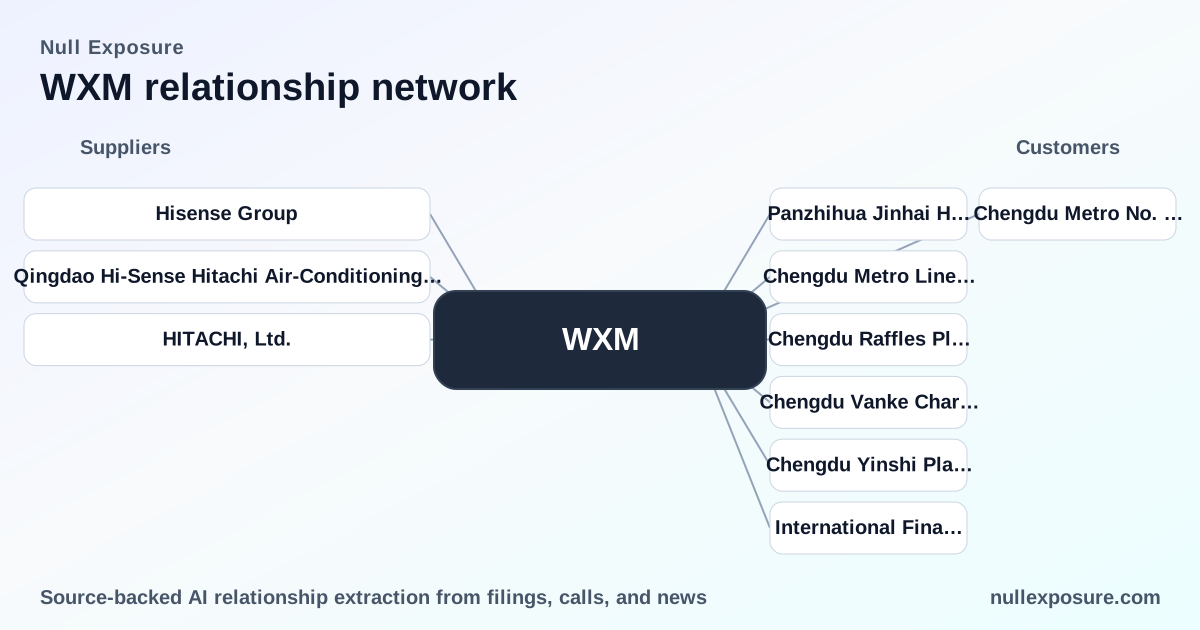
WF International (WXM): Customer Footprint and Commercial Readiness
WF International Limited operates as a China-focused HVAC and water/ventilation systems contractor that monetizes through project revenue from supply, installation, fitting-out, and ongoing maintenance for real estate and infrastructure clients. The company wins discrete commercial and landmark projects across China, invoices project milestones, and retains aftermarket maintenance contracts that produce recurring service revenue; its earnings profile today is project-weighted with high gross concentration in developer and landmark contracts. For a concise view of client counterparties and what they imply about revenue stability and operational risk, continue reading or visit https://nullexposure.com/ for more coverage.
What the customer list says about how WXM runs its business
WF International’s disclosed customer names are consistent with a project-based contracting posture: flagship real estate developments, a metro line, and hospitality clients dominate public mentions. The company’s fiscal picture — revenue of $13.40M TTM, gross profit of $1.17M, operating margin of -54.5%, and net loss per share of -$0.58 — shows a small-scale integrator with thin gross margins and negative operating leverage, where a handful of mid-sized projects materially influence results. Insider ownership is high (53.7%) and institutional ownership is negligible (0.6%), indicating founder/insider control and limited external analyst coverage, a structural factor for liquidity and governance.
- Contracting posture: project execution plus maintenance; cash and margin volatility tied to project cadence.
- Concentration: portfolio references to landmark projects indicate revenue concentrated in developer and infrastructure wins rather than diversified mass-market contracts.
- Criticality to clients: HVAC and ventilation are essential to building operations, giving WXM bargaining leverage on maintenance but limited pricing power on large developers.
- Maturity: limited scale, negative margins, and small market capitalization (~$4.8M) mark an early-stage or turnaround profile rather than a mature contractor.
Customer roll call — who WF International serves (and what it means)
Below are every customer relationship mentioned in the collected coverage, with a plain-English summary and the cited source.
- International Finance Squares — WF International lists International Finance Squares among its landmark real estate clients, indicating participation in large-scale commercial developments across China; this is representative of the company’s positioning in high-profile developer projects (Globe and Mail press release, Mar 10, 2026; Yahoo Finance SG, Mar 10, 2026).
- Chengdu Vanke Charm City — The company has delivered HVAC installations for Chengdu Vanke Charm City, a major residential/commercial development, underscoring reliance on national and regional property developers for project revenue (Globe and Mail press release, Mar 10, 2026; TipRanks, May 4, 2026).
- Chengdu Raffles Plaza — WF International identifies Chengdu Raffles Plaza among completed installations, reflecting exposure to mixed-use retail-office schemes where system reliability and deadlines are contract-critical (Globe and Mail press release, Mar 10, 2026; Yahoo Finance SG, Mar 10, 2026).
- Chengdu Yinshi Plaza — Listed as another landmark installation, Chengdu Yinshi Plaza reinforces the pattern of mid-size to large urban projects forming the backbone of WXM’s backlog (Globe and Mail press release, Mar 10, 2026; Yahoo Finance SG, Mar 10, 2026).
- Chengdu Metro Line 10 (Chengdu Metro No. Ten Line) — The company reports involvement with Chengdu Metro Line 10, signalling participation in public infrastructure where standards, testing, and scheduling discipline are heightened and payments are often milestone-driven (Globe and Mail press release, Mar 10, 2026; TipRanks, May 4, 2026).
- Panzhihua Jinhai Hotel — WF International includes Panzhihua Jinhai Hotel among hospitality projects, revealing some exposure to hotel operators and the service-sector maintenance market that supports recurring aftermarket work (Globe and Mail press release, Mar 10, 2026; Yahoo Finance SG, Mar 10, 2026).
- Wanhua Group (Luyuejiang City project) — WF International announced completion of an HVAC project valued at approximately $850,000 for Luyuejiang City, an eco-luxury development by Wanhua Group in Chongqing, a disclosed contract size that signals the firm’s ability to deliver mid-six-figure installations (Investing.com and related press coverage, May 4, 2026).
What these relationships imply about revenue quality and risk
These customer names together create a clear commercial profile: WXM is a small contractor that wins selective, mid-size to landmark projects with the potential for recurring maintenance revenue, but its scale and current losses leave earnings subject to execution risk. The presence of both private developers and a metro line suggests a mix of commercial and public counterparty risk: payment timing and contractual remedies will be a primary driver of cash conversion.
Key risk signals from company financials:
- Negative operating margin (-54.5%) and net loss indicate the firm is not generating operating profits from current revenue scale.
- Revenue concentration risk: repeated naming of landmark projects signals dependence on a relatively small number of clients and projects within a short time horizon.
- Limited institutional support and small market cap (~$4.8M) reduce the company’s access to capital markets and public liquidity to finance growth or bridge timing-of-payments shortfalls.
Operational takeaways for investors and operators
- Project cadence matters more than headline backlog: given slim margins, missed project milestones or cost overruns will rapidly flow to the bottom line. Monitor project completion notices and specific contract values (like the $850k Wanhua job) for signals of revenue sustainability.
- Aftermarket maintenance is the value lever: converting installations into long-term service contracts will materially stabilize cash flow given the project-driven top line.
- Governance and liquidity are strategic constraints: high insider ownership and low institutional interest mean corporate actions and financing require insider alignment or a private capital solution.
For a focused, data-driven primer on counterparty exposures and operational constraints, see our main research hub at https://nullexposure.com/.
Bottom line for investors
WF International sells essential building systems to developers and infrastructure operators and converts those wins into project revenue and potential maintenance streams. Its customer list confirms a project-heavy commercial model with access to mid-size contracts and landmark jobs; however, current scale, negative margins, and concentration present material execution and liquidity risk. Investors should prioritize contract-level disclosure, payment milestones, and any announcements converting installations into recurring service agreements when evaluating the risk-reward profile.
For continued monitoring of WXM client disclosures and to receive comparable customer-mapping research across small-cap industrials, visit our research center at https://nullexposure.com/.