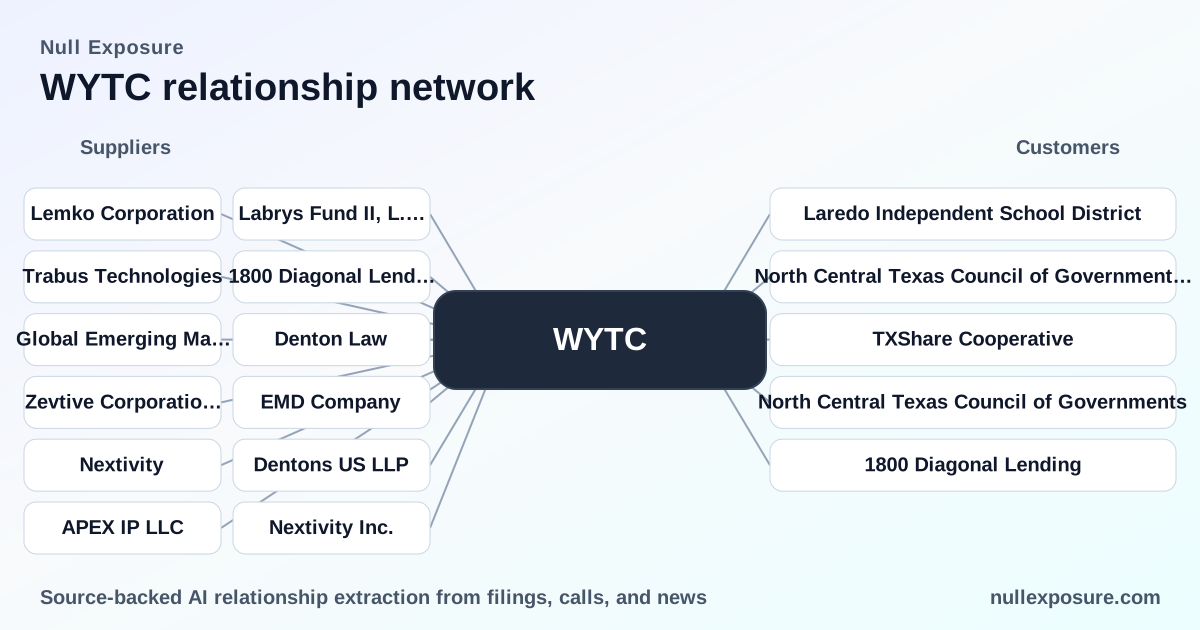
WYTC: Customer Map, Concentration Risks, and Where Revenue Really Comes From
Wytec International (WYTC) designs, manufactures and installs carrier-class wireless and in‑building cellular systems and monetizes through equipment sales, installation contracts, recurring maintenance and short-term support agreements, plus channel-driven deployments under Master Service Agreements (MSAs). The company combines direct hardware sales with monthly network service revenue and leverages cooperative purchasing vehicles to scale distribution to public-sector customers. For deeper sourcing and relationship tracking, visit https://nullexposure.com/.
Executive thesis — how Wytec makes money and why customers matter
Wytec’s revenue model is a hybrid hardware + services mix: one-time recognition on equipment and installation paired with recurring network services and renewable maintenance contracts. Sales are routed through MSAs and channel partners into government and public‑sector buyers, concentrating revenue into a small set of large counterparties. This structure creates high gross-margin upside on scale but significant counterparty concentration and execution risk given the firm’s current revenue profile.
Company-level signals that shape operating risk and upside
- Contracting posture: Wytec runs both short-term support agreements (typically one year) and long-term renewable maintenance arrangements that extend revenue lifecycles beyond installation. This combination produces discrete upfront revenue with a modest recurring base.
- Customer concentration: The company reported two customers accounting for ~89% of 2024 revenue and ~88% of 2023 revenue, flagging extreme concentration and outsized counterparty impact on results.
- Counterparty mix: Evidence shows Wytec sells primarily to government entities and large enterprises, using public‑sector channels such as cooperative purchasing programs.
- Product mix: Wytec is both manufacturer and seller of wireless equipment — revenues in 2024 included ~$77k from equipment and ~$26k from network/services — creating a dependency on both product deployment and ongoing service delivery.
- Contract size and maturity: Disclosed revenue bands imply mid-sized contracts ($100k–$1M) and active performance obligations are small in the near term (aggregate remaining obligations ~ $7,149 next year), signaling that many contracts are either completed or short-duration.
- Geography and program exposure: The company participates in FCC‑registered link programs (70/80 GHz) and U.S. civic marketplaces, suggesting North America‑centric public-sector opportunity.
These signals imply a business that can scale rapidly via MSAs and channel partners, but remains vulnerable to a small number of customers and to successful execution of cooperative‑sales channels.
Customer relationships, one by one
Below are every customer relationship surfaced in filings and news coverage; each entry has a concise, plain‑English summary and the cited source.
-
Laredo Independent School District
Wytec responded to an RFP from Laredo ISD for in‑building cellular enhancement solutions in October 2019, indicating early engagement with K‑12 districts for facility deployments. Source: Wytec 10‑K filing (FY2024). -
TXShare Cooperative
Wytec signed an RFP/MSA arrangement tied to the TXShare Cooperative, enabling access to more than 200 cities, counties, transportation authorities, police departments and ISDs through channel partners and an online bid calculator used to pre‑qualify members. Source: Wytec press release on Yahoo Finance (March 2026) and Wytec investor materials (FY2025 disclosures). -
North Central Texas Council of Governments (NCTCOG) — MSA partner
Wytec has a Master Service Agreement with NCTCOG that covers a broad Civic Marketplace of municipalities and public agencies and supports pilot tests and scaled rollouts of Wytec’s solutions. Source: Wytec press releases on Yahoo Finance (March 2026) and related GovTech coverage (May 2026). -
Judson Independent School District (San Antonio area)
Judson ISD is among roughly 46 Texas school districts that expressed interest in Wytec’s AI‑powered gunshot detection and related safety solutions, representing localized demand in the San Antonio metro. Source: GovTech / Insider coverage (May 4, 2026). -
North East Independent School District (San Antonio area)
North East ISD is listed among the same group of Texas districts expressing interest in Wytec’s safety solutions, signaling multi‑district interest within a single metro and potential bundled procurement. Source: GovTech / Insider (May 4, 2026). -
Southside Independent School District (San Antonio area)
Southside ISD likewise joined the cohort of school districts engaged with Wytec offerings, reinforcing district‑level penetration in San Antonio. Source: GovTech / Insider (May 4, 2026). -
1800 Diagonal Lending
Wytec issued a promissory note under a Securities Purchase Agreement with 1800 Diagonal Lending on March 3, 2026 — a financing transaction in which a $71,300 face note was sold for $62,000 after discounts and one‑time charges. This relationship is a creditor/financing counterparty rather than an operational customer. Source: TradingView summary of the March 3, 2026 Securities Purchase Agreement. -
North Central Texas Council of Governments (NCTCOG) — Pilot and Civic Marketplace mention
In addition to the MSA, Wytec positioned a pilot test with the NCTCOG Civic Marketplace, which it describes as including 90,000+ Civic Marketplace members (cities, counties, transit authorities and ISDs) — a channeling mechanism for scaling deployments through cooperative purchasing. Source: Wytec press release on Yahoo Finance (March 2026).
What these relationships mean for investors
- Concentration risk is the dominant financial variable. Two customers generated nearly all revenue in recent years, creating binary outcomes if one relationship alters procurement or payment behavior. That concentration elevates headline volatility relative to revenue scale.
- Public‑sector channels are the distribution lever. MSAs with NCTCOG and entry into the TXShare Cooperative convert Wytec from direct sales cycles into channel and cooperative purchasing playbooks, accelerating potential penetration but requiring channel orchestration and compliance capabilities.
- Revenue mix drives valuation sensitivity. Equipment sales produce upfront revenue spikes; support and maintenance contracts produce modest recurring cash flow. The combination offers upside on repeatable deployments but limits predictable recurring revenue until maintenance contracts scale. Wytec reported ~$77k in equipment revenue and ~$26k in network/service revenue in 2024.
- Contract tenor and obligations are mixed. Typical support agreements are one year, but the company also reports renewable long‑term maintenance arrangements; aggregate remaining performance obligations are relatively small near term (~$7k), suggesting many contracts are either completed or short‑term in nature.
Bottom line for allocators
Wytec’s customer footprint shows a clear commercial strategy: target public‑sector buyers via MSAs and cooperatives, sell hardware and follow with recurring service agreements, and scale through channel partners. That strategy delivers rapid market access but concentrates execution risk in a handful of counterparties and requires discipline on margin management and contract renewal economics. For institutional investors evaluating WYTC, the critical metrics to watch are customer diversification, renewal rates on maintenance contracts, channel conversion rates through TXShare/NCTCOG, and any material shifts in the handful of large customers that have historically driven most revenue.
For a consolidated view of Wytec’s evolving customer relationships and to subscribe to ongoing monitoring, visit https://nullexposure.com/.