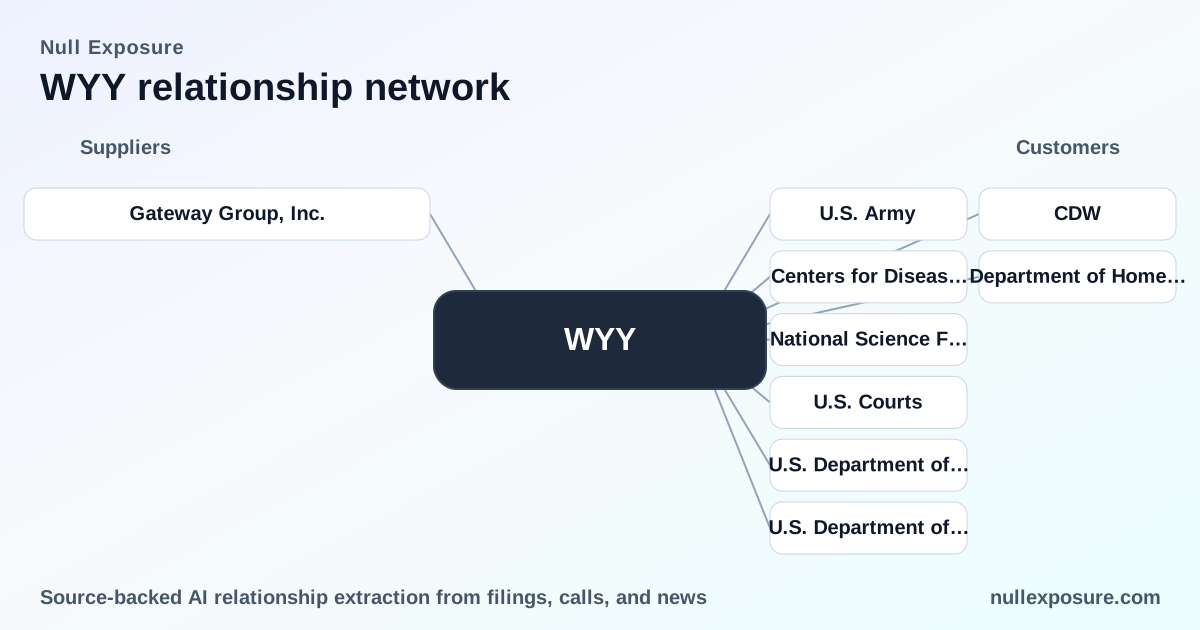
WidePoint (WYY) — Customer Map and Commercial Implications for Investors
WidePoint monetizes by selling technology management services — primarily Trusted Mobility Management (TM2) and related managed mobility and ITMS (IT Management Services) platforms — to government agencies and large enterprises. Revenue derives from multi-year service contracts, subscription-style SaaS deployments (FedRAMP-authorized ITMS), and task orders executed under federal ID/IQ vehicles, with the Department of Homeland Security and other federal customers representing the bulk of billings. For investors, the thesis is simple: WidePoint is a niche managed-services contractor with high revenue concentration in U.S. federal programs and revenue durability built on multi-year contracts — but with single-client concentration that drives both value and risk. For a full customer map and analytic products, see https://nullexposure.com/.
How WidePoint’s customer model generates cash
WidePoint operates as a service provider: it implements, hosts and operates mobility and device-management platforms for large customers, bills on contract schedules and earns follow-on support and device services (activation, repair, replacement, compliance). Most commercial value is derived from recurring services and government task orders that run three-to-five year base terms with annual option years, which creates predictable revenue cadence but also front-loads the company’s exposure to renewal competitions. Company filings show significant geography concentration in North America and a corporate mix skewed toward federal counterparty engagements.
Key operating characteristics to track:
- Contracting posture: Multi-year base terms with option years; many contracts are firm fixed-price not-to-exceed arrangements.
- Concentration: Extreme revenue exposure to federal clients, notably DHS (historically ~79% of revenue in 2024).
- Criticality: Government customers are mission-sensitive; loss or disruption of a major federal contract would be material.
- Maturity & renewal risk: Material contracts are cyclical and subject to competitive recompetes (DHS CWMS 2.0 IDIQ renewal was a disclosed near-term risk).
Customer roster — who WidePoint serves (each relationship in the record)
U.S. Army — FY2026 award for managed mobility and paging
WidePoint will provide the U.S. Army with a secure alphanumeric paging system together with wrap-around managed mobility services, including activation/deactivation, on-site programming, repair/replacement, billing for lost/damaged pagers, infrastructure maintenance, and security/compliance functions. This engagement was reported in March 2026 via a news aggregation feed. (Source: intellectia.ai news capture, March 2026.)
Centers for Disease Control and Prevention — FY2020 option activity
WidePoint disclosed option exercises for Managed Mobility Services by the CDC as part of a broader set of federal option activations, reflecting the company’s historical engagement with federal public-health agencies under TM2 contracts. The detail comes from a July 2020 GlobeNewswire press release announcing more than $42 million in federal TM2 contract activity. (Source: GlobeNewswire, July 2020.)
National Science Foundation — FY2020 option activity
The National Science Foundation exercised options for Managed Mobility Services under WidePoint’s TM2 arrangements, contributing to the company’s federal option activity disclosed in mid-2020. The disclosure was part of the same GlobeNewswire release describing multiple federal customers. (Source: GlobeNewswire, July 2020.)
U.S. Courts — FY2020 option activity
WidePoint reported that U.S. Courts exercised option contracts for Managed Mobility Services as noted in the company’s summer 2020 federal contract announcement; this underscores WidePoint’s footprint across diverse federal agencies. (Source: GlobeNewswire, July 2020.)
U.S. Department of Health and Human Services — FY2020 option activity
HHS was listed among the agencies exercising option contracts for Managed Mobility Services in the July 2020 release, indicating WidePoint’s access to health-sector federal spending through TM2. (Source: GlobeNewswire, July 2020.)
U.S. Department of Homeland Security Headquarters — FY2020 task orders and renewals
WidePoint cited task orders, renewals and extensions with DHS Headquarters and numerous DHS Components in the 2020 contract announcement, establishing DHS as a long-standing counterparty across CWMS and other vehicles. (Source: GlobeNewswire, July 2020.)
CDW (commercial integrator) — FY2025 platform usage
A Q3 2025 earnings-call transcript quoted WidePoint management saying that CDW will use WidePoint’s FedRAMP-authorized ITMS platform to manage devices for a major event (the Olympics), indicating a reseller/partner relationship where CDW relies on WidePoint’s platform capabilities. (Source: InsiderMonkey Q3 2025 earnings call transcript.)
U.S. Army — FY2025 Navy Spiral 4 task order
WidePoint announced a five-year task order awarded by the U.S. Army under the Navy Spiral 4 contract vehicle, with a one-year base and four optional one-year renewals; the public release characterized the award as another federal vehicle win. (Source: PR Newswire press release, FY2025.)
Department of Homeland Security — FY2025 SaaS contract with major telco
WidePoint secured a multi-year SaaS contract involving its FedRAMP-authorized ITMS Command Center platform that serves agencies such as DHS, in connection with a commercial telco engagement reported in 2025. This highlights both federal and commercial revenue paths through the same FedRAMP platform. (Source: QuiverQuant news item, FY2025.)
What the relationship map implies about risk and optionality
WidePoint’s customer set is deeply government-anchored and dominated by federal agencies. Company disclosures and the relationship records together convey several important investor-grade signals:
- Long-term contracting posture: The company’s revenue largely comes from 3–5 year contracts with option years, creating revenue visibility but also locking WidePoint into pricing and performance obligations.
- High concentration risk: DHS accounted for roughly 79% of 2024 revenue under the CWMS 2.0 ID/IQ contract, making the company’s topline sensitive to a small number of federal programs. (Company filing language referenced in company disclosures.)
- Geographic concentration: Revenue is predominantly U.S.-based (Mid-Atlantic federal customer base), limiting diversification by region.
- Materiality and criticality: The federal channel is material (company-level federal revenue in the hundreds of millions) and system-critical for agency operations, so performance and compliance matter more than in general commercial deals.
- Maturity / renewal dynamics: Some major contracts were up for renewal in late 2025 (disclosed DHS recompete risk), which directly links to the DHS relationship and introduces short-term execution risk in maintaining revenue levels.
Investment implications — what to watch next
- Contract renewals and recompetes (especially DHS CWMS 2.0) determine near-term revenue stability; management commentary and awarded task orders will move the stock more than broad market tech sentiment.
- Platform adoption via partners (e.g., CDW, telco arrangements) offers diversification upside if WidePoint can convert platform credentials (FedRAMP) into recurring SaaS rollouts beyond core federal customers.
- Margin leverage on firm-fixed-price work: Execution efficiency on these contracts will drive profitability given tight operating margins reported historically.
For a structured view of customer concentration and to monitor award activity tied to WidePoint’s revenue base, explore our product at https://nullexposure.com/.
Final take
WidePoint is a specialized federal contractor and managed-services operator with predictable contract mechanics but concentrated counterparty risk. The customer list spans multiple federal agencies and select commercial partners — the combination that creates high revenue durability when contracts are retained and material downside if a major ID/IQ or task-order pipeline shifts. Investors should evaluate upcoming recompete outcomes, task-order flow, and partner-led SaaS adoption as the primary drivers of value realization.