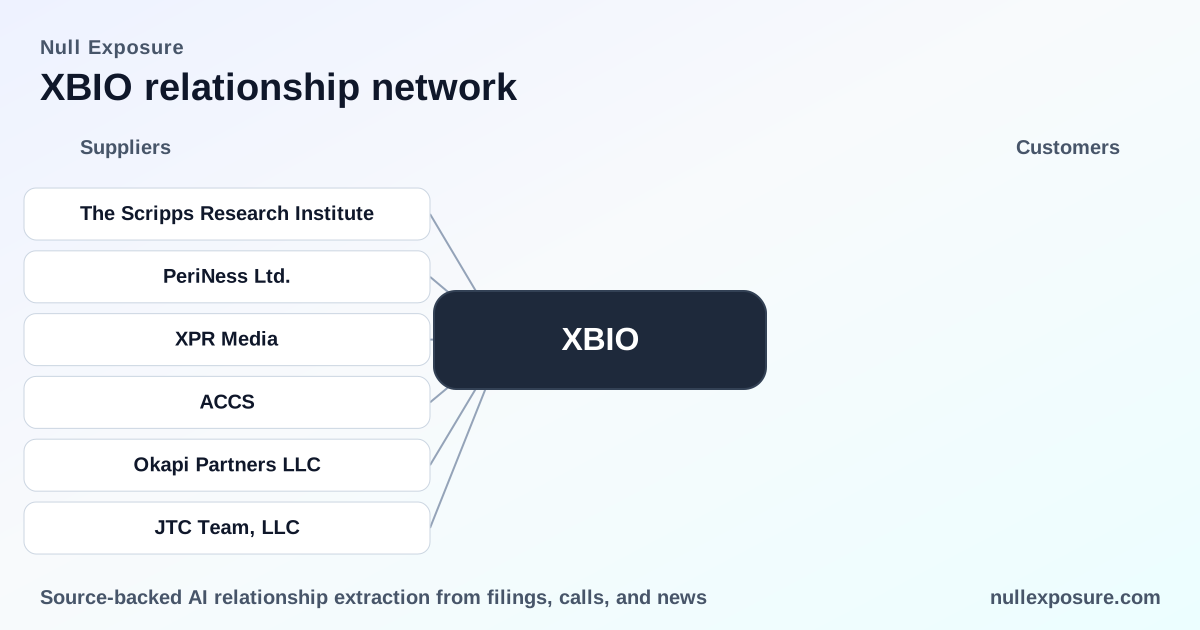
Xenetic Biosciences (XBIO): Partner royalties and long-term supply posture drive near-term cashflow
Xenetic Biosciences advances the XCART personalized CAR-T platform and monetizes primarily through strategic sublicenses and related royalty streams, alongside non-dilutive prepayments for clinical materials. The company's commercial cash generation today is concentrated in partner-driven royalties rather than product sales, while development programs and supply arrangements create multi-year cash and operational linkages to third parties.
For continued, structured coverage of XBIO partner relationships, see the research hub at NullExposure.
Why royalties, sublicenses and supply deals matter for an early-stage CAR‑T company
Xenetic is a small-cap biotech with a negative operating margin and limited current revenues; it therefore relies on licensing structures to convert R&D assets into recurring cash. Royalties from sublicenses represent the primary commercialized revenue line visible in public reporting, and prepayments or long-term supply contracts reduce near-term procurement risk while locking in partner commitment. This operating posture concentrates counterparty exposure: strong partners can supply predictable royalty cashflows, but a small number of counterparties creates single‑counterparty risk and revenue cyclicality.
A mid-article note: for broader relationship tracking and alerts on XBIO counterparties, visit NullExposure.
The Takeda relationship: a material royalty stream in FY2026
Takeda Pharmaceuticals Co. Ltd — Takeda operates under a sublicense arrangement with Xenetic that generated approximately $3.0 million in royalty revenue in the year ended December 31, 2025, up about 19% from $2.5 million in 2024. This stream is described as royalty receipts tied to Takeda’s sublicense territories, and it is clearly the most visible customer-sourced cash inflow reported for the period. According to a Bitget news report dated May 4, 2026, the increase was primarily due to royalty payments received from certain countries. (Source: Bitget news, May 4, 2026.)
Why this matters to investors: Xenetic’s reported Revenue TTM is about $2.98 million, so the Takeda royalty in FY2025 is not just meaningful — it is effectively equivalent to Xenetic’s entire trailing-12-month revenue base, underscoring concentration risk as well as the current commercial value of Xenetic’s IP. (Company financials, latest quarter 2025-12-31.)
What the relationship disclosures imply about contracting posture and criticality
- Contracting posture — partner-led and long-dated: Xenetic’s public disclosures show it uses sublicensing and prepayment structures rather than large-scale direct commercialization. The royalty flow from Takeda is a typical example of monetization through a partner sublicense rather than end-market sales under Xenetic’s own go-to-market activities.
- Concentration — high: Given that the disclosed Takeda royalty approximates Xenetic’s TTM revenue, counterparty concentration is a clear business risk; a change in Takeda’s activities or territory payments would materially affect near-term revenue.
- Criticality — material to liquidity: For an issuer with negative margins and constrained market capitalization, partner royalties and prepayments are critical to sustaining operations and funding development.
- Maturity — mixed: The presence of royalty receipts indicates some commercialization maturity, but R&D programs and reliance on sublicenses indicate the company remains early-stage overall.
These are company-level operating signals inferred from the relationship and financial profile rather than single-transaction conclusions.
Company-level constraint flagged in disclosures: long‑term supply prepayment
Xenetic disclosed a 2016 agreement with Serum Institute for prepayment of clinical polysialic acid (PSA) supply in exchange for common stock, and as of December 31, 2023 $0.7 million of prepaid clinical supply was classified as long-term because the company did not expect to use the majority of that supply within the next 12 months. This demonstrates a practice of converting supplier commitments into capital and shows a long-term contracting posture for key clinical inputs, which reduces short-term procurement risk but ties up upfront economic value. (Source: company disclosure referencing the 2016 agreement and December 31, 2023 classification.)
Do not conflate this signal with the Takeda royalty — the Serum Institute arrangement is a separate, named supply/prepayment relationship disclosed by the company.
Key investment takeaways and risks
- Positive: The Takeda sublicense produces recurring royalty cashflow that materially supports current revenue, lowering short-term financing pressure for Xenetic relative to peers with no commercialized partners. The company’s strategy to secure prepayments for clinical supply also reduces immediate supply risk.
- Negative: High counterparty concentration—one sizable royalty check approximates the company’s entire trailing revenue—creates earnings volatility and counterparty risk. Xenetic’s operating margins remain deeply negative, and market capitalization and institutional ownership are low, which constrains capital access in adverse scenarios (Company financials; latest quarter 2025-12-31).
- Operational: Long-term supply classifications signal prudent planning for clinical programs, but they also represent balance sheet commitments that will not convert to near-term revenue.
A concise risk checklist for operators and investors:
- dependence on a small number of licensing partners for cashflow;
- exposure to territory-by-territory royalty payment timing;
- limited diversification between royalty income, product sales, and other revenue sources.
What to watch next as an investor
- Quarterly updates that break down royalty geography and payment timing from Takeda will be the most direct signal of recurring revenue stability.
- Any amendments, sublicensing expansions, or new partner deals that diversify revenue away from a single counterparty will materially de-risk the name.
- Cash runway metrics and use of prepaid supply credits for upcoming clinical milestones will indicate whether the company’s contracting posture is buying time effectively.
Final read
Xenetic’s current revenue profile is partner-centric: meaningful royalties coupled with long-term supply commitments. That structure provides predictable, near-term cashflows but concentrates counterparty risk and leaves the company dependent on a small set of commercial relationships while it advances XCART development. For active monitoring of Xenetic’s partner cashflows and relationship signals, visit NullExposure.