XBiotech (XBIT): Customer relationships that shaped revenue history and the current runway
XBiotech is a small-cap biopharmaceutical company that discovers and commercializes True Human monoclonal antibodies and monetizes through a mix of one-off licensing/sale transactions, contract manufacturing and clinical services. The firm’s headline cash generation has been driven historically by a large license/asset sale and by providing manufacturing and clinical operations to larger pharmaceutical partners; recurring product revenue is currently immaterial. For an investor, the company’s commercial profile is defined by high-impact, episodic monetization events and a legacy services capability that has recently wound down. Learn more about how this analysis was assembled at https://nullexposure.com/.
How to read XBiotech’s customer footprint: operating model and constraints that matter
XBiotech operates as both an originator of therapeutic antibody assets and as a contract service provider when commercially useful. Several company-level signals explain how that translates into economics and risk for investors:
- Contracting posture — transactional and partnership-driven. Evidence shows XBiotech executes large licensing/sale deals for core assets and enters long-term supply and services agreements with larger pharmaceutical firms. These engagements deliver outsized cash when they close but do not produce steady, broad-based product revenue.
- Concentration — counterparty risk is elevated. The company has worked directly with world-scale pharmaceutical firms; a single large commercial or license transaction can dominate results and investor perception.
- Criticality — strategic but finite. XBiotech’s manufacturing and clinical operations were important to partners while agreements were active; once those contracts conclude, the strategic dependency falls away.
- Maturity and lifecycle — episodic and time-bound engagements. The company’s major supply and clinical contracts have been described as concluded by the end of 2023, implying a reversion from service-provider to asset-originator posture for commercial execution.
- Segment mix — core product value plus services. The firm’s monetization has historically combined a high-value asset sale (core product), manufacturing (drug product supply), and clinical services (trial operations).
These constraints indicate an operating model where revenue volatility and counterparty concentration drive both upside (large license proceeds) and downside (limited recurring sales).
The customer relationships on record — each mention, explained
Below I cover every relationship listed in the source results with a concise, plain-English summary and a source pointer.
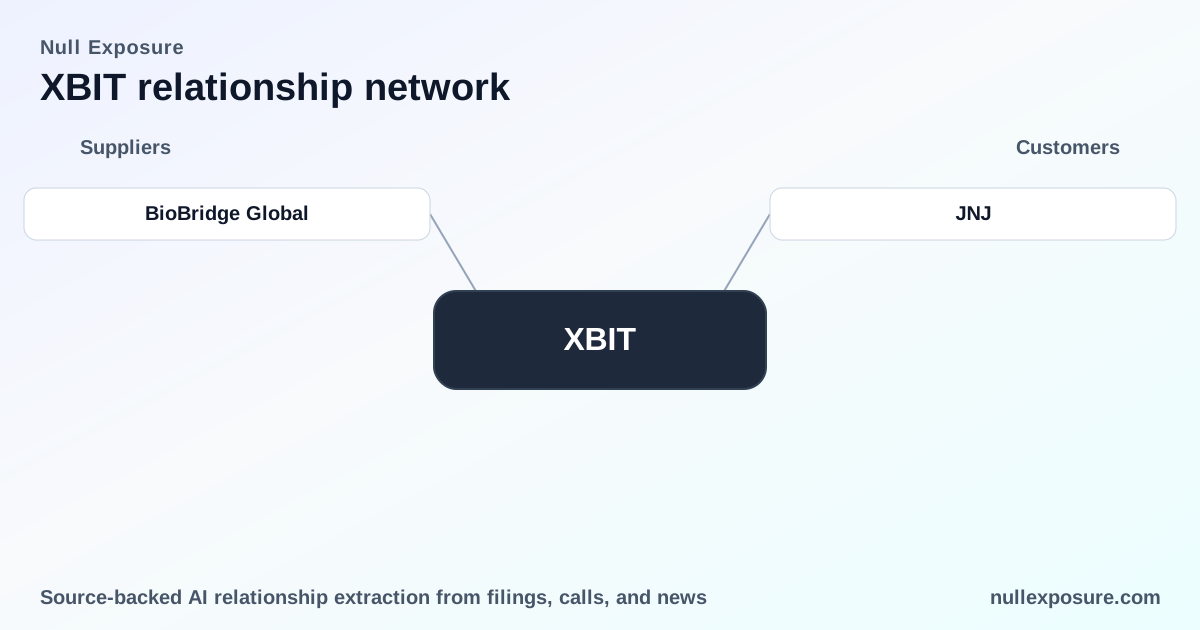
Janssen / Johnson & Johnson (JNJ) — FY2019 press release
XBiotech completed a transaction with Janssen that transferred all rights to the investigational compound bermekimab for $750 million, a transaction executed through the Janssen Pharmaceutical Companies of Johnson & Johnson. Source: PR Newswire announcement (March 10, 2026) — https://www.prnewswire.com/news-releases/janssen-announces-completion-of-acquisition-of-investigational-bermekimab-from-xbiotech-inc-300979941.html
The Janssen Pharmaceutical Companies of Johnson & Johnson — FY2019 press release (same transaction described)
The Janssen Pharmaceutical Companies of Johnson & Johnson announced completion of the bermekimab acquisition and the transfer of certain employees from XBiotech, indicating the deal included both intellectual property and personnel transition. Source: PR Newswire (March 10, 2026) — https://www.prnewswire.com/news-releases/janssen-announces-completion-of-acquisition-of-investigational-bermekimab-from-xbiotech-inc-300979941.html
BioBridge Global — FY2020 media mention
BioBridge Global used an XBiotech test to identify convalescent plasma donors recovered from COVID-19, showing XBiotech’s diagnostic or screening tools were deployed by a blood product provider for hospital supply during the pandemic. Source: RTTNews report (May 4, 2026) — https://www.rttnews.com/amp/3123455/stock-alert-xbiotech-jumps-12.aspx
Janssen Biotech, Inc. — FY2019 definitive agreement announcement
Janssen Biotech announced a definitive agreement to acquire all rights to bermekimab from XBiotech, documenting the contractual step before closing of the licensure/acquisition transaction. Source: PR Newswire (May 4, 2026) — https://www.prnewswire.com/news-releases/janssen-to-acquire-investigational-bermekimab-from-xbiotech-300970952.html
Janssen Biotech, Inc. — FY2019 completion notice (alternate press entry)
A separate PR entry also captures the execution of the bermekimab transfer through Janssen Biotech, reiterating that the formal agreement and closing were routed through that Janssen affiliate. Source: PR Newswire (March 10, 2026) — https://www.prnewswire.com/news-releases/janssen-announces-completion-of-acquisition-of-investigational-bermekimab-from-xbiotech-inc-300979941.html
What the recorded relationships imply for investors
The record of transactions and press coverage produces several clear conclusions about XBiotech’s commercial runway:
- One-off monetization dominates historical cash flows. The bermekimab transaction at a reported $750 million headline value is the largest single monetization event in public records; such events transform balance-sheet dynamics but are not recurring revenue. Treat that cash impact as a structural inflection rather than baseline sales.
- Services and manufacturing were valuable but time-limited. Company disclosures indicate XBiotech provided manufacturing and clinical operations under supply agreements starting in 2020, with those arrangements concluded by the end of 2023. Those contracts materially supported operations while active but do not provide ongoing revenue now.
- Counterparty scale reduces commercial friction while active. Working directly with Janssen/Johnson & Johnson demonstrates XBiotech can transact with major pharmas, validating its platform; however, dependence on a small number of large partners increases concentration risk.
- Current financials reflect the transition. Public financial metrics show minimal revenue (RevenueTTM: $300k), negative EBITDA, and losses per share, consistent with a company that has realized past asset cash flows but is not generating broad-based product sales today.
If you want a concise dossier and signal-level timeline for XBiotech’s partner engagements and how they affected cashflow, visit https://nullexposure.com/ for our investor-focused relationship summaries.
Risk-adjusted investor view and actionable takeaways
- Upside: The company has proven ability to convert an internal asset into a large licensing event; future similar transactions would be value-accretive. Intellectual property and True Human antibody expertise are monetizable assets.
- Downside: Revenue is currently negligible and historical partners’ contracts have terminated, leaving XBiotech exposed to the timing and success of future licensing or commercialization events. Concentration of historic cash events is a structural risk.
- Catalysts to monitor: announcements of new licensing agreements, reinstatement of manufacturing contracts with large pharma, or redevelopment of in-house commercial programs that can generate recurring revenue.
- Valuation context: market capitalization is small, institutional ownership limited, and operating metrics show continued loss-making; investment case relies heavily on successful redeployment of technical capability into new commercial transactions.
Bottom line
XBiotech’s customer record tells a focused story: a company capable of high-value asset monetization and contract service delivery, but one whose current revenue base is not diversified or recurring. For investors, the priority is tracking new licensing deals or service agreements with large partners and assessing management’s plan to rebuild sustainable revenue streams rather than relying on episodic asset exits. For more detailed partner timelines and signal-level analysis, see our coverage at https://nullexposure.com/.