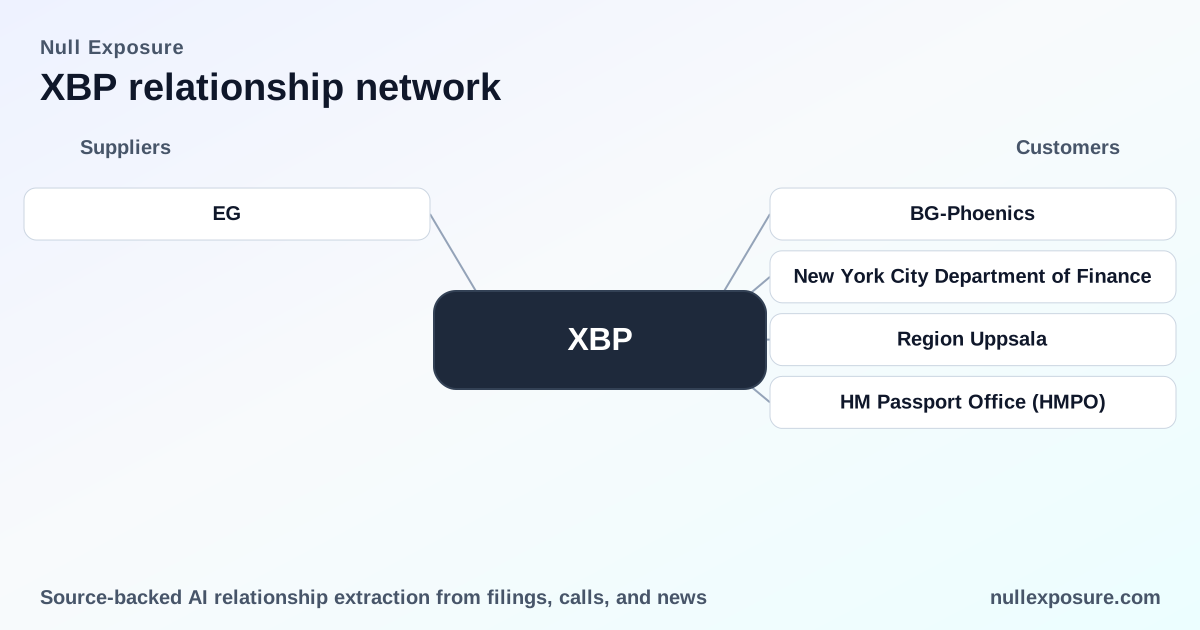
XBP Europe Holdings: customer relationships that map commercial traction and public-sector momentum
XBP Europe Holdings operates a pan‑European bills-and-payments platform and professional‑services business that monetizes through a mix of software licensing (perpetual and term), cloud subscription deployments, usage‑tied pricing, and project‑based digital transformation services sold into public sector and commercial accounts. The company combines recurring platform revenue with higher‑margin transformation projects and hardware sales, creating a revenue mix that is sensitive to large contract wins and multi‑year renewals. For a consolidated view of XBP customer exposures, visit https://nullexposure.com/.
Five customer relationships that explain recent stock action and execution focus
Saarland State Administration Office — a formal public‑sector digital transformation win
XBP Europe was awarded a digital transformation contract by the Saarland State Administration Office, signaling expansion of its public‑sector footprint in Germany during FY2025. A Ritzau press release covering the award described the deal as part of XBP Europe’s regional growth program (Ritzau, May 4, 2026: https://via.ritzau.dk/pressemeddelelse/14688068/xbp-global-holdings-inc?publisherId=90446&lang=en). Key takeaway: public‑sector contracting is driving headline deals.
BG‑Phoenics — a five‑year commercial agreement that moved the market
XBP announced a five‑year agreement with German firm BG‑Phoenics, a development that the market treated as a material commercial inroad and contributed to positive share movement in March 2026. Coverage in Finviz highlighted the term structure and geographic significance of the deal (Finviz, Mar 10, 2026: https://finviz.com/news/256657/xbp-global-xbp-scores-major-inroad-into-european-market). Key takeaway: multi‑year enterprise contracts underpin revenue visibility.
New York City Department of Finance — a municipal payments engagement
XBP has a partnership with the New York City Department of Finance to process parking violation payments, positioning the company as an operator of transaction flows for local government revenue collection. The relationship was noted in market coverage alongside European contracts (Finviz, Mar 10, 2026: https://finviz.com/news/256657/xbp-global-xbp-scores-major-inroad-into-european-market). Key takeaway: U.S. municipal work complements European public‑sector momentum.
Region Uppsala — regional government adoption in Sweden
XBP announced a contract with Region Uppsala in Sweden as part of its EMEA expansion, representing regional public authority adoption of XBP’s bills and payments technology in FY2025. Finviz summarized this deal in the same March 2026 report that covered the BG‑Phoenics agreement (Finviz, Mar 10, 2026: https://finviz.com/news/256657/xbp-global-xbp-scores-major-inroad-into-european-market). Key takeaway: multiple European public authorities are adopting XBP solutions.
HM Passport Office (HMPO) — an AI‑led, mission‑critical document processing deployment
XBP’s work with HM Passport Office involves AI‑led document processing supporting operations that require high accuracy, security, and regulatory compliance, positioning the company in mission‑critical public‑sector workflows. This engagement was described in a company release and subsequently republished by industry outlets in March–May 2026 (Ritzau press release, Mar 10, 2026 and Bitget summary, May 4, 2026: https://via.ritzau.dk/pressemeddelelse/14808510/xbp-global-holdings-inc?publisherId=90446&lang=en; https://www.bitget.com/amp/news/detail/12560605219580). Key takeaway: XBP is executing on AI‑enabled automation for high‑security government functions.
What these relationships collectively reveal about XBP’s operating model
These customer motions are consistent with several company‑level operating signals extracted from XBP’s disclosures:
-
Contracting posture: XBP sells a mix of licensing (perpetual and term), subscription SaaS, and usage‑based arrangements — a flexible commercial model that supports both recurring platform economics and project revenue. This mix enables variability in cashflows between recurring fees and one‑off transformation projects.
-
Counterparty mix: The company pursues government and very large enterprise accounts while also servicing mid‑market and small businesses through its XBP portal. That multi‑tier approach spreads commercial risk but concentrates strategic headline exposure in public sector and large enterprise wins.
-
Geographic focus: Operations and client base skew towards EMEA, with targeted public‑sector penetration in Germany, Sweden and the U.K., while maintaining U.S. municipal relationships.
-
Role and service scope: XBP functions primarily as a service provider and seller of software, hardware, and professional services — integrating platform, implementation, and operations for clients.
-
Relationship maturity and scale: The company reports a base of over 2,000 clients with many recurring and mature relationships, indicating client retention and repeat contract activity drive a material portion of revenue.
-
Revenue segments and spend scale: Revenue is split between software, services, and hardware, with services and digital transformation projects representing a meaningful portion of revenue and some customer engagements likely in the $100k–$1m spend band. This suggests a revenue profile blending stable recurring streams with episodic, higher‑ticket projects.
These signals explain why recent announcements with public authorities and multi‑year enterprise contracts are meaningful for both near‑term revenue and long‑term credibility with large buyers.
Investment implications and principal risks
-
Revenue durability and upside: The mixed monetization model provides recurring SaaS revenue tempered by project‑driven digital transformation revenue, so successful execution of announced multi‑year deals (BG‑Phoenics, Saarland) can materially lift near‑term topline and extend lifetime value.
-
Concentration and execution risk: Public‑sector contracts are highly strategic but concentrated; failure to deliver on mission‑critical deployments (for example, HMPO) would threaten renewals and references that are vital to further government expansion.
-
Contract variability: The combination of licensing, usage‑based pricing and capital hardware sales introduces earnings volatility — hardware and project revenue can spike EBITDA one year and compress margins the next.
-
Margin profile and valuation context: XBP reports positive gross profit and thin operating margins. Market capitalization and multiples suggest the stock is trading as a growth‑for‑turnaround story with upside tied to consistent contract conversion and margin expansion.
-
Regulatory and security requirements: Working with national and regional governments imposes elevated compliance, security, and reliability standards; those are barriers to entry but also sources of execution risk and cost.
Bottom line: a public‑sector playbook with commercial breadth
XBP is executing a clear go‑to‑market that blends public sector credibility (HMPO, Saarland, Region Uppsala) with multi‑year enterprise deals (BG‑Phoenics) and municipal payments work (NYC Department of Finance). That footprint supports a hybrid revenue model—recurring platform economics plus discrete transformation projects—and positions XBP to scale across EMEA while retaining U.S. municipal use cases.
For investors and operators tracking customer concentration, contract economics, and execution on mission‑critical deployments, these relationships are the most relevant signals in XBP’s current pipeline. For a deeper investor view and ongoing customer signal monitoring, visit https://nullexposure.com/.
Bold wins on contracts validate the strategy; delivery and margin improvement determine the valuation re‑rating.