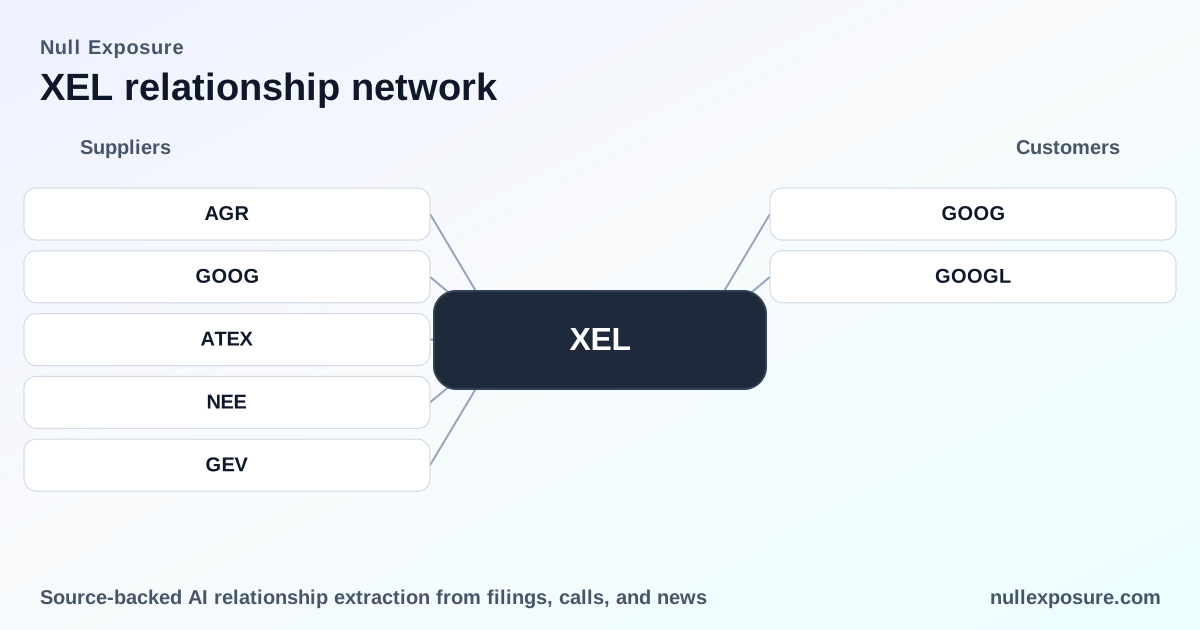
Xcel Energy (XEL): Customer Relationships Driving a Grid Transition
Xcel Energy operates as a regulated utility holding company that monetizes through retail and wholesale electricity and natural gas sales across eight U.S. states, plus regulated transmission and distribution services. The company’s commercial model combines predictable rate-base returns with growing merchant-style engagements tied to large corporate loads and grid-scale clean energy projects—contracts that transfer capital and operational risk to counterparties while expanding Xcel’s long-term capacity and storage footprint. For a fuller investor view, visit https://nullexposure.com/.
Why the customer lens matters for XEL investors
Xcel’s regulated base delivers steady cash flow, but large, bespoke customer agreements—particularly with hyperscalers—are reshaping growth and capital deployment. These deals accelerate renewable additions, change load profiles, and influence regulatory narratives around cost recovery and ratepayer impacts. The company’s ability to structure agreements where large customers pay marginal service costs or sponsor grid upgrades directly alters the economics of new assets and the security of Xcel’s rate-base returns.
All documented relationships, intact and summarized
Below are every relationship referenced in the collected coverage. Each entry is a plain-English summary followed by the cited source.
Google / Alphabet (listed as Google, GOOG, GOOGL across sources)
Xcel executed an electric service agreement to power a new Google data center in Pine Island, Minnesota, supporting approximately 1.9 GW of new clean energy additions and a multiday iron-air battery system while structuring costs so existing ratepayers are not billed for the incremental service. Xcel and Google’s arrangement includes a clean energy accelerator charge and places the operational and incremental energy costs with Google as the large customer. — Xcel Newsroom press release and regional reporting, Feb–Mar 2026; investor commentary in March–May 2026.
(Primary coverage: Xcel Energy newsroom announcement, Feb 24, 2026; follow-ups and market analysis in March–May 2026 on Tikr, Simply Wall St, KFGO and Finviz.)
XELLL (entries referencing project contractors and third-party winners)
Two discrete mentions labeled XELLL in the reporting document the broader project ecosystem rather than a customer counterparty: one notes that Xcel’s Sherco Solar project emerged from an RFP won by National Grid Renewables, and another records that Quanta Infrastructure Solutions Group served as a contractor on an Elbert County transmission project connected to Xcel work. These items reflect Xcel’s reliance on third-party developers and contractors to deliver large renewable and transmission projects. — Utility Dive (Sherco Solar, FY2022) and The Colorado Sun (Elbert County transmission coverage, FY2025).
(Primary coverage: Utility Dive reporting on Sherco Solar, referenced to FY2022; Colorado Sun coverage of transmission contractors, June 2025.)
What these relationships imply about Xcel’s operating posture
- Contracting posture: Xcel is shifting from pure retail utility billing toward hybrid commercial arrangements—structuring large-load agreements that allocate incremental energy and certain upgrade costs to corporate customers. The Google agreement is a clear example where Xcel provides grid and generation capacity while the customer sponsors or underwrites the incremental cost stream (Xcel Newsroom, Feb 2026).
- Concentration and counterparty risk: The emergence of very large customers such as hyperscalers increases counterparty concentration risk on the load side, but Xcel’s approach of passing incremental costs to the customer reduces direct ratepayer exposure and limits downside to the regulated utility if contracts include customer-paid charges (news coverage, Mar 2026).
- Criticality and strategic lock-in: Large data-center customers create multi-year, high-capacity load profiles that justify long-lived renewable and storage investments, strengthening Xcel’s regulatory case for cost recovery and creating a competitive moat for local service territories.
- Maturity of deal flow: The referenced projects span recent years (FY2022–FY2026) and show a trajectory from vendor-sourced RFP wins (National Grid Renewables) to turnkey hyperscaler partnerships (Google), signaling maturation of Xcel’s commercial playbook for large industrial and tech customers.
Investment implications — growth, margin, and regulatory vectors
- Growth: Large customer-driven load growth accelerates renewable and storage capital deployment, which supports higher capital spending and potentially a larger rate base over the medium term. The Google contract specifically underpins nearly 1.9 GW of new capacity additions and long-duration storage capacity referenced in public statements (Xcel Newsroom; market coverage, Mar 2026).
- Margins and earnings quality: While the regulated base supports steady margins, bespoke commercial deals can improve utilization and create incremental revenue streams; however, they also shift capital intensity and timing of returns. Xcel’s financials (FY2026 metrics) continue to show regulated utility profitability but with increasing capital expenditure implications for projects tied to large customers.
- Regulatory risk and public perception: Structuring customer-paid charges (e.g., a clean energy accelerator) reduces direct ratepayer impact but creates regulatory scrutiny and political exposure during rate cases or public utility commission hearings. Investors should monitor cost-recovery filings and commission feedback that could alter expected returns.
Key takeaways for operators and researchers
- Xcel is actively monetizing hyperscaler and large industrial load growth while protecting ratepayers through customer-paid cost structures. The Google Pine Island agreement is the most visible example and is shaping analyst expectations for Xcel’s growth trajectory (news releases and commentary, Feb–May 2026).
- Project execution depends on third-party developers and contractors, evidenced by RFP winners and contractor mentions for major solar and transmission projects—this increases project delivery complexity but leverages specialist partners to scale build-outs (Utility Dive, Colorado Sun).
- Company-level signals show Xcel’s footprint is geographically concentrated in North America across eight states and still very much centered on regulated electric distribution and generation, preserving the defensive cash flow profile even as commercial deals bring growth optionality.
If you want continued monitoring of XEL’s counterparty dynamics and project pipeline, review Xcel’s public releases and regulatory filings regularly or check our research hub at https://nullexposure.com/ for aggregated relationship signals.
Bold summary: Xcel is balancing regulated rate-base stability with targeted commercial deals that transfer marginal costs to large customers, accelerating renewable and storage investment while preserving core utility economics.