Xcel Brands (XELB): Customer Relationships, Concentration and Contracting — what investors need to know
Xcel Brands operates and monetizes a portfolio of influencer-driven consumer brands by licensing intellectual property and selling branded product through third‑party retail partners — principally interactive television networks and wholesale licensees — while collecting upfront license payments, guaranteed minimum royalties and usage‑based royalties on net retail sales, plus modest service fees for design and support work. This model yields high gross margins when royalty waterfalls perform, but it also concentrates cash flow risk in a small set of distribution partners and long‑term license structures. For a concise relationship risk picture and ongoing monitoring, see https://nullexposure.com/.
How the commercial model actually behaves for investors
Xcel is fundamentally a brand licensor: the company signs long‑term master licenses to third‑party manufacturers/wholesalers, licenses its brands directly to retailers and interactive‑TV buyers, and receives a mix of upfront payments, guaranteed minimums, quarterly usage‑based royalties and small annual service fees. The FY2024 10‑K shows the company recognizes material revenue from interactive TV agreements and long‑dated master licenses; Qurate accounted for roughly half of licensing revenue in the most recent reporting period, while the Halston master license contributed a single large, multi‑year revenue stream tied to guaranteed minimums. For an ongoing feed of relationship signals, visit https://nullexposure.com/.
Contracts, concentration and operational constraints that matter
- Contracting posture mixes long‑term and usage‑based deals. The Halston Master License includes a 25‑year economic structure (five years + twenty‑year extension) with guaranteed minimum royalties and annual minimums, while the Qurate agreements pay Xcel on a quarterly, usage‑based basis tied to net retail sales (FY2024 10‑K).
- Revenue concentration is high and material. Qurate‑related net licensing revenue was $3.7 million in the current year, representing roughly 44% of company revenue; losing a single major licensee would be a clear earnings shock rather than a diversification event.
- Geographic focus is North America. Management reports a single reportable segment with revenue derived in North America and consolidated operations.
- Relationship roles and spend bands are concrete. Qurate is identified as the largest licensee for multiple brands; Xcel recognized service fees of $150,000 per year under a services agreement — a sign of small but recurring buy‑side services in addition to licensing revenue.
- Maturity and criticality differ by contract. The Halston license is a high‑maturity, high‑criticality revenue stream with guaranteed minimums; Qurate is high‑material but variable because payments are tied to retail sales.
These characteristics drive valuation sensitivity to retail sell‑through and the stability of interactive‑TV distribution economics.
Customer and partner roll call (each relationship listed in public materials)
Below are every relationship mentioned in the collected results with a concise, plain‑English note and the source cited.
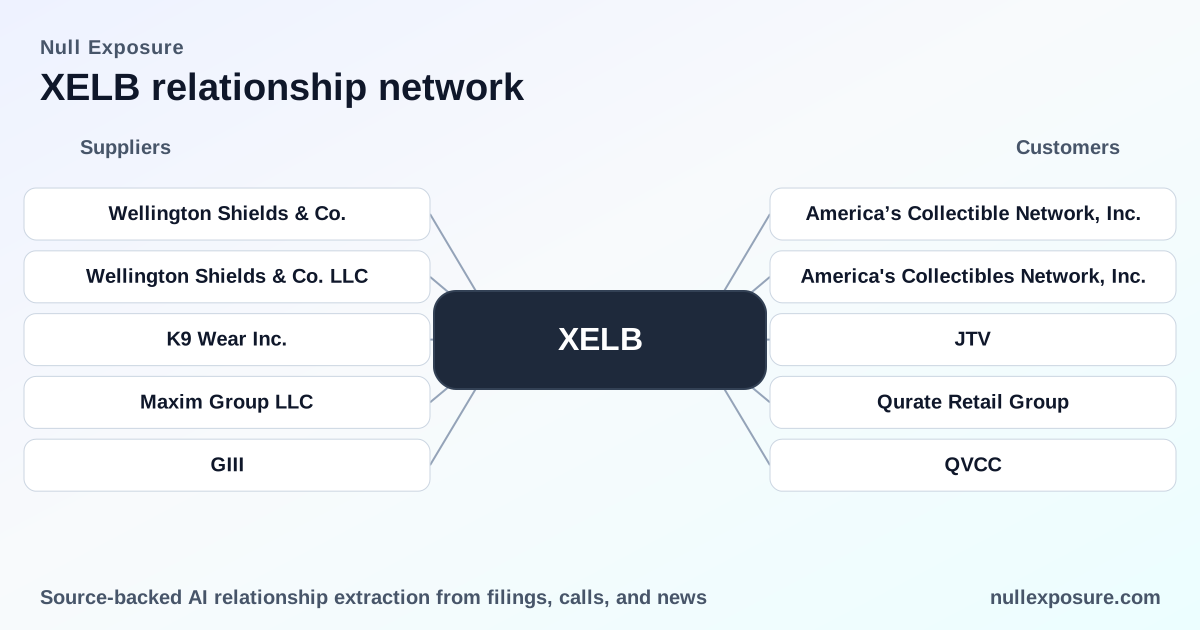
America’s Collectible Network, Inc. (FY2024 10‑K)
Xcel discloses distribution and/or licensing of its brands for sale through interactive television channels including America’s Collectible Network, Inc.; this is referenced as part of the company’s interactive‑TV distribution strategy in the FY2024 10‑K. According to Xcel Brands’ FY2024 10‑K, interactive‑TV partners are a core distribution channel.
JTV (FY2024 10‑K)
Xcel calls out JTV (America’s Collectible Network d/b/a JTV) as an interactive television outlet for brand distribution. The FY2024 10‑K specifically lists JTV among the channels used to distribute licensed merchandise.
Qurate Retail Group (FY2024 10‑K)
Qurate is described as an important strategic partner in Xcel’s interactive television business and is party to “Qurate Agreements” under which payments are made quarterly based on net retail sales; the FY2024 10‑K shows Qurate accounted for a material share of licensing revenue ($3.7M current year). According to the FY2024 10‑K filing, the Qurate relationship is the largest single customer concentration.
America's Collectibles Network, Inc. — license detail (FY2024 10‑K)
Xcel discloses a license agreement that obligates America’s Collectibles Network (d/b/a JTV) to pay royalties to Xcel based on product sales of Judith Ripka brand merchandise, per the FY2024 10‑K.
Fuzion Creations (WWD / FY2026 reporting)
Xcel sold the Judith Ripka luxury fine‑jewelry brand to Fuzion Creations, a wholesale fine‑jewelry manufacturer, as reported in WWD and subsequent press in 2026; the disposition reduces future royalty exposure tied to that brand. A WWD story and Xcel press coverage in 2026 confirm the sale of the Judith Ripka brand to Fuzion Creations.
White Lion Capital (TradingView / FY2026)
Xcel entered financing agreements with White Lion Capital to establish an equity line of up to $15.0 million over 24 months and to register resales of shares issued under that facility, a capital‑markets action reported on TradingView in 2026.
HSN (The Home Shopping Network) — press releases (GlobeNewswire / Yahoo Finance, FY2026)
Xcel announced that celebrity chef Jenny Martinez will debut a Mesa Mia kitchen collection on HSN, underscoring continued product rollouts through HSN live‑stream channels; the launch was promoted in April 2026 press releases and company financial disclosures.
QVC (WWD feature FY2021; GlobeNewswire FY2026)
Historically, QVC has been a primary distribution channel for certain acquired brands (Logo by Lori Goldstein had been sold exclusively on QVC), and Xcel continues to premiere new lines (e.g., GemmaMade) on QVC per 2026 press releases and a WWD feature recounting historical distribution.
QVCC (WWD / FY2021)
A WWD feature from FY2021 references Xcel’s acquisition of Logo by Lori Goldstein and notes QVC as the brand’s primary distribution channel; that item is indexed under the inferred symbol QVCC in the results.
HSNGY (GlobeNewswire / FY2026)
Press releases in April 2026 referencing product premieres and brand launches list HSN as the distribution partner; these items appear in the monitoring feed under the inferred symbol HSNGY.
QRTEA (GlobeNewswire / FY2026)
Multiple GlobeNewswire press items in April 2026 cite QVC and HSN appearances for Xcel brands; those releases are indexed with QRTEA in the results feed.
(Each of the above entries maps to public filings or press items in the provided results and covers the full roster of relationships that Xcel itself cites or that appeared in news coverage in the capture set.)
What this means for investors and operators
- Concentration is the dominant risk: when one partner (Qurate) accounts for ~44% of licensing revenue, a drop in retail sell‑through or a contract termination would generate outsized top‑line volatility. The company explicitly warns that losing major licensees would impair cash flow.
- Contracts are heterogeneous: Xcel benefits from long‑dated guaranteed economics (Halston master license with a 25‑year structure and minimums) and quarterly usage‑based flows (Qurate Agreements). This mix reduces immediate downside from single low quarters but preserves sensitivity to retail performance over time.
- Operational leverage is high but contingent: licensing economics deliver high gross profit when partners execute, but they are dependent on partner merchandising, marketing and the health of interactive‑TV and wholesale channels.
- Portfolio actions change the revenue runway: the sale of Judith Ripka to Fuzion Creations converts an ongoing royalty stream into an immediate transaction, altering future revenue composition.
Bottom line and recommended next steps
Xcel Brands is a licensing‑centric, distribution‑dependent business with clear long‑term license instruments and substantial near‑term concentration in interactive‑TV retail partners. Investors should price in both the upside from high‑margin licensing and the downside from partner concentration and usage‑driven volatility. Operators evaluating engagement should require clarity on guaranteed minimums, reporting cadence, and termination provisions for any new license. For continued monitoring of contractual signals and partner concentration, visit https://nullexposure.com/.