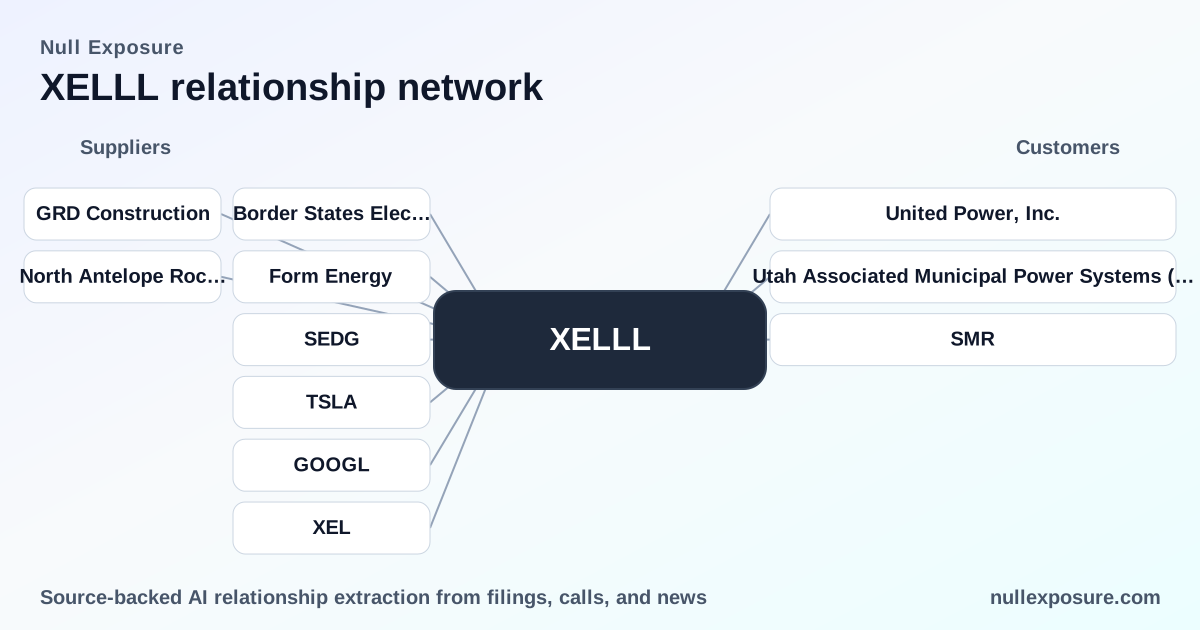
XELLL — Customer Relationship Map: Xcel Energy’s Partner Footprint and Commercial Signals
Xcel Energy operates as an integrated regulated utility that generates, purchases, transmits, distributes and sells electricity across eight U.S. states, monetizing through regulated retail rates, wholesale market sales and long-term commercial supply arrangements. For holders of XELLL (Xcel Energy Inc. 6.25% Junior Subordinated Notes due 2085), customer relationships expose the issuer to a mix of regulated demand stability, wholesale contract disputes, and strategic industrial partnerships that influence operating cash flow and regulatory recoverability. Learn more about how relationship-level intelligence shapes credit and operational assessment at https://nullexposure.com/.
Why customers and partners matter to noteholders
Xcel’s business model is rooted in essential service economics: residential and commercial customers produce predictable volumetric revenues, while wholesale and municipal customers create higher‑value but more contractual exposures. The company’s operating posture blends regulated rate recovery with market-facing sales, so customer disputes or contract allocation issues can transmit into rate cases, regulatory scrutiny and capital recovery timing. At the same time, strategic partnerships (e.g., in emerging nuclear SMR projects) signal an attempt to diversify operational roles and long-term revenue sources beyond pure commodity sales.
- Contracting posture: Predominantly regulated retail contracts with pockets of wholesale commercial arrangements that are susceptible to FERC/regional transmission debates.
- Concentration and geography: Operations span multiple states (Colorado, Minnesota, Texas, New Mexico, the Dakotas, Wisconsin and Michigan), reducing single-state revenue concentration but creating multi-jurisdictional regulatory complexity.
- Criticality and maturity: Electricity is a critical, mature product with stable demand from millions of residential customers; that stability supports credit fundamentals, while outage events and new infrastructure costs present episodic downside.
- Revenue mix signal: Corporate disclosures show a material residential base and significant wholesale activity, making Xcel both a buyer and seller in energy markets rather than a pure monopoly retailer.
If you want a deeper mapping of how specific counterparties influence cash flow and regulatory exposure, see the platform at https://nullexposure.com/.
The relationship roster — what every listed counterparty indicates
Below are the customer and partner relationships surfaced in the coverage set, with concise takeaways and source references.
-
United Power, Inc.
Xcel agreed a power‑supply arrangement to provide United Power access to Xcel’s increasingly carbon‑neutral portfolios, positioning Xcel as a supplier of decarbonized energy to a municipal cooperative. Source: Longmont Leader (March 10, 2026) — https://www.longmontleader.com/local-news/united-power-and-xcel-energy-announce-power-supply-partnership-7550165. -
Colorado State University
Xcel executed a precautionary service interruption that cut power to CSU’s Foothills Campus as part of wildfire risk management protocols, underscoring operational risk and the utility’s role in public‑safety driven outages. Source: CBS News Colorado (May 4, 2026) — https://www.cbsnews.com/colorado/news/xcel-energy-cut-power-thousands-people-colorado-front-range-wildfire-risk/. -
Municipal Energy Agency of Nebraska (MEAN)
MEAN filed complaints arguing that wholesale customers would be charged for transmission upgrades from a Xcel project that they do not directly benefit from, highlighting cost allocation and FERC‑area dispute risk in multi‑jurisdictional infrastructure projects. Source: Denver Gazette (Feb 22, 2024) — https://www.denvergazette.com/2024/02/22/xcel-energys-2-billion-power-pathway-project-in-eastern-colorado-under-fire-976f365e-d1cf-11ee-833c-4720f56f16cc/. -
Utah Associated Municipal Power Systems (UAMPS)
Xcel and UAMPS agreed on process, roles and next steps that would apply if Xcel became the operator of a NuScale‑manufactured SMR, signaling Xcel’s potential move from pure utility operator to nuclear project operator for municipal buyers. Source: Power‑Eng (March 10, 2026) — https://www.power-eng.com/nuclear/smrs/xcel-energy-could-become-operator-of-smr-plant-in-idaho/. -
NuScale
Xcel earlier signed an agreement with NuScale to explore becoming a preferred operator for NuScale’s SMRs, indicating a strategic commercial development pipeline tied to small modular reactor technology. Source: Power‑Eng (March 10, 2026) — https://www.power-eng.com/nuclear/smrs/xcel-energy-could-become-operator-of-smr-plant-in-idaho/. -
SMR (Small Modular Reactors, generic)
Coverage references Xcel’s exploratory role with SMR technology and plant operation, which represents an emerging business line that could shift capital allocation and operational responsibility over long horizons. Source: Power‑Eng (March 10, 2026) — https://www.power-eng.com/nuclear/smrs/xcel-energy-could-become-operator-of-smr-plant-in-idaho/.
What these relationships say about credit and operational risk
Collectively, the roster exposes several investment‑relevant themes:
- Regulatory and cost‑allocation exposure is material. Complaints from wholesale customers (e.g., MEAN) over project cost charging increase the probability that Xcel will face protracted regulatory processes or need to absorb adjustments to cost recovery timing. That pressure affects near‑term cash flow timing more than long‑term demand fundamentals.
- Operational interruptions are a tail risk to revenue and reputation. Wildfire‑driven de‑energization (CSU event) demonstrates that public‑safety protocols can translate into short‑term revenue forgone and potential customer relations costs.
- Strategic upside from new operating roles in nuclear. Agreements to explore SMR operating roles (UAMPS/NuScale) diversify Xcel’s revenue profile from commodity sales toward operator services, but such moves carry execution, construction and regulatory licensing risk before they contribute reliably to cash flow.
- Customer mix balances stability and dispute risk. A large residential base delivers predictable cash flows, while commercial/municipal and wholesale contracts offer higher margins at the cost of contract and regulatory contention.
Company‑level signals from relationship constraints
The relationship‑level constraints in the record support several company‑wide conclusions rather than tie to any one counterparty. Notable signals:
- Counterparty type skew to individual/residential customers — Xcel’s revenue schedule shows large residential contributions, reinforcing demand predictability and ratebase fundamentals.
- North American geographic footprint — The company’s regulated operations across eight U.S. states diversify state‑level exposure but increase regulatory complexity and cross‑jurisdictional transmission disputes.
- Dual buyer‑seller role — Xcel functions both as wholesale seller and buyer in energy markets, which increases market exposure and requires active hedging and portfolio management.
- Active relationship posture and core product focus — Most customer relationships are operational and tied to core electricity generation and distribution services, reflecting a mature utility business model.
Bottom line for investors and operators
For XELLL stakeholders, the customer map points to a fundamentally stable revenue base tempered by episodic regulatory and operational risks. Key monitoring items include FERC filings and cost‑allocation disputes, wildfire‑related operational protocols, and progress on SMR operator agreements that could alter capital commitments and revenue streams. Investors should weigh the smoothing effect of a large residential customer base against the potential for regulatory lag and one‑off outage impacts on near‑term cash flow.
For further relationship‑level analytics and credit exposure modeling, visit https://nullexposure.com/.