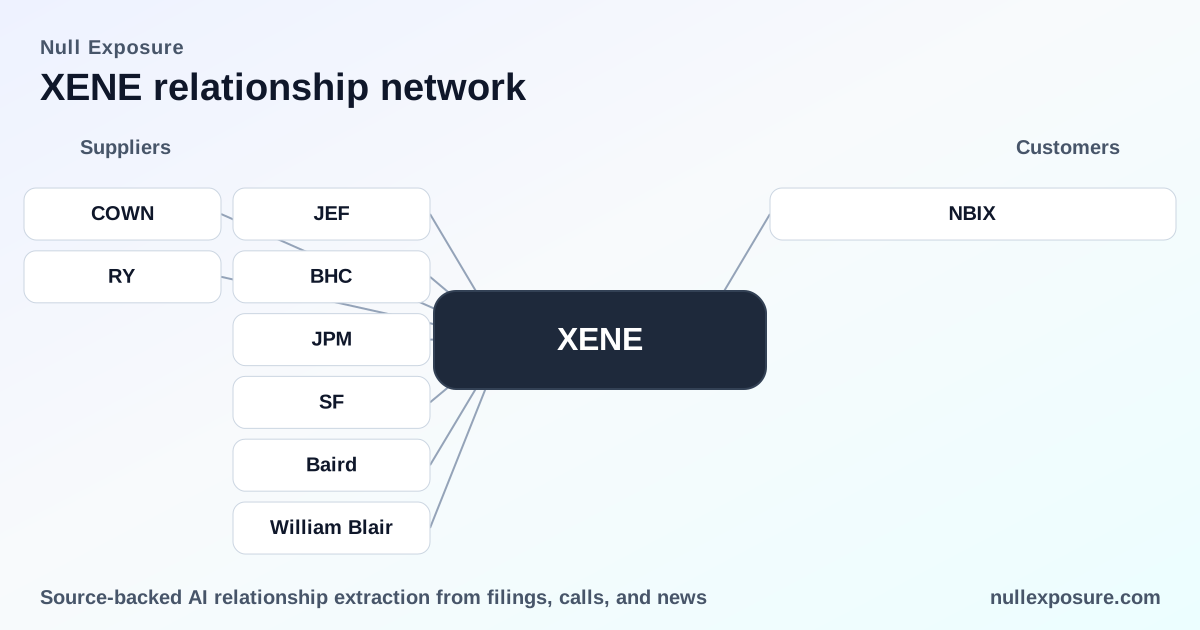
Xenon Pharmaceuticals (XENE): Partner payments, licensing exits, and what customers tell investors
Xenon Pharmaceuticals operates as a clinical-stage neurology-focused biopharma that monetizes primarily through licensing deals, milestone receipts, and providing R&D services tied to partnered programs. The business model generates episodic cash inflows when partners advance programs into defined clinical stages or exercise program rights, while ongoing operating losses reflect early-stage assets and development spending. For investors evaluating XENE’s customer relationships, the most relevant signal is that partners, not product sales, drive near-term revenue, producing lumpy, milestone-driven cash flow rather than steady recurring revenue. For more structured relationship analysis and comparable coverage, visit https://nullexposure.com/.
Why customer relationships matter for valuation
Xenon’s value proposition to partners is concentrated: it supplies specialized neuroscience assets and R&D capabilities that external developers license and advance. That contracting posture means revenue recognition is highly contingent on partner progress and regulatory events, and a small number of contractual counterparties can swing reported revenue and short‑term cash. Material milestone receipts—rather than broad commercialization royalties today—support the revenue line.
Key investor takeaways:
- Revenue is lumpy and milestone‑dependent, amplifying headline volatility.
- Partnerships are critical to de‑risk programs and convert preclinical assets into clinical value.
- Xenon functions as both licensor and R&D service provider, creating mixed accounting and cashflow profiles.
Relationship breakdown: every customer interaction in the record
Below I cover each relationship entry in the available results. Each item is presented as a short, plain-English summary with the sourcing context.
NBIX (listed as NBIX) — milestone payment recorded in 2025
Xenon received a $7.5 million milestone payment tied to NBI‑921355 advancing into clinical study, reflecting a cash inflow triggered by partner-driven development progress. According to a Finviz news summary published March 2026, that payment was recognized in early 2025 as part of the Neurocrine collaboration (FY2026 / reported March 10, 2026).
Neurocrine Biosciences, Inc. — same milestone event referenced by full name
Neurocrine exercised a program milestone that generated the same $7.5 million payment to Xenon when NBI‑921355 reached clinical stage, underscoring that partner advancement is the primary monetization mechanism. This relationship and the 2025 milestone are cited in the same Finviz news piece (first reported March 10, 2026).
FLXN (Flexion Therapeutics) — asset licensing / sale of global rights (2019)
Xenon granted Flexion Therapeutics global rights to develop and commercialize XEN402 (a NaV1.7 inhibitor) under a licensing agreement reported in 2019, a deal described at the time as carrying up to $128 million in potential value. The Pharma Letter recounted the definitive agreement and accompanying market reaction in FY2019 (reporting on the XEN402 commercial licensing transaction).
What the relationship set reveals about operating posture
The relationships above demonstrate three concrete characteristics of Xenon’s operating model:
- Contracting posture: service provider and licensor. The explicit accounting language used by Xenon—recognizing consideration upon performance of R&D activities—positions the company to earn payments both as a licensor (milestones and potential royalties) and as a contractor providing research services. This dual posture affects revenue timing and accounting recognition.
- Concentration and sensitivity. A handful of partner milestones (for example, the Neurocrine $7.5M event) materially move reported revenue for a given period, highlighting concentration risk and the sensitivity of headline earnings to single development events.
- Criticality and optionality for partners. Licensing or transferring global rights—illustrated by the Flexion XEN402 transaction—shows Xenon’s ability to monetize assets through exits and to capture value at discrete junctures rather than through established commercial infrastructure.
- Maturity of engagement. The Flexion deal (2019) and continued milestone flow into 2025 demonstrate a multi-year cadence of partnership activity, indicating that Xenon has an established track record of external collaborations rather than one-off transactions.
Investment implications and risk map
Xenon’s relationship profile creates a clear set of investment implications:
- Upside is binary and event-driven. Positive partner milestones and successful clinical transitions unlock meaningful revenue recognition and rerate potential; conversely, setbacks suppress near-term receipts.
- Cash management is central. The company’s reliance on sporadic partner payments requires prudent balance-sheet planning and potentially frequent financing if milestone cadence is thin.
- Partner selection and contract terms matter. The value realization for investors depends on the structural economics of each deal (upfront, milestones, royalties, and retained rights), and Xenon’s role as a service provider increases its exposure to performance obligations.
- Diversification reduces headline volatility. Growing the number of active collaborations or securing larger structured payments would flatten revenue swings and improve predictability.
Constraints and what they signal about the business model
A company-level constraint in the record indicates a relationship role classification as a service provider with a confidence score of 0.80, accompanied by the explicit phrase: “Consideration in exchange for research and development services performed by us on behalf of the licensee is recognized upon performance of such activities.” This is a direct accounting and contractual signal that:
- Revenue recognition is tied to performed R&D, not ongoing product sales.
- Contracts are performance-based, making cash flows milestone contingent.
- Business maturity is partnership‑driven—the firm relies on external developers to advance assets commercially.
These constraints reinforce earlier observations: Xenon operates in a milestone-centric, partner-reliant model that is highly leveraged to development progress.
Bottom line for investors
Xenon’s customer universe, as reflected by the recorded relationships, confirms a licensing-and-service monetization model where milestone receipts and asset licensing transactions drive short-term revenue. The Neurocrine $7.5M milestone and the earlier Flexion XEN402 licensing exit are emblematic: value crystallizes episodically when partners advance assets. Investors should weight near-term valuations to partner pipelines, contract economics, and the company’s ability to sustain operations between milestone events.
For a deeper read on relationship-level signals and how they affect valuation scenarios, visit https://nullexposure.com/.