Xeris Pharmaceuticals (XERS): Customer Relationships, Concentration Risk, and Partner Notes
Xeris Pharmaceuticals develops and commercializes ready-to-use injectable and infusible therapies and monetizes through product sales of three commercial brands—Recorlev, Gvoke and Keveyis—primarily to U.S. wholesalers and specialty pharmacies, which then service retail pharmacies and patients. Revenue is recognized at the point of sale to these customers, creating a spot-sales commercial posture with concentrated counterparty exposure. For a consolidated view of customer relationships and signals, visit https://nullexposure.com/.
Commercial operating model and revenue characteristics
Xeris' go-to-market is a classic specialty pharma distribution chain: manufacture or supply finished injectable products, ship to wholesalers and specialty pharmacies, and recognize product revenue at the time of sale to those customers. The company explicitly lists its three marketed products—Recorlev (Cushing’s), Gvoke (severe hypoglycemia) and Keveyis (Primary Periodic Paralysis)—as top commercial priorities, anchoring near-term revenue growth to adoption and channel execution for these brands.
Several operating-model constraints shape the investment thesis:
- Contracting posture: spot sales. Product revenue is recorded at the time of sale to wholesalers or other customers, with downstream allowances (rebates, chargebacks, copay assistance) reducing net product revenue. This produces high near-term revenue visibility tied to shipment volumes rather than long-term contractual lock-ins.
- Geography: predominantly North America. Xeris currently sells its commercial portfolio in the United States, focusing commercial effort and regulatory risk domestically.
- High customer concentration: critical dependence. Four customers generated the vast majority of gross product revenue for recent years, a concentration level the company itself classifies as material and potentially critical to operations.
- Active, transactional relationships. The majority of commercial interactions are active product shipments to wholesalers or specialty pharmacies—not long-term licensing or recurring service contracts.
- Product-focused revenue mix. The commercial segment is dominated by the three approved products; near-term growth is therefore tied to market uptake of these brands and any label or formulation extensions.
These constraints together create a profile of high execution risk on a small number of channel partners, where quarterly shipment cadence and inventory flows will drive reported results and cash conversion. For additional customer coverage and signals consult https://nullexposure.com/.
Covering every customer-relationship mention in the available monitoring
BlackBerry (BB) — mention is sector-mismatch and not a pharmaceutical customer
An InsiderMonkey transcript from May 2, 2026 quoted BlackBerry referencing deployment of QNX on "Xeris SoCs" for smart sensors in China, which is a semiconductor/embedded-software context and is unrelated to Xeris Pharmaceuticals' commercial business; this result is a textual match rather than an indicator of a pharma commercial relationship. (InsiderMonkey transcript, May 2, 2026: https://www.insidermonkey.com/blog/blackberry-limited-nysebb-q4-2026-earnings-call-transcript-1735761/)
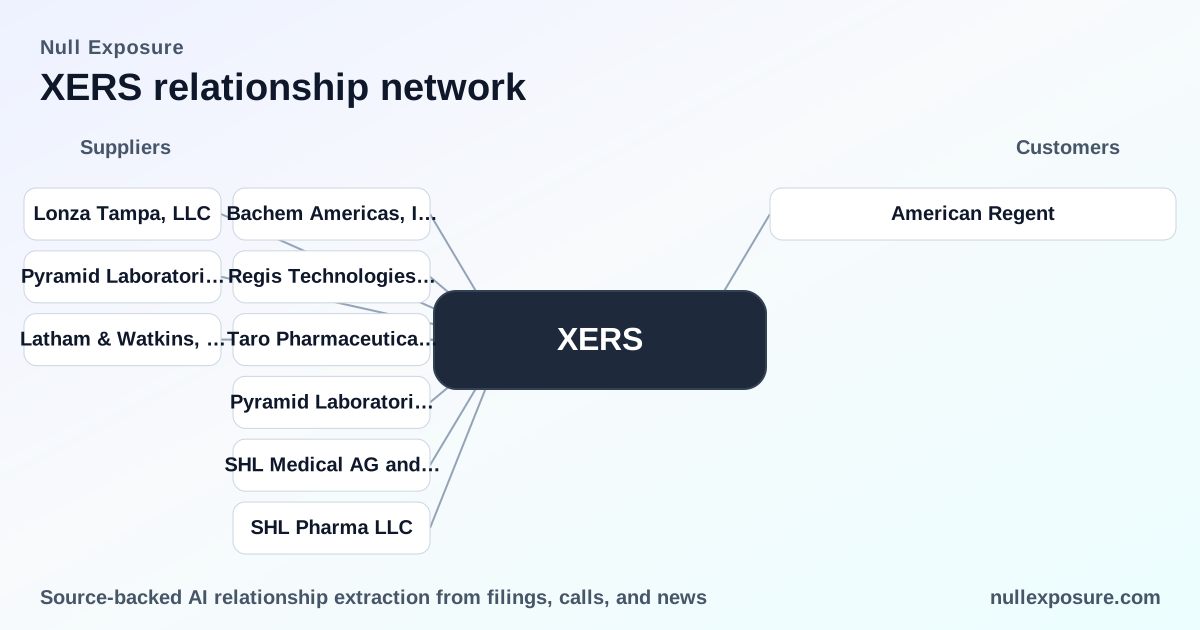
American Regent — partner in U.S. launch activity for a Gvoke variant
A Sahm Capital news summary reported that the FDA approval and the partnered U.S. launch of Gvoke VialDx with American Regent was a notable recent development tied to Xeris' upward revenue guidance in early 2026, indicating a commercial partnership supporting launch and distribution for a Gvoke product variant. (Sahm Capital, March 10, 2026: https://www.sahmcapital.com/news/content/how-investors-are-reacting-to-xeris-biopharma-xers-raising-2025-revenue-outlook-and-recorlev-momentum-2026-01-09)
Constraints that shape concentration, cash flow and downside
Xeris’ own filings and public commentary provide the evidentiary basis for the constraints above. For investors that evaluate customer concentration and counterparty risk, prioritize these readings from the company’s disclosures:
- The netting of rebates, chargebacks and copay assistance at time of sale creates volatility between gross shipments and net revenue, and aligns incentives around wholesaler inventory management.
- The company discloses that four customers accounted for approximately 97% of gross product revenue in recent years, a critical concentration that elevates counterparty credit risk and the impact of any distribution re-pricing or delisting.
- Primary commercial geography remains the United States; international expansion is not the dominant near-term revenue driver.
Taken together, these company-level signals justify viewing Xeris as a boutique specialty pharma with strong product-level gross margins but materially concentrated commercial exposure.
Investor implications — what to watch and what it means for valuation
- Concentration is the primary downside risk. Loss or renegotiation with a top-four wholesaler or specialty pharmacy would materially affect revenue and receivables; allocate downside scenarios in valuation models accordingly.
- Revenue recognition and working-capital swings will drive quarter-to-quarter volatility. Because sales are recorded at shipment, management guidance and channel inventory trends are high-value information for forecasting.
- Partner-led product launches are a growth lever. The American Regent partnership for Gvoke VialDx is a concrete example of how Xeris leverages external partners to expand reach; execution on those launches will determine near-term revenue upgrades.
- Monitor customer mix, days sales outstanding and trade receivables concentration. These operational metrics will be leading indicators of collection stress or channel disputes.
Conclusion and next steps
For research teams and buy-side analysts, the actionable checklist is clear: validate the composition of the top four customers, track channel inventory and shipment cadence, and quantify scenario outcomes for the loss of a major distributor. Xeris is a product-driven specialty pharmaceutical with attractive gross margins but concentrated counterparty exposure; execution on partner launches and steady wholesaler relations drive the investment outcome.
For a systematic customer map and live signal tracking on XERS and other tickers, visit https://nullexposure.com/ for expanded relationship intelligence and monitoring tools.