XHLD (TEN Holdings) — Customer Relationships and What They Signal for Investors
TEN Holdings provides event planning, production and broadcasting services and monetizes by charging for delivered virtual, hybrid and physical events via a mix of master service agreements, prepaid event bundles and one-off event engagements — often executed on its proprietary Xyvid Pro Platform. For investors, the company’s model combines platform-led service delivery with high customer concentration, producing strong recurring revenue potential that is nevertheless exposed to client-specific volatility. Learn more at https://nullexposure.com/.
How TEN makes money and how customers are contracted
TEN’s commercial model is straightforward and service-centric: revenue is generated by producing and delivering events, with technology (the Xyvid Pro Platform) enabling virtual and hybrid workflows that support both one-off and multi-event engagements. According to TEN Holdings’ FY2024 Form 10‑K, the company runs three primary contract types: a master service agreement supplemented by purchase orders, prepaid event-bundle contracts, and event-by-event engagements. That structure creates a hybrid contracting posture — some predictability via MSAs and bundles, with incremental variability tied to one-off events and renewal dynamics.
Key business-model characteristics derived from public filings and disclosures:
- Concentration: TEN is highly concentrated — one customer accounted for approximately 64.6% of revenue in 2024 and 51.1% in 2023, indicating revenue is driven by a very small set of clients (FY2024 10‑K).
- Customer mix and criticality: The company serves a broad roster from early-stage firms to multinational corporations, but services are mission-critical for clients running virtual and hybrid engagement programs — the Xyvid Pro Platform and production execution sit at the center of delivery.
- Relationship maturity: Repeat business is material — nine of TEN’s top ten customers by revenue were repeat customers in 2024, indicating renewal behavior and customer stickiness (FY2024 Form 10‑K).
- Operational implication: The mix of prepaid bundles and MSAs supports cash conversion and revenue visibility for scheduled event pipelines, while the high concentration requires active account management and contingency planning.
Customer concentration and credit implications
TEN’s revenue mix creates a binary investment profile: high upside from predictable, repeat event contracts backed by platform capabilities, and high downside from client loss. The FY2024 Form 10‑K discloses that the company had approximately 33 customers in 2024 (down from 46 in 2023) and one customer independently accounted for more than 10% of revenue in both years, with that single customer representing 64.6% of 2024 revenue. That level of concentration translates to near single-account risk — losing that client would cause acute top-line disruption.
At the same time, the contracting posture (MSAs, bundle prepayments) provides avenues to mitigate short-term cash shock: prepaid event bundles create upfront cash inflows, and MSAs permit ongoing purchase orders that normalize delivery cadence.
All disclosed customer relationships and what they tell investors
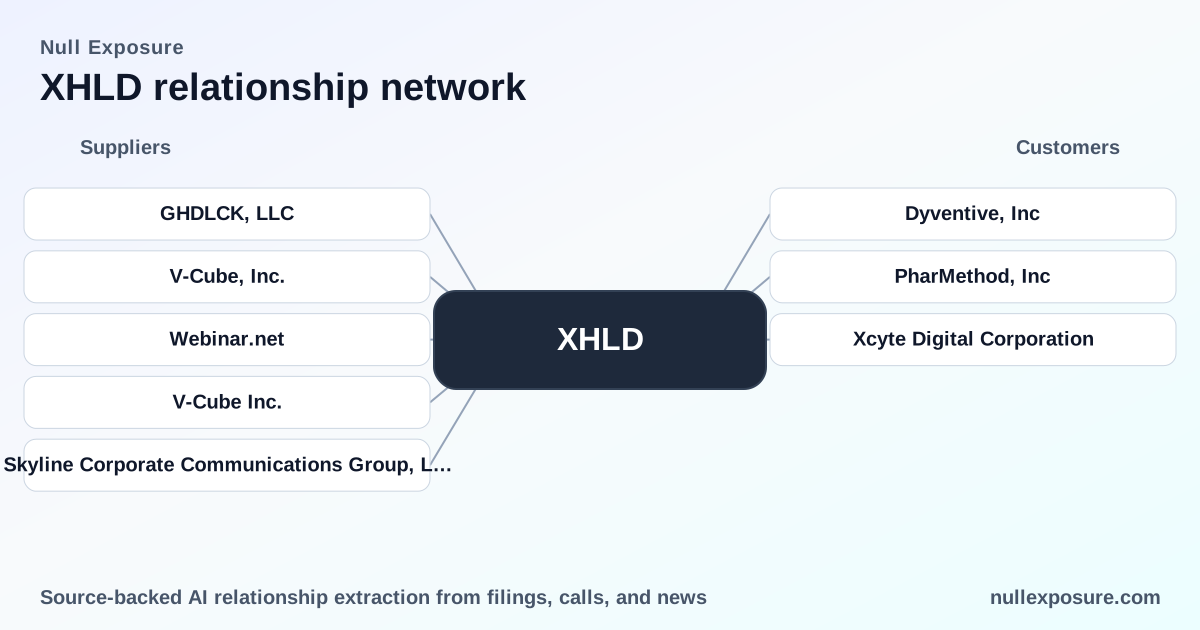
Dyventive, Inc.
Dyventive is listed in TEN’s FY2024 Form 10‑K under revenue from related parties for “sales from delivered events,” indicating Dyventive purchased event services from TEN. According to the 2024 Form 10‑K, Dyventive is recorded as a related-party customer with revenue attributable to delivered events (TEN Holdings FY2024 Form 10‑K).
PharMethod, Inc.
PharMethod is similarly reported in the FY2024 Form 10‑K as a related-party customer, with revenue recorded for sales from delivered events. The filing treats PharMethod as a customer that generated event-sales revenue for the company (TEN Holdings FY2024 Form 10‑K).
Xcyte Digital Corporation
TEN entered a Digital Reseller Program Agreement with Xcyte Digital Corporation, described publicly in a Marketscreener news report dated October 27, 2025, which positions Xcyte as a reseller partner for TEN’s enterprise communication offerings. The Marketscreener article notes the reseller program agreement and frames it as an expansion of TEN’s distribution channel (MarketScreener, Oct 27, 2025).
(Each relationship above is explicitly disclosed in TEN’s public materials: the Dyventive and PharMethod mentions come from the FY2024 Form 10‑K; the Xcyte Digital relationship is disclosed via the Marketscreener news report.)
What the relationships and constraints imply for risk and strategy
From a risk-management and operational-strategy perspective, the disclosures point to several investor-facing conclusions:
- High client concentration is the single largest risk. The top customer representing ~64.6% of revenue in 2024 creates revenue and receivables vulnerability. That concentration is a structural feature of current revenue generation rather than a transient metric.
- Contract structure provides partial insulation. The presence of MSAs and prepaid bundles introduces contractual levers to preserve revenue streams and cash flow, improving short-term resilience even in the presence of customer concentration (FY2024 Form 10‑K).
- Customer diversity exists but is not currently de-risking. TEN serves customers across sizes — small businesses to very large enterprises — which offers a path to diversify revenue. However, current revenue is not diversified: the bulk of revenue flows through a very small number of accounts (company 10‑K).
- Repeat customers signal execution competency. Nine of the top ten customers in 2024 were repeat buyers, indicating TEN’s services and platform drive renewal and that the company can execute complex events with sufficient quality to retain clients (FY2024 Form 10‑K).
If you evaluate platform-driven event service providers, this is a classic trade-off: operational expertise and platform utility produce strong retention, but business concentration requires explicit mitigation strategies such as expanding reseller agreements (e.g., Xcyte), diversifying enterprise sales, and building out prepaid-bundle penetration to stabilize cash flow. Learn more at https://nullexposure.com/.
How investors and operators should act on this profile
- For investors: prioritize monitoring large-customer renewal timelines, accounts receivable concentration, and progress on diversification initiatives (reseller agreements, enterprise pipeline). The company’s economic upside is dependent on retaining top accounts and scaling reseller/distribution channels.
- For operators: accelerate contract conversions from one-off events to MSAs or prepaid bundles, expand channel partnerships like the Xcyte reseller agreement, and set explicit targets to lower revenue share from the single largest customer below materiality thresholds.
Bottom line
TEN Holdings combines a profitable niche — platform-enabled event production and broadcasting — with acute customer concentration that frames both its risk and reward. The disclosures in the FY2024 Form 10‑K show repeatable business and contractual levers that support revenue visibility, but the single-customer concentration and small customer base require active strategic diversification to unlock stable, institutional-grade growth.