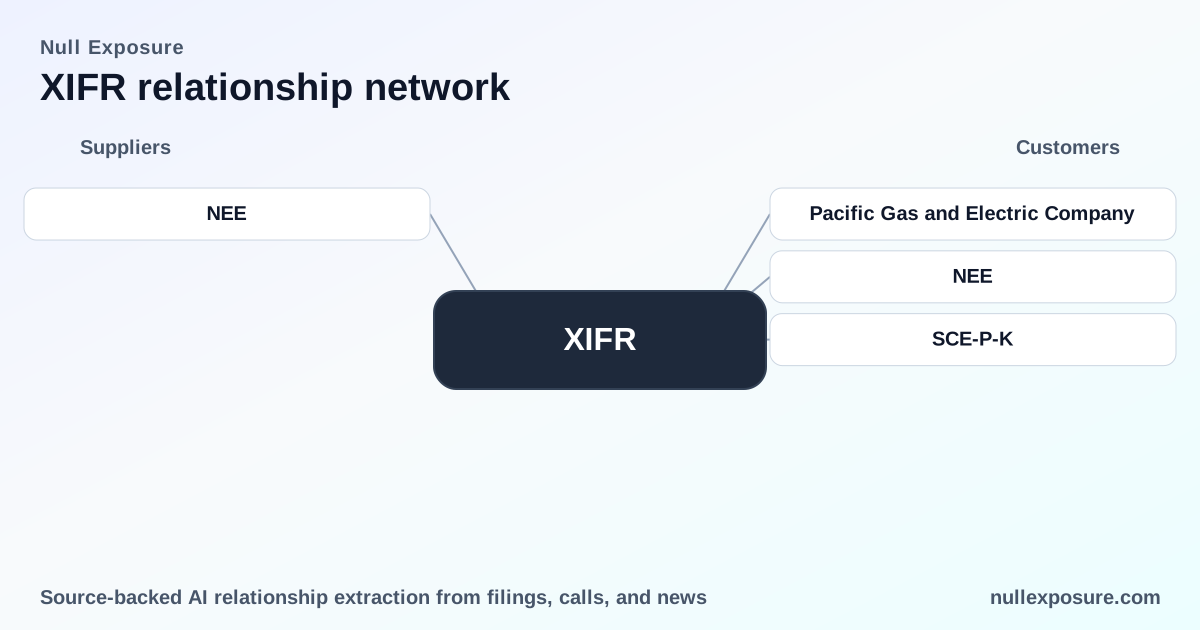
XIFR customer relationships: concentrated utility counterparties and growing offtake backlog
XPLR Infrastructure LP (XIFR) acquires, owns and operates contracted clean energy projects and monetizes them primarily by selling electricity and renewable attributes under long‑term, fixed‑price power purchase agreements (PPAs) and by commercializing ancillary project rights such as interconnection capacity. The business generates stable cash flows from contracted counterparties, shows revenue concentration in large regulated utilities, and is expanding origination activity with corporate offtakers and merchant trades that drive backlog growth.
For a consolidated view of XIFR’s counterparties and contract profile, see the full coverage at https://nullexposure.com/.
Why customers matter: revenue concentration is the financial story
XPLR’s operating cash flow and valuation are driven by contract length, counterparty credit and the ability to monetize non‑core project rights. The company reported that two utility counterparties accounted for about 30% of consolidated revenue in 2024, a structural concentration that both stabilizes near‑term cash flow and creates counterparty risk that investors must underwrite. At the same time, origination wins with large industrial and utility buyers expand optionality and backlog, which supports growth and gives route to scale.
Customer-by-customer readout (every relationship in the record)
Pacific Gas and Electric Company — material PPA counterparty (10‑K, FY2024)
XPLR disclosed in its FY2024 Form 10‑K that contracts with Pacific Gas and Electric Company represented approximately 15% of consolidated revenue during 2024, indicating a material long‑term offtake relationship with a major California utility. This fact is reported directly in the company’s 2024 filing. (Source: XPLR 2024 Form 10‑K)
ETR (ticker ETR) — framework agreement headline in corporate presentations (news, FY2026)
XPLR announced new framework agreements that name Entergy alongside two Fortune 50 customers and ETR in a presentation of origination capacity, committing to up to 15 GW of renewables and storage by 2030, which reflects sizeable offtake pipeline potential. The announcement appeared in investor event coverage in 2026. (Source: investor event coverage, Q1–Q2 2026)
Google (GOOGL) — corporate offtake adding sizeable MW to backlog (news, FY2026)
XPLR’s Energy Resources business added 860 MW from Google agreements to its backlog during a high‑origination quarter, a disclosure that underlines growing demand from technology corporates for long‑dated clean energy supply. This was noted in earnings / investor presentation coverage in 2026. (Source: investor event coverage, FY2026)
Entergy — named in framework agreements for large‑scale buildout (news, FY2026)
Entergy was included with Entergy/ETR references in XPLR’s disclosures around framework agreements that together target up to 15 GW of renewables and storage by 2030, positioning Entergy as a strategic utility counterpart for future contracted supply. The remark comes from public investor communications in 2026. (Source: investor event coverage, FY2026)
NEE (NextEra Energy / NextEra Energy Resources) — commercial sales of interconnection capacity (earnings call, 2025Q4)
XPLR told investors that it is monetizing surplus interconnection capacity and rights at certain project sites through sales to NextEra Energy Resources, converting stranded project options into near‑term proceeds and demonstrating an additional revenue axis beyond contracted power sales. This was discussed on the Q4 2025 earnings call. (Source: XIFR Q4 2025 earnings call)
NextEra Energy Resources — same commercial transaction described to investors (earnings call, 2025Q4)
The company reiterated on its Q4 2025 call that transactions with NextEra Energy Resources involve the sale of interconnection capacity and rights, confirming a direct commercial relationship that supplements PPA revenue and reduces interconnection risk for specific sites. (Source: XIFR Q4 2025 earnings call)
Southern California Edison Company — material PPA counterparty (10‑K, FY2024)
XPLR’s FY2024 10‑K states that Southern California Edison Company accounted for approximately 15% of consolidated revenue in 2024, matching the contribution from PG&E and underscoring a concentrated revenue exposure to California investor‑owned utilities. (Source: XPLR 2024 Form 10‑K)
SCE‑P‑K — duplicate 10‑K reference to SCE revenue contribution (10‑K, FY2024)
The filing also lists SCE under an alternate designation (SCE‑P‑K) in the revenue concentration disclosure; the underlying point is the same — SCE‑related contracts are material to FY2024 revenue as captured in the company’s annual filing. (Source: XPLR 2024 Form 10‑K)
Operating model constraints and what they imply for investors
XPLR operates under a set of contract and structural constraints that shape both risk and value creation:
- Long‑term, fixed‑price PPAs dominate revenue. Company filings state that the majority of project output and renewable attributes are sold under long‑term PPAs, creating predictable cash flow but exposing the firm to long‑dated price fixation relative to market upside. (Company filing evidence)
- North America centricity. Revenue concentration disclosures and portfolio descriptions indicate the portfolio and counterparties are U.S.‑focused, which concentrates regulatory and market risk regionally. (Company filing evidence)
- Mixed relationship roles: seller, buyer, and service provider. XPLR is primarily a seller of energy/attributes, but also acts in contexts akin to a service provider (for firm pipeline capacity) and a buyer in contract mechanics, implying operational complexity and multiple commercial channels. (Company filing evidence)
- Active, mature infrastructure profile. The portfolio was reported at approximately 10 GW of net generating capacity across 31 states as of year‑end 2024, signaling scale, operational maturity and infrastructure attributes that influence capital structure and return expectations. (Company filing evidence)
These constraints mean investors must weigh credit quality and regulatory stability of top counterparties, the impact of fixed PPA pricing on upside capture, and the role of non‑PPA monetizations (like interconnection sales) in smoothing returns.
Investment implications — risks and opportunities
- Key strength: Stable, contracted cash flow from long‑term PPAs and material utility counterparties supports valuation multiples that reflect predictable revenue streams.
- Key risk: Customer concentration — two counterparties accounted for roughly 30% of 2024 revenue, concentrating counterparty risk and making results sensitive to utility contracting dynamics and regulatory changes in California.
- Growth vector: Origination momentum with corporate names such as Google and framework deals including Entergy position XPLR to diversify revenue sources and scale backlog into build‑out through 2030.
- Commercial flexibility: The company’s ability to monetize interconnection capacity with NextEra demonstrates optionality that converts latent asset value into cash.
For a deeper run‑rate and counterparty exposure dashboard, visit our full analysis at https://nullexposure.com/.
Bottom line
XPLR’s customer base combines large regulated utilities that deliver near‑term revenue stability and corporate/utility origination wins that expand long‑term optionality. Investors should price in both the defensive cash‑flow attributes of long‑term PPAs and the concentration risk tied to major California utilities, while tracking origination and interconnection monetizations as key upside catalysts.