Xometry (XMTR): Customer Map and Commercial Health for Investors
Xometry operates an AI-enabled online manufacturing marketplace that connects buyers — from individual engineers and small businesses to Fortune 500 procurement teams — with a distributed network of suppliers for on-demand custom parts and assemblies. The company monetizes primarily through marketplace transactions (roughly 89% of revenue in 2024), plus cloud services such as Workcenter and Teamspace, collecting fees and service margins on orders while recognizing marketplace-related costs on a short-term basis. For deeper research into counterparty exposures and relationship signals, visit https://nullexposure.com/.
Business model and monetization
Xometry is a two-sided marketplace that extracts revenue from transaction flows and from software services it layers on top of manufacturing capacity. Marketplace revenue dominates the P&L, and the platform’s economics depend on order frequency, supplier capacity utilization, and the company’s ability to retain buyers. The latest trailing-twelve-month figures show revenue of $686.6M and gross profit of $268.8M, while profitability remains negative on the bottom line (TTM diluted EPS -$1.20), underscoring that top-line growth is still being prioritized over operating margin expansion.
Customer composition and concentration
Xometry’s customer book spans many counterparty types: individual buyers, small businesses, large enterprises, and very large enterprises including Fortune 500 firms. According to company disclosures, no single customer accounted for more than 10% of revenue in 2024, a corporate-level signal of low revenue concentration and diversified demand. That diversification reduces single-customer credit risk but increases the importance of scale and retention to defend unit economics.
Contracting posture, criticality, and maturity
- Short-term contracting posture: The company recognizes marketplace costs over periods of one year or less, indicating primarily short-duration engagements with buyers and suppliers — typical for on-demand manufacturing orders. This implies limited long-term contractual lock-ins and revenue tied to repeat transactional activity rather than multi-year contracts.
- Buyer role and activation: Xometry classifies the bulk of its external relationships as buyers and defines “Active Buyers” as those who purchased within the last twelve months. For the quarter ended December 31, 2024, 97% of marketplace revenue came from existing accounts, signaling high repeat purchasing and the importance of retention metrics.
- Maturity signal: Marketplace revenue comprised approximately 89% of total revenue in 2024, which positions Xometry as a predominantly transaction-driven marketplace rather than a diversified enterprise SaaS vendor; commercial maturity depends on maintaining order frequency and supplier network depth.
Geographic reach and segment concentration
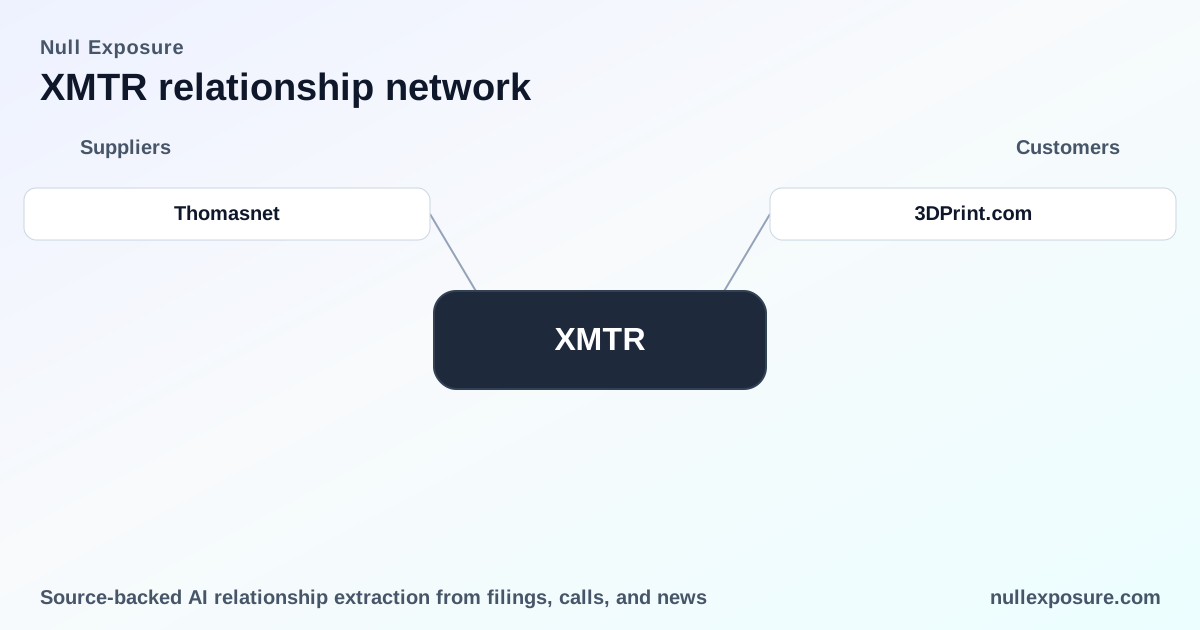
Xometry operates globally but maintains significant roots in North America. Company statements emphasize both North American industrial buyer connectivity and broader global capacity: the firm advertises “real-time access to global manufacturing demand and capacity,” while platforms like Thomasnet are cited as North American industrial connectors. Manufacturing is the core segment; marketplace activity and the Workcenter/Teamspace offerings are explicitly built for the industrial-distribution and custom-manufacturing verticals.
Active, diverse buyer base — why it matters
Two operational facts matter for investors: buyer diversity and buyer activity. The buyer base includes a spectrum from one-off individual orders to repeat enterprise procurement. High retention (97% of revenue from existing accounts) demonstrates that Xometry’s platform converts trial volume into ongoing flows, which stabilizes revenue even under cyclical industrial demand. At the same time, the short-term contract posture means revenue durability is a function of continued engagement rather than contractual commitments.
Relationship-level coverage
3DPrint.com (March 10, 2026) — FY2026 mention
3DPrint.com listed Xometry among platforms powering on-demand 3D printing services, indicating Xometry’s role as an enabling backend for third-party print services and marketplaces. This public mention highlights Xometry’s presence in the 3D printing ecosystem and brand recognition among industry-focused media. (Source: 3DPrint.com article, March 10, 2026)
Operational implications of the constraints
The constraint signals extracted from company materials and filings form a coherent operating picture:
- Short-term contracts are the norm: Marketplace economics are transactional and renewal-driven, not anchored by long-duration contracts. This compresses counterparty credit exposure but increases sensitivity to order-rate fluctuations.
- Counterparty diversity is broad: The platform serves individuals, small businesses, and enterprises up to Fortune 500 scale. That breadth reduces concentration risk while increasing the need for product features that serve different buyer archetypes.
- Geography is both North American and global: Xometry leverages North American industrial networks while running a global marketplace; supply chain and currency dynamics across regions are relevant to margin stability.
- Materiality is low at the single-customer level: No single buyer exceeded 10% of revenue in recent years, a positive diversification signal for risk management.
- Active, retention-driven revenue: The platform’s revenue is highly dependent on repeat buyers; retention rates and customer lifetime value are therefore primary operational KPIs.
Key risks and upside drivers
- Upside drivers: retention and wallet expansion among existing buyers, scaling supplier capacity to reduce lead times, and growing higher-margin software services could materially improve unit economics. Analyst consensus pricing (target ~$62.62) and institutional ownership >99% indicate investor interest in execution-led valuation improvements.
- Risks: transactional nature of contracts and negative operating margins increase sensitivity to demand swings; concentration of revenue in marketplace transactions (89%) concentrates execution risk; and global supply-chain disruptions can affect delivery performance and margins.
Investor takeaways
- Xometry is a high-growth marketplace whose economics depend on sustained buyer engagement and supplier depth. The customer base is diverse and low in single-customer concentration, which is a structural advantage for enterprise risk.
- Short-term contracting and heavy reliance on repeat orders make retention the central operational KPI. Investors should track churn, active buyer growth, average order values, and the pace of migration into higher-margin software services.
- Public mentions such as the March 2026 3DPrint.com article underline Xometry’s strategic visibility in manufacturing and 3D printing ecosystems, reinforcing its role as a platform enabler.
For a consolidated view of Xometry’s customer relationships, counterparty profiles, and constraint signals used in this analysis, visit https://nullexposure.com/ — the research hub for relationship-level corporate intelligence.