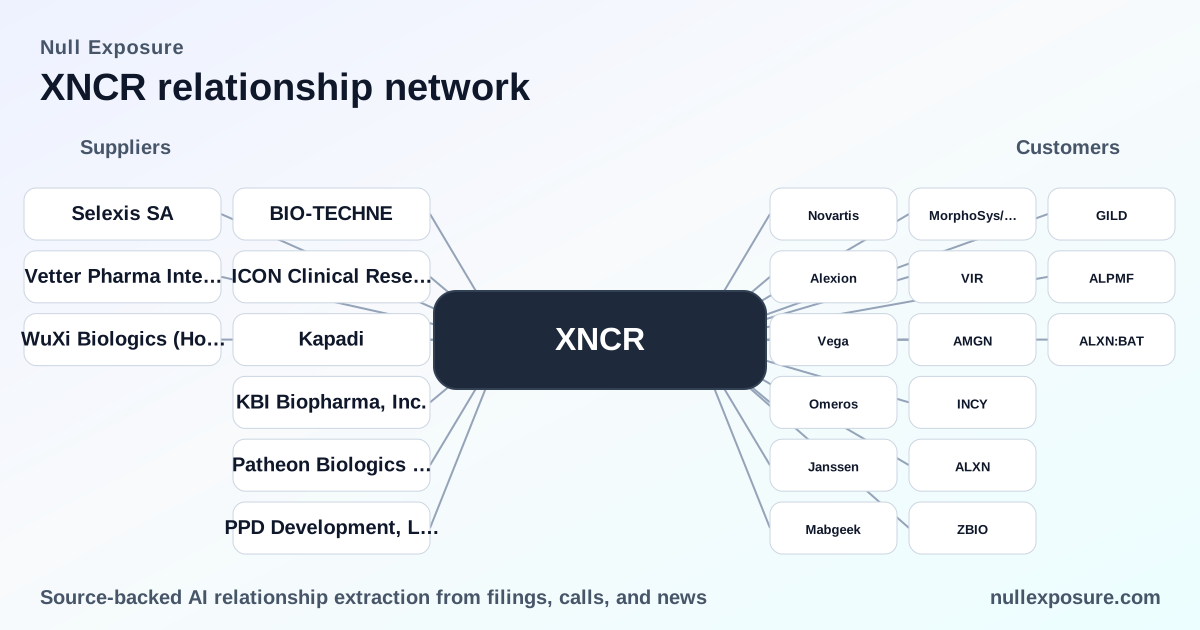
Xencor (XNCR) — Partner Map and What License Relationships Mean for Revenue and Risk
Xencor is a clinical‑stage biopharma that monetizes an engineered Fc and antibody platform (Xtend™ and XmAb®) primarily through licensing, milestone payments and royalties to larger biopharma partners while advancing its own clinical programs. The company’s top‑line is therefore partnership‑driven: recurring and non‑cash royalty revenue plus contract/license fees account for the majority of reported revenue, and a small set of licensees contribute a material share of receipts. For investors evaluating counterparty exposure and revenue durability, the partner roster and recent news flow are the primary value drivers. For a concise view of this relationship intelligence visit https://nullexposure.com/.
How Xencor’s partnership model maps to cash flow and risk
Xencor’s operating model is license‑centric: the company grants technology and molecule licenses that convert into upfront and milestone cash plus royalties on product sales. That contracting posture creates four practical business signals for investors:
- Concentration: Xencor’s 10‑K reports a short list of licensees driving most revenue, signaling high revenue concentration at the company level rather than broad retail sales diversification (see relationship table below).
- Contracting posture: Agreements are structured as multi‑component deals (upfronts, milestones, tiered royalties), which creates episodic cash inflows tied to partner development and commercialization events.
- Criticality: Some licensed products are commercial and royalties can be material to cash flow; disputes or license interpretations can therefore move guidance and liquidity rapidly.
- Maturity mix: Partners range from large, commercial biopharma (Amgen, Alexion, Novartis, Gilead) to smaller biotech licensees and development‑stage deals, producing a mixed maturity profile across revenue sources.
No explicit contract constraints were extracted in the record set supplied here; this absence is itself a company‑level signal that the available data set did not include additional contract caveats or embargoed provisions.
Relationship map — each partner shown in source material and what they mean
Janssen
Xencor’s FY2024 Form 10‑K lists Janssen among licensees contributing to principal revenue and shows a figure of 77.8 adjacent to Janssen for the period reported in the 10‑K. This indicates Janssen’s material presence in Xencor’s revenue disclosures. (Source: Xencor 2024 Form 10‑K)
Mabgeek
Mabgeek is named in the FY2024 10‑K with an associated figure of 1.5 in the licensee table, reflecting a small but recorded revenue relationship in the 10‑K. (Source: Xencor 2024 Form 10‑K)
Vega
Vega appears in the FY2024 licensee listing with a 0.5 notation in the 10‑K’s principal licensee schedule, showing it as a minor recorded licensee for that year. (Source: Xencor 2024 Form 10‑K)
Omeros
Omeros is included in the 10‑K table with 5.0 noted, positioning it as a modest contributor to reported license revenues in FY2024. (Source: Xencor 2024 Form 10‑K)
Novartis
Novartis is listed in Xencor’s FY2024 licensee schedule with a 4.0 figure, marking it among the named licensees in the company’s audited revenue disclosure. (Source: Xencor 2024 Form 10‑K)
MorphoSys / Incyte
MorphoSys/Incyte are jointly presented in the 10‑K schedule with entries showing 8.7 (and similar prior‑year figures), indicating a recurring license relationship recorded across reporting periods. (Source: Xencor 2024 Form 10‑K)
Alexion / Alexion Pharmaceuticals, Inc. (ALXN)
Alexion is listed prominently in the 10‑K and accounted for sizeable reported license amounts historically (see the 10‑K line items). Separately, Xencor announced it expects low‑single digit royalties on Ultomiris® sales into December 2028 following a U.S. patent‑term extension (BioSpace, May 4, 2026), but public reports in March–May 2026 document a dispute in which Alexion informed Xencor it would cease U.S. royalty payments while continuing international payments, a development Xencor acknowledged and that affected cash guidance in public disclosures (TradingView, Investing.com, FinViz, Mar–May 2026). (Sources: Xencor 2024 Form 10‑K; BioSpace press release May 4, 2026; TradingView and Investing.com March–May 2026)
Amgen (AMGN)
Amgen is listed in the 10‑K schedule (showing a 30.0 figure) and in press releases describing active development programs using Xencor’s bispecific technology; a BioSpace Q3 2025 release notes Amgen initiated a Phase 3 XALience study and states Xencor is eligible for up to $225 million in future milestone payments plus tiered royalties in the mid‑ to high‑single digits on that program. (Sources: Xencor 2024 Form 10‑K; BioSpace Q3 2025 press release)
Incyte (INCY)
Incyte appears both in the 10‑K schedule (as part of the MorphoSys/Incyte entry) and in Xencor’s Q3 2025 commentary where company revenue recognized in certain quarters was described as primarily non‑cash royalty revenue from Alexion and Incyte. (Sources: Xencor 2024 Form 10‑K; BioSpace Q3 2025 press release)
Vir / VIR
Vir is listed in the 10‑K table and multiple press releases for 2025–2026 note that Vir’s engineered Fc domain incorporates Xencor’s Xtend™ technology to extend half‑life, confirming a technology license relationship supporting Vir’s clinical programs. (Sources: Xencor 2024 Form 10‑K; Vir press releases via BioSpace Mar 2025–2026)
Zenas / Zenas Biopharma (ZBIO)
Zenas is listed in Xencor’s FY2024 licensee table with a 10.0 figure, and company press releases state that Xencor licensed obexelimab to Zenas (Nov 2021) and is eligible for up to $460 million in future milestone payments and tiered royalties ranging from mid‑single‑digit to mid‑teen percentages, dependent on geography. (Sources: Xencor 2024 Form 10‑K; BioSpace Q3 2025 press release)
Gilead (GILD)
Gilead is recorded in the FY2024 10‑K licensee schedule with a 6.0 notation, placing it among the named contributors to license revenue in the audited disclosure. (Source: Xencor 2024 Form 10‑K)
Astellas (ALPMF)
Astellas is in the FY2024 licensee table (noted as 5.0), and Xencor’s Q3 2025 commentary highlights Astellas’ Claudin18.2 XmAb program (ASP2138), stating Xencor is eligible for $232.5 million in future milestone payments and tiered royalties ranging from high‑single to low‑double digits. (Sources: Xencor 2024 Form 10‑K; BioSpace Q3 2025 press release)
Genentech
News aggregation in early 2026 reports that Xencor and Genentech will end their protein therapeutics collaboration effective March 9, 2026, marking a termination of a historical partnership line item in public reporting. (Source: MarketBeat/TipRanks news alert, March 2026)
Pfizer, AstraZeneca, Lilly
Market commentary and analyst notes list Pfizer, AstraZeneca and Lilly among larger partners that leverage Xencor’s XmAb platform to generate candidates across oncology and immunology, positioning those relationships as platform‑licensing partnerships rather than single‑product royalty streams in the public summaries. (Source: MarketBeat analyst coverage and company press materials, 2026)
Investment implications — what to watch
- Revenue concentration is a live risk: the 10‑K licensee table and management commentary show a small set of partners producing a large share of reported revenue; any commercial dispute or royalty cessation (Alexion case) materially changes near‑term cash flow.
- Deal economics drive upside and episodic cash: milestone potential (Amgen $225M; Zenas $460M; Astellas $232.5M) and tiered royalties are the primary sources of upside; those payments are contingent on partner development and commercialization outcomes (BioSpace, Q3 2025 releases).
- Licensing disputes demonstrate legal and execution risk: the Alexion U.S. royalty disagreement shows how interpretation of royalty obligations can become a binary cash event, affecting guidance and valuation multiples (news reports Mar–May 2026).
- Portfolio diversification is mixed: Xencor’s partner list includes global pharmas and smaller biotechs, which spreads technological adoption but still leaves company cash flow vulnerable to a handful of outcome events.
For analysts building exposure models, the critical next inputs are (1) product‑level sales trajectories for licensed drugs subject to royalties, (2) the status and outcomes of active disputes (Alexion), and (3) cadence and probability assumptions for milestone realization across Amgen, Astellas and Zenas programs. For a distilled contract and counterparty view of Xencor partnerships, visit https://nullexposure.com/ for the underlying source references and timeline reconstruction.
Key takeaway: Xencor’s business is intrinsically partner‑driven — upside is concentrated in milestone/royalty economics, while downside is concentrated in legal/interpretive risks around commercial royalties. Monitoring partner trial milestones and any further license disputes is the highest‑value activity for investors tracking XNCR.