XOMA Corporation (XOMAO): who pays the royalty aggregator and why it matters
XOMA is a biotechnology royalty aggregator and IP licensor that monetizes through a combination of upfront payments, royalties, milestone receipts, and the sale or purchase of future revenue streams (RPAs/AAAs/CPPAs). The company’s cash flow is driven by contractual royalty interests in marketed products and negotiated revenue-sharing on development-stage assets across the U.S., EMEA and APAC, with a repeated emphasis on licensing transactions and milestone frameworks. For investors, XOMA’s value proposition is predictable, contract-driven revenue coupled with concentrated exposures to a handful of strategic counterparties. Learn more about coverage and signals at https://nullexposure.com/.
How XOMA’s commercial relationships shape its cash flow profile
XOMA’s operating model is contract-centric: income derives from licensed IP, royalty streams, and structured sales of future receipts rather than from a large commercial product portfolio. That posture produces several company-level characteristics investors must weigh:
- Contracting posture: XOMA functions primarily as a licensor/royalty holder and a purchaser/seller of revenue streams; its economics are governed by multi-year license agreements, royalty rate schedules and contingent milestone provisions (company-level signal from filings).
- Concentration and geography: Revenues are weighted to the U.S., Europe and Asia Pacific and therefore subject to regional regulatory and commercial dynamics across those markets (company-level signal from filings).
- Criticality and maturity: The mix is a balance of established royalties on marketed assets and exposure to development-stage externalized assets where milestone realizations and partnering outcomes generate step-function value.
- Predictability: Royalty and CPPA/CPPA-like receipts provide a predictable baseline; however, near-term volatility comes from amendment-driven restructurings and contingent-value arrangements announced in the press.
Deal-by-deal readout: the counterparties on XOMA’s ledger
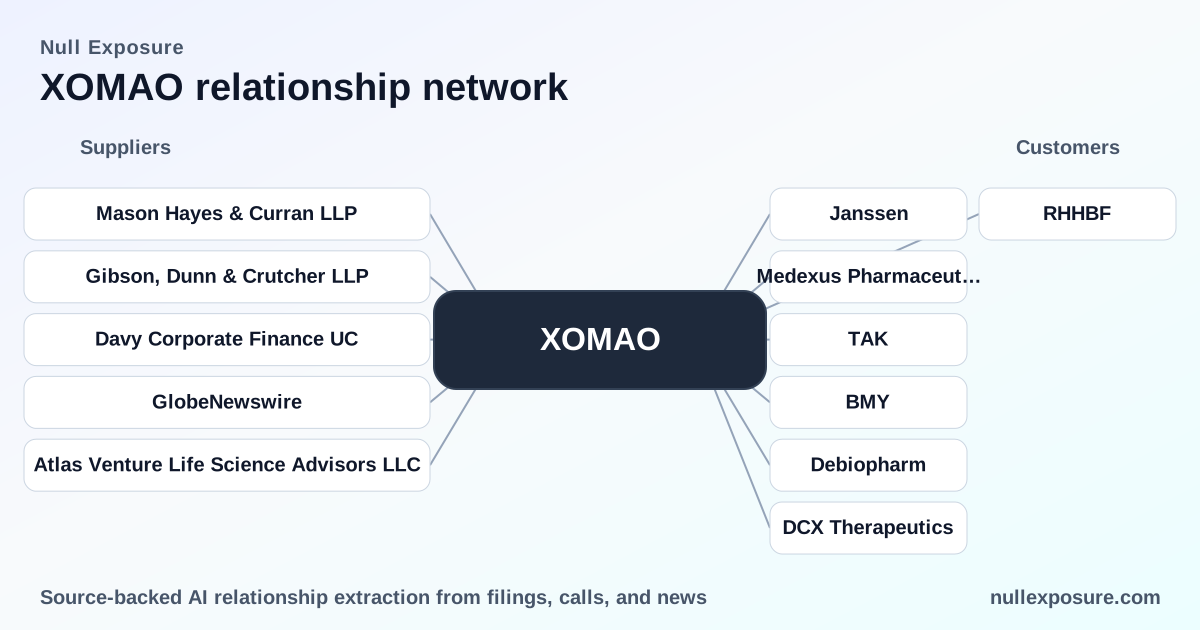
Below is a concise, itemized review of every customer/partner relationship disclosed in XOMA’s recent results with a plain-English take and the underlying source.
Janssen — non-exclusive license for product development
XOMA granted Janssen a non-exclusive license to develop and commercialize certain product candidates under an agreement disclosed in XOMA’s 2024 Form 10-K, signaling a traditional licensor-licensee relationship that can deliver milestone and royalty flows if assets progress. According to XOMA’s 2024 Form 10‑K (filed Feb 2026), the company recorded this licensing arrangement in FY2024.
Medexus Pharmaceuticals — IXINITY royalty/milestone stream
XOMA retains a revenue stream and a portion of milestone rights tied to IXINITY, the recombinant coagulation factor IX product marketed by Medexus, representing a product-linked royalty exposure. The 2024 Form 10‑K references the stream and milestone allocation to Medexus in FY2024.
Takeda (TAK) — amended royalty-sharing and royalty reduction on mezagitamab
XOMA executed a strategic royalty-sharing transaction with Takeda that reduces XOMA Royalty’s royalty and milestone obligations on mezagitamab while replacing them with low- to mid-single-digit royalties and milestone payments across a basket of nine development-stage assets from Takeda’s externalized portfolio. This transaction and amendment were disclosed in a GlobeNewswire press release reported via The Globe and Mail in March 2026 and covered by multiple news outlets in early May 2026.
Takeda (TAK) — additional public coverage on milestone adjustments
Follow-up reporting indicates the amended arrangement lowered XOMA’s mezagitamab royalty interest from mid-single digits to low-single digits and reduced potential milestone payments (for example, reducing a referenced milestone bucket from $16.25 million to $13 million), reflecting a negotiated trade-off between concentrated upside and broader, but smaller, portfolio receipts. Reporting on this amendment appeared in Investing.com’s coverage in May 2026.
Bristol Myers Squibb (BMY) — contingent value right tied to Repare asset sale
XOMA’s acquisition of Repare includes a contingent value right that allocates a material share of net proceeds from Repare’s existing collaborations with Bristol Myers Squibb; that structure gives XOMA a route to upside from BMY-linked deals while capping immediate cash consideration. OncologyPipeline reported on XOMA’s Repare acquisition and the contingent-value structure in March 2026.
Debiopharm — part of contingent-proceeds pool from Repare transactions
Debiopharm is named among the collaborators whose existing deals with Repare are covered by the contingent value right; XOMA’s acquisition therefore gives it downside-protected exposure to potential proceeds from Debiopharm collaborations. This arrangement was described in OncologyPipeline’s March 2026 coverage of the Repare transaction.
DCX Therapeutics — included in contingent-value sharing on Repare
DCX Therapeutics appears in the same contingent-proceeds construct tied to XOMA’s Repare acquisition, meaning XOMA stands to receive a negotiated share of proceeds from any monetizations associated with DCX collaborations. OncologyPipeline’s March 2026 article includes DCX in the Repare contingent-value description.
Roche (RHHBF) — Affitech CPPA and VABYSMO royalty stream
Under XOMA’s Affitech CPPA, the company is eligible to receive 0.5% of net sales of VABYSMO for 10 years following first commercial sale in each jurisdiction, representing a long-dated, product-level royalty with a clearly defined rate and duration. This entitlement is disclosed in XOMA’s 2024 Form 10‑K (filed Feb 2026).
What investors should take away
- Revenue composition is contractual rather than product-driven. XOMA’s cash flows come from licenses, royalties, milestone clauses and revenue-stripping arrangements, which produces a predictable baseline but concentrated counterparty risk.
- Recent amendments shift risk-return profiles. The Takeda transaction rebalances concentrated upside on mezagitamab into more diversified, lower-per-asset royalties across nine assets — a structural change that reduces single-asset exposure while expanding the number of smaller revenue contributors.
- Repare acquisition creates optionality on third-party collaborations. The contingent value structure tied to BMY, Debiopharm and DCX provides asymmetric upside if those collaborations produce monetizable outcomes, while limiting initial cash outlay.
Key risk and upside vectors
- Upside: Successful commercialization or licensing of development-stage assets (especially those in the Takeda basket and Repare portfolio) converts contingent payments into cash flows.
- Risk: Amendments and restructurings can compress royalty rates (as seen with Takeda) and reduce headline receipts; regional sales dynamics for VABYSMO and IXINITY remain material for near-to-medium-term revenue realization.
- Concentration risk: Despite multiple counterparties, a handful of counterparties and a small number of product linkages account for the majority of contractually defined receipts.
If you want a deeper readout on contractual terms and exposure maps, visit https://nullexposure.com/ for expanded coverage and contract-signal analytics.
Final assessment
XOMA operates as a contract-first royalty vehicle: predictable contractual cash flows punctuated by event-driven upside from milestone realization and asset monetizations. For investors focused on yield and contractual cash visibility, XOMA offers a differentiated profile—with the trade-offs of counterparty concentration, amendment risk and dependence on the commercialization or licensing success of a limited number of partner-held assets.