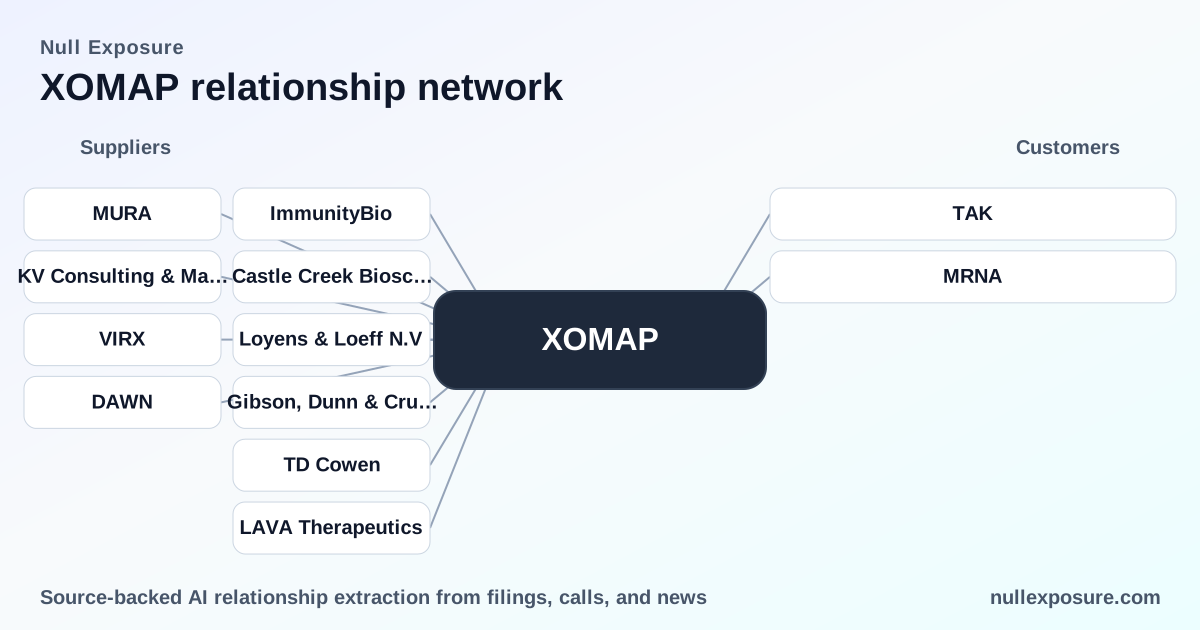
XOMA Royalty Corporation (XOMAP): A concise read on customer relationships and revenue drivers
XOMA Royalty Corporation aggregates biotech royalties and milestone streams by acquiring rights to future payments from drug developers and licensors; it monetizes through license-derived revenue — upfront fees, milestone receipts, and running royalties — and selectively acquires royalty-bearing assets to grow recurring cash flows. This profile focuses on XOMAP’s key counterparty relationships that drive near‑term cash realization and medium‑term optionality for investors. For a structured view of related counterparties and their deal contexts, visit https://nullexposure.com/.
How XOMA structures its commercial exposure: licensing, royalties and concentrated partners
XOMA recognizes revenue from licensing arrangements that typically include non‑refundable upfront fees, development/regulatory/commercial milestone payments, and royalties on net sales. That accounting posture creates cash-flow profiles that are lumpy but high‑margin: royalties deliver long-duration tails while milestones deliver binary near-term boosts.
- Contracting posture: Contractual relationships are licensing-centric and therefore enforceable but outcome contingent — payments depend on development progress and commercial launches.
- Concentration: A small number of large counterparties (e.g., Takeda, collaborations tied to Moderna) dominate the profile; that implies counterparty concentration risk alongside upside if those programs commercialize.
- Criticality and maturity: Many referenced assets are development‑stage or early commercial, so timing and probability of receipts are immature and hinge on regulatory readouts and partner decisions.
- Revenue quality: When realized, royalties are high‑margin — XOMA’s gross profit metrics reflect this — but predictability is lower than fee‑for‑service models.
Customer relationships: clear line items you need to model
Takeda (TAK) — restructured royalty share on mezagitamab and a basket of assets
XOMA executed a strategic royalty‑sharing and amendment arrangement with Takeda that reduces Takeda’s obligations tied to mezagitamab while replacing that exposure with low‑to‑mid single‑digit royalty and milestone payments on a nine‑asset basket drawn from Takeda’s externalized portfolio. According to a company press release covered by The Globe and Mail (March 10, 2026), the transaction shifts XOMA’s mix from a single‑asset concentration to broader, smaller royalty stakes. (Source: Globe and Mail press release, March 2026.)
Recursion Pharmaceuticals (RXRX) — REC‑4881 included in the Takeda asset basket
REC‑4881, developed by Recursion for familial adenomatous polyposis, is one of the assets folded into the Takeda basket that will generate low‑to‑mid single‑digit royalties and milestone rights for XOMA under the restructuring. This inclusion was listed in coverage of the Takeda transaction (Investing.com, May 4, 2026). (Source: Investing.com report, May 2026.)
Mirum Pharmaceuticals (MIRM) — volixibat part of the reallocated royalty stream
Volixibat (Mirum) is identified among the nine assets that transfer royalty upside to XOMA under the Takeda sharing arrangement; the company will receive royalties and potential milestone payments tied to that program’s development path. Investing.com’s May 4, 2026 article documents volixibat’s inclusion in the basket. (Source: Investing.com, May 4, 2026.)
Neurocrine Biosciences (NBIX) — osavampator referenced in the basket
Osavampator, being developed by Neurocrine for major depressive disorder, is also listed among the assets in the Takeda portfolio that now underpin XOMA’s expected royalty streams, giving XOMA exposure to Neurocrine’s clinical and commercial progress on that program. This was reported in the same May 2026 coverage of the Takeda transaction. (Source: Investing.com, May 4, 2026.)
Oak Hill Bio — multiple early‑stage assets (OHB‑607 and others) included
Oak Hill Bio’s OHB‑607 and five additional early‑stage assets form part of the nine‑asset basket that supplies incremental, development‑stage royalty and milestone claims to XOMA under the Takeda restructuring. Those assets increase the number of shots on goal but are early in their lifecycles and therefore higher risk. (Source: Investing.com, May 4, 2026.)
Moderna (MRNA) — indirect exposure via Generation Bio acquisition
XOMA’s acquisition of Generation Bio Co. gives the royalty aggregator potential milestone and royalty upside tied to Generation Bio’s collaboration with Moderna, introducing exposure to Moderna’s clinical and commercial execution where applicable. This linkage was disclosed in XOMA transaction coverage (QuiverQuant, March 10, 2026). (Source: QuiverQuant news, March 10, 2026.)
What these relationships mean for investors: risk/reward framed in operational terms
- Revenue optionality vs predictability: The portfolio-wide shift from a single‑asset royalty (mezagitamab) toward a diversified basket reduces idiosyncratic concentration but creates a higher number of low‑value, development‑stage claims that collectively can deliver steadier milestone cadence if multiple programs progress.
- Counterparty credit and execution risk: Takeda and Moderna represent high‑quality counterparties whose decisions materially affect XOMA receipts; counterparties like Oak Hill and other early‑stage collaborators increase development risk.
- Cashflow modeling implications: Modelers must assume lumpy milestones with low near‑term probability on early‑stage assets, while treating existing royalties from commercial products as higher‑confidence recurring revenue when present.
- Valuation sensitivity: XOMA’s value is highly sensitive to binary development outcomes and licensing amendments; a single large milestone or commercial approval from a basket constituent can materially change forward cashflows given the concentrated nature of potential payouts.
For a practical investor checklist and to benchmark these relationships against XOMA’s broader asset acquisition strategy, explore our research hub at https://nullexposure.com/.
Bottom line: portfolio management is the product
XOMA Royalty converts intellectual property and contractual royalty rights into a portfolio of concentrated but high‑margin cash streams. The recent Takeda restructuring and the Generation Bio acquisition reframe XOMA’s revenue path toward a broader set of development‑stage exposures, improving diversification while increasing reliance on development outcomes and partner execution. Investors should underwrite both the upside of milestone aggregation and the timing/realization risk that comes with development‑stage royalty assets.
Bold decision‑makers will price XOMA by balancing the probability‑weighted present value of milestones against the resiliency of any existing commercial royalties; that is the investment thesis in practice.