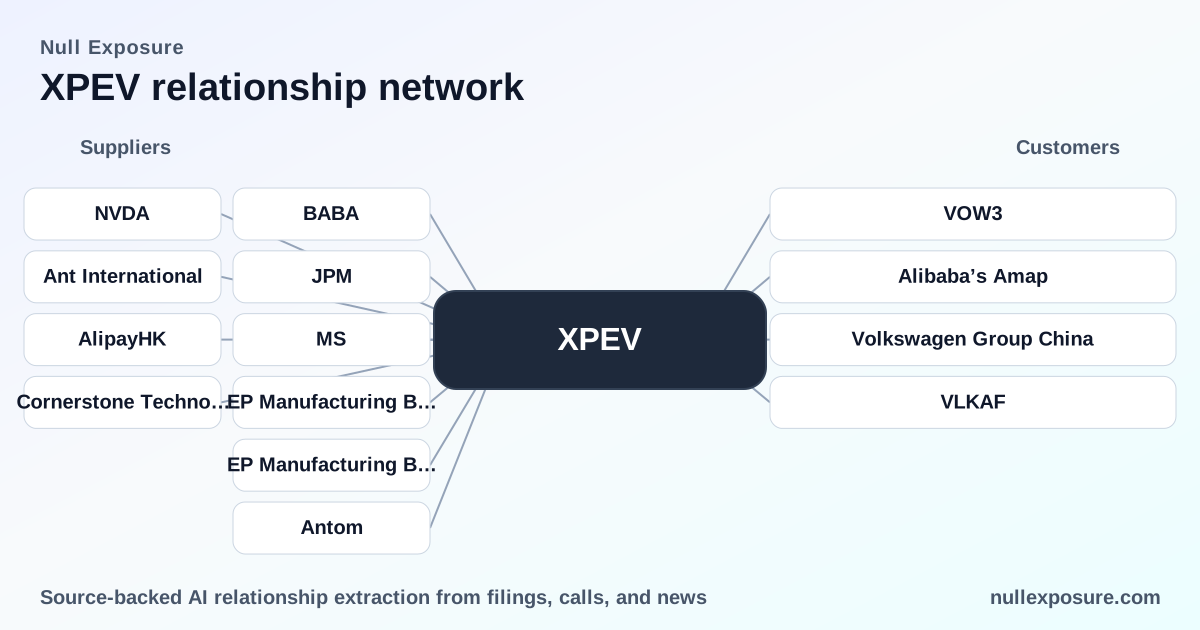
XPeng’s customer map: software-first revenue with Volkswagen as the strategic fulcrum
XPeng designs and sells smart electric vehicles in China and increasingly monetizes core software and electronic architecture through licensing, technical service fees and platform agreements with large OEMs. Vehicle sales remain the top-line engine, but the transition to high-margin technology and recurring platform revenue—anchored by Volkswagen—is now the defining commercial story for investors. For an expanded view of counterparty-level intelligence visit https://nullexposure.com/.
Volkswagen: the partnership that re-frames XPeng’s economics
XPeng’s commercial relationship with Volkswagen is the single most consequential customer tie in the public record. Multiple independent reports confirm Volkswagen has been designated the launch commercial customer for XPeng’s second‑generation VLA (Vision‑Language‑Action) autonomous driving stack, with global deliveries tied to 2027 programs. Beyond software deployment, XPeng is earning technical service fees for its G9 platform and the China Electrical Architecture (CEA), positioning software licensing and architecture services as a high‑margin revenue stream distinct from vehicle sales. Sources include GlobalChinaEV (March 10, 2026), FinancialContent/Markets (May 4, 2026) and SimplyWall.St (May 4, 2026).
- Key takeaway: Volkswagen provides both a large hardware platform for scale deployments and a route to recurring, higher-margin technology revenue that materially changes XPeng’s revenue mix and margin profile.
Other commercial touchpoints: robotaxis and distribution
XPeng has parallel customer and channel relationships that support product distribution and new mobility services:
- Alibaba’s Amap is the reported partner for a robotaxi service trial integrating XPeng vehicles, with trials targeted for 2026 and intended to operate on Amap’s platform. This positions XPeng as a vehicle and software supplier into mobility-as-a-service initiatives (TS2.Tech / Reuters reporting, March 10, 2026).
- TrueEV retains dealership/showroom distribution for XPeng vehicles in Australia, keeping export and retail channels active while XPeng pursues direct and platform-based monetization (ZeCar review, May 4, 2026).
Both relationships broaden XPeng’s go-to-market beyond direct retail and extend its software value proposition into mobility services and international sales channels.
Contracting posture, concentration and maturity: company-level signals
The public signals point to a shift from transactional OEM supply toward strategic platform contracts. XPeng’s commercial posture increasingly resembles a technology licensor and systems integrator: the company extracts technical service fees and architecture licensing fees on top of hardware deliveries. That pattern reduces unit margin pressure when scaled but introduces concentration risk—a relatively small number of large OEM partnerships will account for an outsized share of future platform revenue growth.
- Contracting posture: Strategic, long‑term platform and architecture agreements rather than one-off component sales.
- Concentration: Elevated—VW is a dominant counterparty in the public record and will materially influence XPeng’s margin profile.
- Criticality: High—VW’s decision to adopt XPeng’s CEA and VLA technology makes XPeng’s software a critical input to certain Volkswagen‑branded vehicles produced in China.
- Maturity: Transitioning from pilot to production deployment, with commercial rollout signals targeted for 2027.
No explicit contractual excerpts or constraints were provided in the source payload; that absence is a company‑level signal that public coverage emphasizes commercial milestones and press confirmations rather than detailed contract terms.
Relationship-level notes (source-by-source)
The following are concise, source-specific summaries derived from the available coverage; each line cites the original reporting context.
- GlobalChinaEV (Mar 10, 2026): XPeng chairman He Xiaopeng confirmed Volkswagen will be the launch commercial customer for the second‑generation VLA system, marking a first for a major Western automaker to adopt a Chinese autonomous driving stack.
- Same GlobalChinaEV record (listed under VOW3, Mar 10, 2026): The same reporting identifies the beneficiary OEM using the VOW3 ticker reference, reiterating Volkswagen’s role as the inaugural commercial customer.
- FinancialContent / Markets (May 4, 2026): XPeng is earning technical service fees from Volkswagen for its G9 platform and the China Electrical Architecture, creating a standalone revenue stream beyond vehicle sales.
- SimplyWall.St narrative (May 4, 2026): The platform describes Volkswagen as the inaugural launch partner for XPeng’s VLA 2.0 system with global delivery expectations set for 2027.
- SimplyWall.St analysis (May 4, 2026): The coverage frames the partnership as providing XPeng access to a massive hardware install base and a potential multi‑billion dollar technology service revenue stream with higher margins than vehicle sales.
- ZeCar review (May 4, 2026): In distribution notes for Australia, ZeCar reports XPeng vehicles remain available through TrueEV showrooms, preserving a retail channel while broader direct operations evolve.
- TS2.Tech summary of Reuters reporting (Mar 10, 2026): Volkswagen Group China will extend the jointly developed China Electronic Architecture (CEA) beyond EVs into locally produced conventional and hybrid models starting in 2027, elevating the strategic value of XPeng’s E/E work.
- SahmCapital commentary (May 4, 2026): Analysts highlight that XPeng’s collaboration around the ID. UNYX 08 and broader E/E architecture connects the AI/software story to potential high‑margin licensing and platform revenue.
- SimplyWall.St company news feed (May 4, 2026): A separate note repeats that XPeng’s E/E collaboration with Volkswagen links its software roadmap to licensing and platform economics.
- TS2.Tech/Reuters (Mar 10, 2026): Reuters coverage, relayed by TS2.Tech, reports XPeng plans to team with Alibaba’s Amap to launch a robotaxi service with trial operations targeted for 2026.
- IBTimes (Mar 10, 2026): Coverage framed Volkswagen’s adoption as validation of XPeng’s AI capabilities while also noting the partnership contributed to a period of stock volatility amid competitive concerns.
- Duplicate IBTimes entry (Mar 10, 2026): Repeats the market reaction context associated with Volkswagen’s adoption of XPeng technology.
- InsiderMonkey (May 4, 2026): Quotes President Brian Gu emphasizing the potential to deepen cooperation with Volkswagen, noting VW started mass production of its first EV in partnership with XPeng.
Investment implications and risk summary
- Upside: The Volkswagen relationship transforms XPeng from a pure OEM into a software and architecture licensor with materially higher gross margins than hardware sales; successful scaling could re‑rate valuation multiples tied to recurring platform revenue.
- Key risks: Customer concentration around VW, dependency on OEM integration timelines (production and homologation cycles), and public reporting that emphasizes commercial intentions rather than signed contract economics.
- Operational watchlist: Monitor concrete revenue recognition from technical service fees, timeline slippage between pilot and mass deployment (2027 delivery targets), and any public disclosures on contract length and exclusivity.
For a structured map of corporate counterparty signals and to track these commercial relationships continuously, see the intelligence hub at https://nullexposure.com/.
XPeng’s commercial story is no longer only vehicle distribution; it is a software licensing and E/E architecture play anchored by Volkswagen, with adjacent mobility and channel partnerships extending reach. Investors should treat VW as the strategic fulcrum that will determine whether XPeng’s margin transformation is a credible, repeatable outcome.