XPO Logistics: Customer Relationships That Drive the Service Model
XPO Logistics operates a high-frequency freight and last-mile services business, monetizing through transactional transportation contracts, value-added logistics services, and network asset sales. Revenue is generated by short-duration service agreements across a highly diversified customer base that spans small businesses to Fortune 500 enterprises, with operational concentration in North America and Europe. For investors, the key themes are volume-driven margins, asset-light service expansion (especially last-mile and eHGV initiatives in EMEA), and exposure to both retail and industrial counterparties that influence utilization and working capital.
Explore a structured view of XPO’s customer footprint and relationship signals at https://nullexposure.com/.
Why these customer links matter to investors
XPO’s economics depend on utilization, short-cycle cash conversion, and the ability to scale last-mile capacity rapidly. Customer wins that add recurring delivery volumes or deepen sustainability commitments (electric heavy goods vehicles) translate into predictable revenue uplifts and differentiated bidding advantage. Conversely, exposure to retail insolvencies and asset disposals can create episodic cash and margin risk. Below I map the recent disclosed customer ties and translate them into investor-relevant takeaways.
How XPO’s operating posture shows up across relationships
XPO’s company-level disclosures signal a consistent operating model:
- Contracting posture: short-term, transactionally focused, with performance obligations often under one week.
- Counterparty mix: extremely broad, servicing roughly 55,000 customers from small businesses to very large enterprises — a structural diversification that reduces concentration risk.
- Geographic footprint: North America and Europe are core, with targeted program growth across EMEA for last-mile and decarbonization services.
- Role and segment: primary service provider in freight and logistics services, not a manufacturing or product vendor.
These constraints frame how each customer link affects revenue stability, margin profile, and strategic optionality. For deeper mapping of partner exposure and commercial cadence, visit https://nullexposure.com/.
Customer relationships (direct reporting and press coverage)
B&Q — Irish home-delivery partnership
XPO was chosen by B&Q as its home delivery partner in Ireland, expanding XPO’s last-mile footprint in the UK and Ireland and anchoring retail parcel and heavy-item deliveries. According to XPO’s Europe press release (May 4, 2026), this is a strategic last-mile assignment that should increase recurring delivery volumes in the region. Source: XPO Europe news release, May 4, 2026.
Boots — logistics partnership for healthcare and online operations
Boots signed a logistics partnership with XPO to support healthcare and online operations, reinforcing XPO’s position in pharmaceutical/healthcare logistics and e-commerce fulfillment in the UK. XPO’s European announcement (May 4, 2026) frames this as an expansion of healthcare-capable capacity. Source: XPO Europe news release, May 4, 2026.
Saint‑Gobain — fleet electrification and emissions collaboration
Saint‑Gobain and XPO deepened their sustainability partnership by adding six electric HGVs to the UK fleet, evidencing joint progress toward zero-emissions logistics and premium service for a global building-products leader. XPO’s press materials (May 4, 2026) highlight this as part of a multi-year decarbonization program. Source: XPO Europe news release, May 4, 2026.
Crown Paints — strategic customer engagement to improve experience
Crown Paints and XPO strengthened a strategic partnership aimed at transforming customer experience and driving growth, signaling a move beyond pure transport to integrated logistics and customer-facing services for a branded manufacturer. The engagement is described in XPO’s European communications dated May 4, 2026. Source: XPO Europe news release, May 4, 2026.
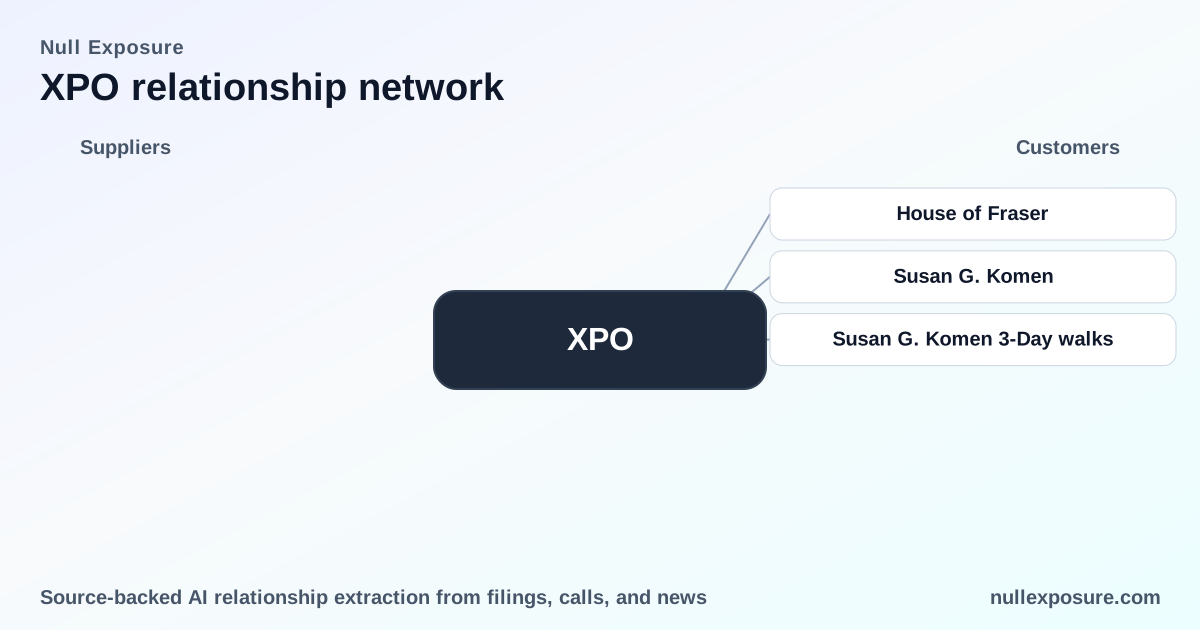
House of Fraser — legacy receivable exposure and DC shutdown
XPO’s UK division shut down the distribution centers it operated for House of Fraser on August 10, 2025, after the retailer owed millions, illustrating counterparty credit and operational unwind risk in retail contracts. This episode demonstrates the company’s exposure to retail insolvency and the short-term nature of many service contracts. Source: TruckingInfo reporting, March 10, 2026.
SAIA — property divestitures to a competitor
Saia acquired two former XPO properties in North Carolina, reflecting asset rationalization and the company’s willingness to divest real estate as network needs evolve. The transaction was covered in industry press on May 3, 2026 and is indicative of XPO’s selective asset management in North America. Source: TruckingDive, May 3, 2026.
Susan G. Komen / Susan G. Komen 3‑Day walks — event logistics renewal
XPO renewed transportation services for Susan G. Komen’s national 3‑Day walks, preserving a nonprofit/event logistics relationship that underscores XPO’s portfolio mix of commercial and not‑for‑profit customers. The renewal was announced in March 2026 across investor press and trade coverage. Sources: Globe and Mail/press release (Mar 10, 2026) and TipRanks reporting (Mar 10, 2026).
What these relationships reveal about risk and growth vectors
- Growth vector — last-mile and sustainability: Contracts with B&Q, Boots, and Saint‑Gobain show focused investment in last-mile capacity and electric vehicles, which supports higher-margin services and strengthens renewal prospects with retail and manufacturing customers.
- Risk vector — retail credit and churn: The House of Fraser shutdown underscores earnings volatility from retail counterparties; short-term contracts reduce lock‑in and require constant re-bidding.
- Capital management signal: The SAIA property sale illustrates active portfolio optimization — a lever to convert underutilized assets into working capital or debt reduction.
- Customer breadth reduces concentration: The company’s stated 55,000-customer base signals low client concentration, which buffers revenue if a few large customers exit, while still leaving exposure to large-enterprise strategic relationships that are commercially important.
Investment implications for operators and researchers
- Operational focus should be on utilization and short-cycle cash: With transit performance obligations usually under a week and a heavy last-mile mix, maximizing route density and same-day/next-day efficiency drives margin expansion.
- Commercial strategy should prioritize sustainability-linked partnerships: The Saint‑Gobain move shows sustainability investments unlock multi-year commitments from industrial customers.
- Balance asset ownership with flexibility: Real-estate disposals to parties like Saia suggest XPO will continue to rationalize capital to match network needs and reduce fixed-cost risk.
Final takeaways
XPO’s customer set combines high-frequency retail/event contracts with strategic industrial partnerships, underpinning a services-led revenue model that is growth-capable but operationally sensitive to utilization and retail credit cycles. For a concise, navigable map of these relationships and historic signals, visit https://nullexposure.com/.
For portfolio managers and operating partners evaluating exposure to XPO’s customer mix, the emphasis is clear: prioritize capacity utilization, credit monitoring of large retail customers, and capture sustainability-linked premium services.