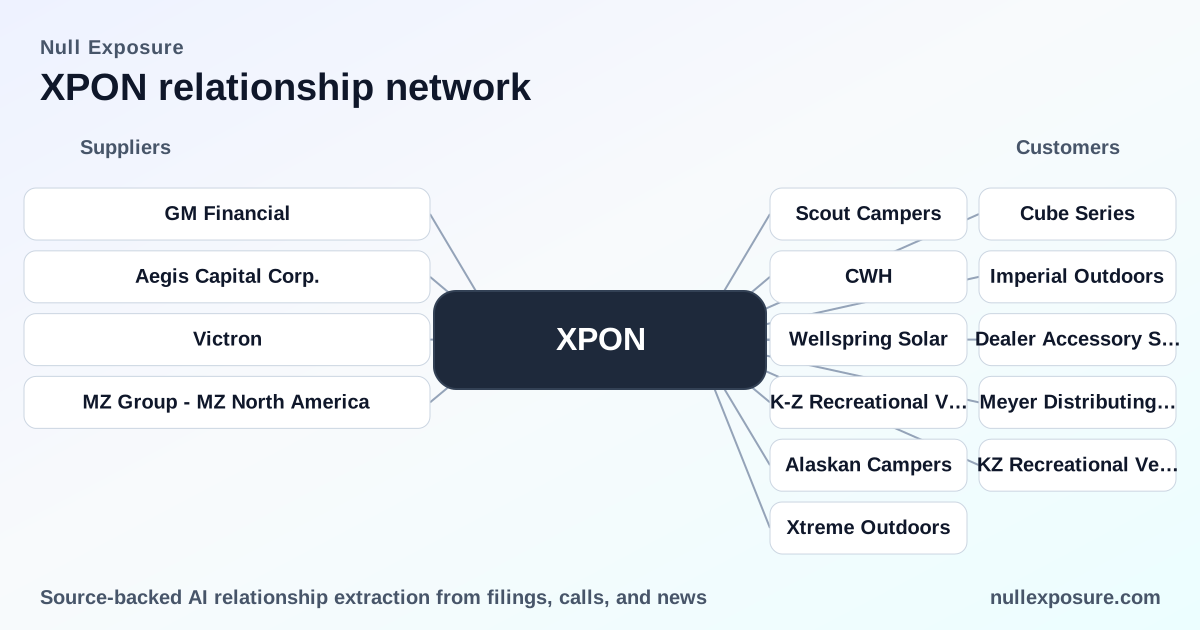
Expion360 (XPON) – Customer Map and Commercial Implications for Investors
Thesis: Expion360 sells high-energy lithium-ion batteries and related power systems into a channel-led model that monetizes through product sales to dealers, OEMs, retailers and direct consumers. Revenue is driven by short-term, purchase-order relationships with over 300 U.S. customers across the RV, outdoor recreation and emerging industrial storage verticals; strategic OEM exclusives and the recent DASGen partnership give the company scaled distribution and an avenue to move upmarket into jobsite energy systems. For research access and ongoing tracking, see https://nullexposure.com/.
How Expion360 makes money and how its commercial model behaves
Expion360 is a product-centric company: revenue is generated from sales of batteries and accessories; contracts are predominantly purchase-order based rather than long-term, recurring service agreements. The firm distributes through a mix of dealers, wholesalers, private‑label customers, OEM channel partners and direct-to-consumer sales, concentrated primarily in the United States and spread across more than 300 customers. That combination creates high leverage to unit volume, but also revenue volatility tied to order timing and retail channel inventory cycles.
Key operating constraints and what they imply:
- Contracting posture: short-term purchase orders. Expion360 explicitly states sales are largely without long‑term revenue commitments; this drives quarter-to-quarter volatility in top-line recognition.
- Counterparty mix includes individuals (direct retail) and resellers (dealers, wholesalers, OEMs). The company both sells direct and relies on partners to reach end users, trading margin control for market reach.
- Geography is concentrated in North America. All sales are primarily within the United States, signaling exposure to U.S. RV and construction market cycles.
- Core revenue from product sales. Batteries and accessories are the primary revenue drivers, with systems integrations (e.g., DASGen) representing a route to higher‑ticket sales.
For ongoing portfolio monitoring and deeper relationship analytics visit https://nullexposure.com/.
Customer roster: what every named relationship tells investors
Below are the company relationships found in public reporting and press—each summarized in plain language with the original source cited.
-
Camping World / CWH
Expion360 lists Camping World among its network of over 300 U.S. customers and identifies the retailer as a meaningful distribution partner to broaden retail reach. (Zacks initiation coverage and related press republished via The Globe and Mail / Yahoo Finance, March 2026: https://www.theglobeandmail.com/investing/markets/stocks/XPON/pressreleases/37303315/zacks-initiates-coverage-of-expion360-with-neutral-recommendation/ ; https://finance.yahoo.com/news/zacks-initiates-coverage-expion360-neutral-162800763.html) -
K‑Z Recreational Vehicles (KZ)
K‑Z is named as a sales relationship and OEM partner, indicating Expion360 supplies batteries through OEM channels into factory-installed RV programs. (Q2 2025 earnings call transcript via The Motley Fool, August 2025: https://www.fool.com/earnings/call-transcripts/2025/08/13/expion360-xpon-q2-2025-earnings-call-transcript/) -
Alaskan Campers
Alaskan Campers adopted Expion360’s GC2 162Ah VHC battery as a standard option across their truck camper product lines, reflecting an OEM-style adoption that locks product specification into the vehicle platform. (Company release reported by RV Business, FY2024: https://rvbusiness.com/expion360-alaskan-campers-partner-on-gc2-lithium-battery/) -
Scout Campers
Scout Campers is listed among recent new OEM partners, supporting Expion360’s strategy of OEM penetration to secure recurring OEM purchase volumes. (Preliminary Q4 2024 financial results press release republished via The Globe and Mail / March 2026: https://www.theglobeandmail.com/investing/markets/stocks/XPON/pressreleases/30269619/expion360-reports-select-preliminary-unaudited-fourth-quarter-2024-financial-results/) -
Wellspring Solar
Expion360 began shipping its Home Energy Storage Solutions to integration partner Wellspring Solar in January 2025, indicating a channel entry into residential and small commercial energy storage. (Q4 2024 press release, March 2026: https://www.theglobeandmail.com/investing/markets/stocks/XPON/pressreleases/30269619/expion360-reports-select-preliminary-unaudited-fourth-quarter-2024-financial-results/) -
Cube Series
Cube Series selected Expion360 as its exclusive strategic supplier for batteries and power components on a new ultra‑lightweight foldable camper, representing an exclusive OEM supply agreement for that product line. (Company release as republished on Yahoo Finance, FY2023: https://finance.yahoo.com/news/expion360-reports-2022-revenue-59-200500413.html) -
Xtreme Outdoors
Expion360 was chosen as the exclusive lithium‑ion battery supplier for Xtreme Outdoors, giving the company access to Xtreme’s dealer network of more than 130 dealers across North America. (Investor release republished on Yahoo Finance, FY2023: https://finance.yahoo.com/news/expion360-reports-2022-revenue-59-200500413.html) -
Imperial Outdoors
Imperial Outdoors entered an exclusive strategic supplier agreement with Expion360 for extreme overland RV campers, reinforcing the firm’s OEM strategy in higher-margin specialty RV segments. (Investor release republished on Yahoo Finance, FY2023: https://finance.yahoo.com/news/expion360-reports-2022-revenue-59-200500413.html) -
Meyer Distributing Inc.
Meyer Distributing is named as a distribution partner, underscoring the company’s reliance on traditional distributor channels to reach small dealers and specialty retailers. (Q2 2025 earnings call transcript via The Motley Fool, August 2025: https://www.fool.com/earnings/call-transcripts/2025/08/13/expion360-xpon-q2-2025-earnings-call-transcript/) -
Dealer Accessory Supply (DAS)
Dealer Accessory Supply will serve as final system assembler for the DASGen Hybrid Energy Storage System; Expion360 supplies the battery technology and will lead sales and marketing for the system, representing a clear strategic push into construction and industrial jobsite energy buffering. This relationship combines product supply with co‑branded systems go‑to‑market responsibilities. (Multiple announcements and partner releases across EnergyDigital, Bitget and MarketScreener, FY2025–FY2026: https://energydigital.com/globenewswire/3239307 ; https://www.bitget.com/news/detail/12560605203847 ; https://www.marketscreener.com/news/expion360-inc-enters-securities-purchase-agreement-with-institutional-investors-sec-filing-ce7d5adddf8ef223)
What these relationships imply for revenue trajectory and risk
- Distribution breadth with concentrated short-term commitments. Over 300 U.S. customers spread across dealers, retailers and OEMs creates a wide addressable channel, but the purchase-order model constrains revenue visibility. OEM exclusives (Cube Series, Xtreme, Imperial, Alaskan Campers) introduce higher predictability for specific product lines and support scaling when those programs ramp.
- Channel mix balances reach and margin pressure. Retail partners like Camping World and distributor arrangements with Meyer support volume; OEM exclusives and systems partnerships (DASGen) support higher ASPs and margin expansion if commercialization executes.
- Sector diversification expanding from RV/outdoor into residential and industrial. Wellspring Solar addresses home energy; DASGen targets construction/jobsite applications—this reduces single-vertical exposure but requires different sales cycles and support capabilities.
- U.S.-centric exposure. Concentration in the U.S. simplifies logistics and service expectations but increases susceptibility to domestic macro cycles in RV sales and construction spending.
Investment checklist — what to watch next
- Monitor quarterly revenue composition: OEM program ramp-ups versus spot retail orders will govern margin trends.
- Track commercialization milestones for DASGen and Wellspring Solar shipments for proof of up‑market expansion.
- Follow inventory and order cadence at large retail partners (Camping World) and distributor channels for near-term revenue signals.
Bold takeaway: Expion360’s commercial model combines high upside from OEM exclusives and systems partnerships with inherent top-line variability because most sales are short‑term, purchase‑order driven. For active investors, the signal set to prioritize is order cadence and delivery milestones from the named OEMs and DASGen commercialization reports.
For continued relationship intelligence and alerts on updates to these customer ties, visit https://nullexposure.com/.