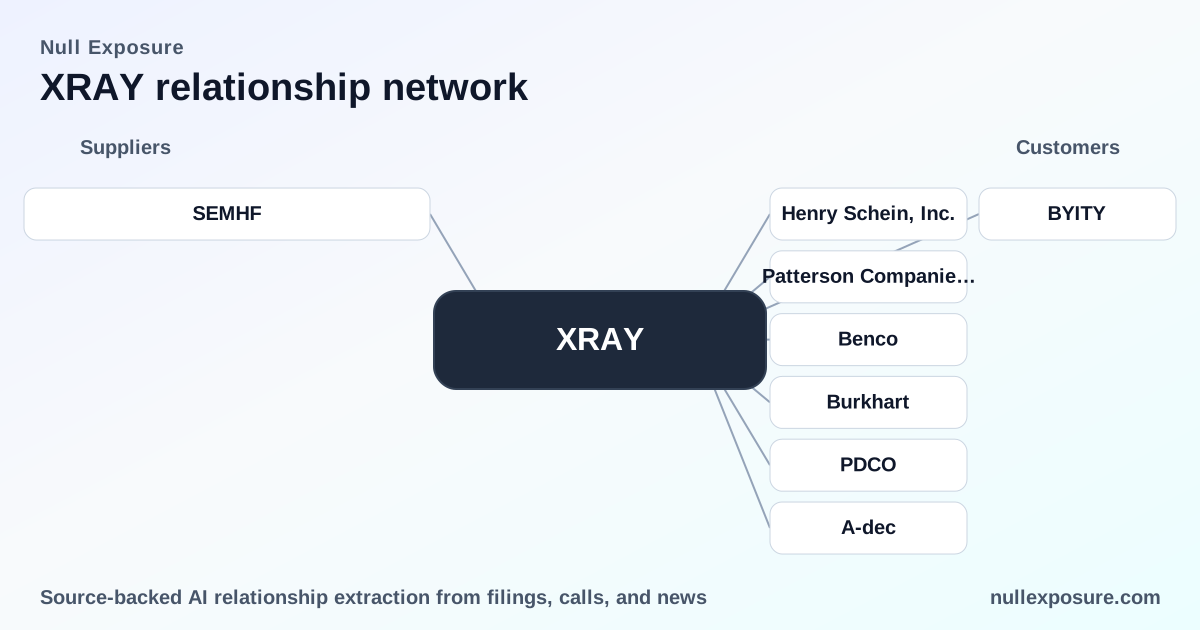
XRAY (Dentsply Sirona): Distributor-heavy customer footprint, short-term revenue cadence
Dentsply Sirona operates as a global manufacturer and marketer of dental equipment, consumables and adjacent software-enabled services, monetizing primarily through the sale of hardware, recurring consumables and service contracts routed largely through third‑party distributors. Revenue flows combine high-margin equipment sales with recurring consumables and software/support revenue, delivered through a multichannel distribution model where distributors drive volume and timing. For investment teams evaluating XRAY customer relationships, the interplay between distributor concentration, short-term contract recognition and ongoing dealer renewals will determine near-term revenue volatility and the timing of any recovery in free cash flow. Learn more at https://nullexposure.com/.
How to read the relationship map: distributors first, then dealer renewals
Dentsply Sirona sells roughly two‑thirds of its products through third‑party distributors and maintains direct relationships with dental practices and service providers. That commercial posture creates revenue timing risk driven by distributor inventory cycles and short-term deferred revenue recognition, while also offering scale when major distributor agreements are renewed or expanded.
Below I walk through every customer relationship surfaced in regulatory filings and media coverage and explain what each means for the company’s top-line profile.
The customer and partner roster (plain-English takeaways)
Patterson Companies, Inc.
Patterson appears in Dentsply Sirona’s FY2024 Form 10‑K as a counterparty that accounted for a meaningful share of accounts receivable in prior periods, reflecting a substantial distribution relationship in the U.S. market. According to the FY2024 10‑K, Patterson represented 10% of accounts receivable in 2023 and 12% in 2022.
Henry Schein, Inc.
Henry Schein is reported in the FY2024 10‑K as a large channel partner that generated a double‑digit share of net sales in recent years, underscoring its role as a major U.S./global dental distributor. The company disclosed Henry Schein accounted for 14% of net sales and 11% of accounts receivable in 2023 (FY2024 10‑K).
Benco
Media coverage of the Q4 2025 earnings call notes that Dentsply Sirona has signed new or expanded agreements with Benco, signaling a deliberate push to rebuild and broaden dealer partnerships to drive CTS (connected technology solutions) growth. InsiderMonkey’s transcript of the Q4 2025 call highlights new or expanded agreements with Benco (Q4 2025 earnings-call coverage).
Burkhart
Burkhart is reported as another dealer with which Dentsply Sirona expanded arrangements, reflecting the company’s multichannel distribution pivot intended to accelerate CTS revenue in the second half of the fiscal year. The Q4 2025 call transcript mentioned Burkhart among key partners (InsiderMonkey, Q4 2025 earnings coverage).
Burkhart Dental Supply
Separately, press commentary records an expanded technology distribution partnership with Burkhart Dental Supply, confirming the public narrative of dealer renewals and board updates that accompanied the company’s post‑impairment reset. SAHM Capital’s coverage noted the expanded partnership announcement (SAHM Capital, March 2026 / May 2026 report).
A‑dec
A‑dec is listed among recently renewed or expanded partner agreements cited by management as part of the reorganization and commercial refresh aimed at the CTS segment’s recovery. The Q4 2025 call transcript and subsequent analyst write‑ups reference A‑dec as a strategic channel partner (InsiderMonkey; analyst commentary May 2026).
Patterson (press mentions)
Multiple news outlets referenced renewed and expanded agreements with Patterson in early 2026, including a formal renewal of U.S. distribution rights that underpins Dentsply Sirona’s push to stabilize U.S. access for its products. TradingView reported on the January 14, 2026 renewal of the U.S. distribution agreement with Patterson Dental (TradingView, January 2026).
PDCO (ticker for Patterson)
Several market writeups refer interchangeably to Patterson by its PDCO ticker when summarizing distribution renewals, reinforcing that Patterson/PDCO remains a primary U.S. channel for XRAY’s commercial execution. TradingView and other coverage used PDCO when reporting the renewal (TradingView; market coverage January–May 2026).
Patterson (investment commentary)
Analyst and blog commentary in May 2026 reiterated that new and expanded agreements with Patterson underpin the company’s pivot toward a broader multichannel distribution model, suggesting Patterson’s role is central to any revenue recovery thesis. Trading and analyst notes highlighted Patterson in that context (TIKR and Zacks coverage, May 2026).
Patterson Dental (specific entity)
Press releases and news aggregators cite the formal renewal of U.S. distribution arrangements specifically with Patterson Dental on January 14, 2026, giving legal and commercial clarity to the dealer channel in the U.S. TradingView’s January 14, 2026 item covered the renewal announcement.
BYITY
BYITY/Byte is referenced in earnings commentary related to refunds and sales comparisons; the Byte business had refund activity that influenced reported constant‑currency sales movements in Q4 2025. The Q4 2025 earnings-call transcript noted a 6.9% constant currency increase after accounting for Byte refunds (InsiderMonkey, Q4 2025).
Byte
Byte operations were significantly reduced after October 24, 2024, with sales and marketing suspended and activity limited to supporting current patients — a company‑identified winding down of that business line in FY2024 filings. The FY2024 10‑K documents the significant reduction of Byte operations and the voluntary suspension of sales and marketing (FY2024 Form 10‑K; Q4 2025 call commentary).
What the relationship set tells investors about XRAY’s operating model
- Channel concentration and multichannel shift: Historically large distributors (Henry Schein, Patterson and their affiliates) have been material contributors; management’s 2026 strategy emphasizes expanded agreements with Benco, Burkhart and A‑dec to diversify channels and drive CTS adoption.
- Short‑term contracting posture: The company reports deferred revenue that it expects to recognize mostly within twelve months, which creates a short revenue recognition horizon and near‑term sensitivity to execution timing.
- Global reach with regional skew: Dentsply Sirona sells to approximately 150 countries and reports U.S. and Europe as the largest regional contributors (U.S. roughly $1,348M vs. total net sales $3,793M in the referenced period), so performance will be driven by U.S. and EMEA demand conditions.
- Distributor dynamics create timing risk: Two‑thirds of sales flow through distributors whose inventory and rebate dynamics (reserve for distributor rebates noted in filings) amplify revenue cyclicality during price changes or promotional cycles.
- Segment mix and maturity: The business combines hardware (equipment), consumables (recurring sales) and an emerging software/cloud stack (DS Core), so upside depends on converting equipment customers into recurring software/support revenue. Byte’s winding down is an explicit operational de‑risking of a non‑core consumer aligner initiative.
Investment implications — how relationships convert to value
- Upside: Renewals with large U.S. dealers and expanded agreements with mid‑tier distributors accelerate route‑to‑market for CTS hardware/software and can produce a visible second‑half revenue inflection if execution holds, supporting the recovery narrative many analysts cite.
- Downside: Distributor inventory cycles, rebate reserves and short deferred revenue recognition create pronounced timing volatility; if channel partners slow purchases, near‑term revenues will compress more quickly than a direct‑sell model would show.
- Operational anchor: The company’s global distribution footprint and two‑thirds dealer flow provide scale, but the commercial reorganization requires consistent dealer execution to translate into sustained margin and free cash flow improvement.
If you want a focused, continuous feed of relationship signals and constraint analysis for XRAY and peer dental OEMs, visit https://nullexposure.com/ for more investor‑grade intelligence and tracking.
Conclusion: Dentsply Sirona’s commercial health will be decided by distributor execution and the company’s ability to convert equipment sales into recurring software and consumables revenue; recent dealer renewals reduce short‑term distribution risk but leave the company exposed to inherent channel timing dynamics.