XRPN (Armada Acquisition Corp. II): Trustee economics, sponsor posture, and what counterparties tell investors
Armada Acquisition Corp. II (Ticker: XRPN) operates as a SPAC that monetizes through capital-raising events and the management of IPO proceeds held in a trust account; its economic profile today is dominated by non‑operating interest income from the trust and sponsor/underwriter transactions rather than recurring operating revenue. Investors should evaluate XRPN as a capital‑allocation vehicle where counterparty arrangements—trustee, underwriters, and sponsors—determine cash availability, governance constraints, and deal optionality.
For further primary‑source documents and diligence reference, visit https://nullexposure.com/.
How XRPN’s business model actually works in practice
XRPN is a shell vehicle: it raises cash via an Initial Public Offering, holds the proceeds in a trust account, and seeks a qualifying business combination in technology, media, and telecom. The company reports no operating revenue and records interest on marketable securities in the Trust Account as its only material income stream today, which is consistent with the SPAC archetype. According to the company’s FY2025 Form 10‑K (filed for the fiscal year ended September 30, 2025), Continental Stock Transfer & Trust Company acts as the trustee for that Trust Account and XRPN records the related interest income as non‑operating income.
Key financial posture signals from public filings:
- Market capitalization is reported at roughly $409 million, reflecting the market’s valuation of the SPAC vehicle post‑IPO.
- Reported EPS (diluted) around $0.11 despite zero operating revenue, underscoring the non‑operational nature of current earnings. These figures underline that XRPN’s economic value is tightly coupled to trust performance, sponsor behavior, and successful deal execution.
Trustee mechanics and what it costs you as an investor
Continental Stock Transfer & Trust Company: XRPN’s filings state Continental is the trustee that holds marketable securities in the Trust Account for the benefit of public shareholders; XRPN recognizes the interest that accrues in that account as non‑operating income. This trustee relationship is fundamental: the trustee controls the custody and distribution mechanics of IPO proceeds, and by extension the liquidity available for a future merger. (Source: XRPN FY2025 Form 10‑K.)
Investor implication: The trustee arrangement is a core operational dependency—any dispute, operational failure, or delay at the trustee level directly affects escrowed funds and timeline for a business combination. XRPN’s immediate income and optionality are therefore contingent on efficient trust administration.
What the public filings reveal about XRPN’s contracting posture and sponsor activity
XRPN’s 10‑K contains explicit transaction and sponsor disclosures that reveal a transactional contracting posture rather than a subscription‑style operating revenue model. The filing documents the IPO mechanics, private placement units purchased by the Original Sponsor and underwriters, and sponsor share transactions. These excerpts function as company‑level signals about concentration, roles, and maturity:
- Contract type (subscription‑style transactions): The filing describes private placement units purchased by the Original Sponsor and the underwriters simultaneously with the IPO, which indicates XRPN’s capital structure relies on negotiated private placements and underwriter support rather than recurring client subscriptions. (Evidence: XRPN FY2025 Form 10‑K.)
- Relationship role — seller: XRPN states it consummated the IPO of 23,000,000 Units on May 22, 2025, generating gross proceeds of $230 million, representing the company functioning as issuer/seller in the capital markets. (Evidence: XRPN FY2025 Form 10‑K.)
- Relationship role — buyer: The filing discloses that on November 7, 2024, the Original Sponsor purchased founder (Class B) shares at nominal price, demonstrating sponsor capital commitments and typical founder economics in SPAC structures. (Evidence: XRPN FY2025 Form 10‑K.)
These signals indicate a concentrated counterparty ecosystem (sponsor + underwriters + trustee) and a pre‑deal maturity stage where financial flows are primarily custodial and transactional.
For complementary diligence materials, visit https://nullexposure.com/.
All identified counterparty relationships (plain English, one by one)
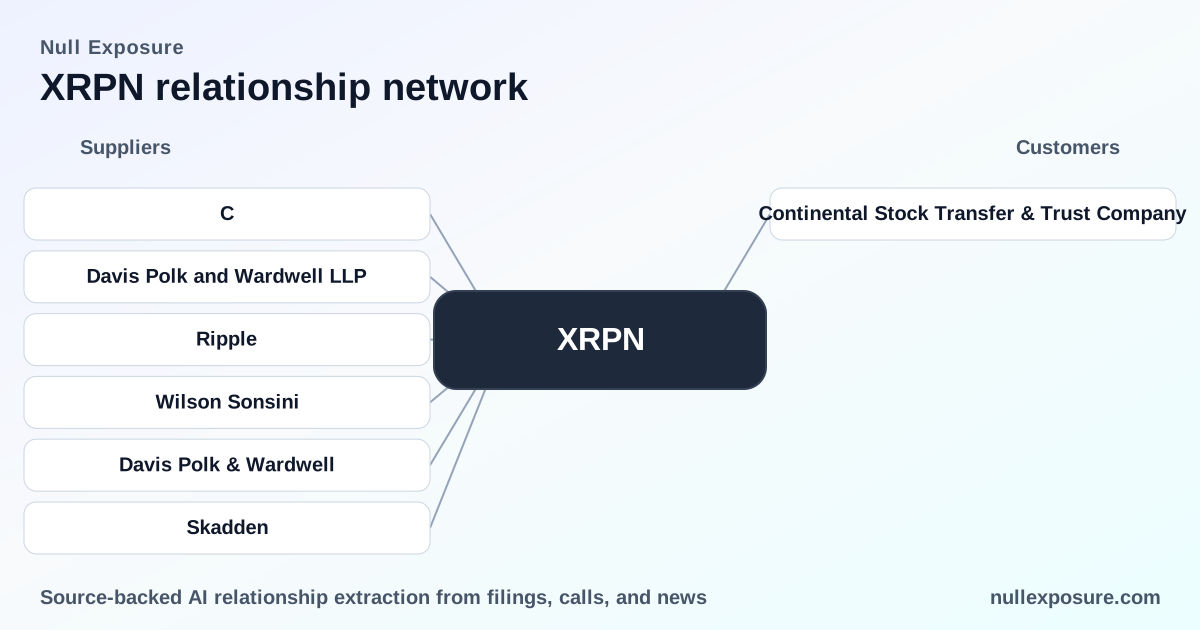
Continental Stock Transfer & Trust Company — Continental is the trustee that holds XRPN’s Trust Account and therefore is responsible for custody of the marketable securities that generate the company’s non‑operating interest income; the company explicitly states that interest income from the Trust Account is recorded as non‑operating income. (Source: XRPN FY2025 Form 10‑K.)
No other counterparties are named in the “customer”‑scope relationships returned in the public results provided.
What investors should focus on next: risk factors and catalysts
- Counterparty concentration is high. Trustee, sponsors, and underwriters dominate XRPN’s operational footprint; any operational or contractual friction in these relationships materially affects cash access and timeline to merger.
- Economics are non‑operational and time‑bound. With no core operating revenue, XRPN’s value proposition rests on the trust account’s performance, deal sourcing, and sponsor incentives to consummate a merger before SPAC deadlines.
- Sponsor incentives and founder economics matter. Sponsor purchases and founder share structures control dilution and governance levers; the filing shows standard sponsor purchases and underwriter activity that investors must model into post‑combination ownership outcomes.
- Maturity stage implies binary outcomes. As a pre‑business‑combination SPAC, XRPN’s investment thesis is binary: successful deal execution creates value; failure leads to liquidation and return mechanics governed by the trust.
Final assessment and action points
XRPN is a classical SPAC where trustee mechanics and sponsor behavior are the value drivers. For investors and operators doing counterparty diligence, the two priorities are (1) confirm trustee custody practices and fee schedules with Continental, and (2) model sponsor dilution and lockups using the disclosed private placement and founder purchase terms in the 10‑K.
If you need consolidated access to primary filings and relationship mapping for further underwriting or research, explore Null Exposure’s resources at https://nullexposure.com/.
Bold takeaway: XRPN’s credit and execution risk is concentrated in its trustee and sponsor relationships—understanding those contractual terms is essential to any valuation or deployment decision.