Xerox (XRX) customer relationships: what investors need to know
Xerox operates and monetizes through a dual model: hardware and consumables sales for printers and production devices, and a growing services and financing franchise that converts one‑time device revenue into recurring streams (managed print services, supplies, software and lease financing). This mix drives a high proportion of post‑sale revenue — a structural margin and cash flow lever that underpins valuation and counterparty risk assessment for operators and investors. For a concise briefing on how these customer ties translate into commercial optionality, see https://nullexposure.com/.
Quick read: the strategic posture beneath the headlines
Xerox’s customer footprint is deliberately broad and multi‑modal: longer‑term contracting, a mix of government, enterprise, mid‑market and small business buyers, and a global go‑to‑market spanning North America, EMEA, LATAM and APAC. The company’s model is weighted to services and recurring revenue — management reports that a substantial share of revenue is post‑sale based — and financing (XFS) converts device sales into annuity‑like receivables. These characteristics make Xerox less dependent on any single account while emphasizing execution risk around service delivery, channel partnerships and production portfolio competitiveness. For continuing monitoring of named customer activity, visit https://nullexposure.com/.
What the disclosures signal about contracts, concentration and criticality
- Xerox holds long‑term contracting posture in several areas: the company publicly described five‑year funding and servicing agreements with automatic renewals, indicating structural multi‑year commitments for financing and other programs. This is a company‑level signal of contract maturity and continuity.
- Counterparty mix is broad: Xerox calls out government customers, large and very large enterprises, mid‑market and small businesses in its filings — a deliberate diversification that reduces single‑customer materiality.
- Geographic reach is global, with emphasis on EMEA and North America but explicit presence in LATAM and APAC.
- Relationship roles span reseller/distributor, service provider, and buyer (lessee), consistent with a go‑to‑market that relies on channel partners for distribution and on Xerox for managed services and financing.
- The company has stated that loss of a single customer would be immaterial to the business; operationally this supports investment in scale‑efficient services rather than dependence on bespoke, concentrated accounts.
These constraints shape how specific customer relationships should be read: wins with channel partners validate distribution leverage, enterprise and retail rollouts validate managed services and production capabilities, and early adopters of IT services validate recurring monetization.
Customer relationships called out by management and the press
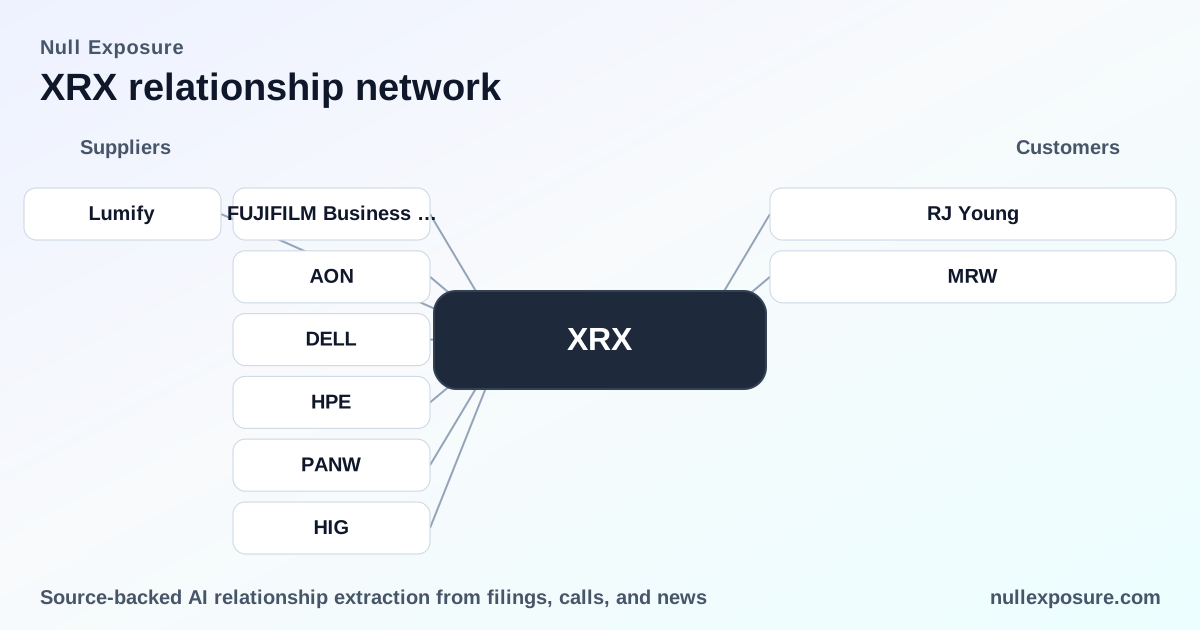
RJ Young — partnership announced on the Q4 2025 earnings call
On the Q4 2025 earnings call Xerox highlighted a partnership agreement with RJ Young, described as one of the largest office equipment and technology dealers in the U.S., which extends distribution and service capability for Xerox offerings. Source: Q4 2025 earnings call (xrx-2025q4-earnings-call, March 2026).
RJ Young — press characterization of the agreement and channel impact
Press coverage of the same deal emphasizes that the agreement stems from an existing Lexmark collaboration and extends Xerox’s portfolio into RJ Young’s installed base via RJ Young’s service network. Source: InsiderMonkey Q4 2025 earnings transcript coverage (FY2026).
Toshiba Americas — validation for Xerox production portfolio (MarketBeat)
Toshiba Americas added Xerox PrimeLink production printers to its portfolio, an endorsement that management framed as a validation of Xerox’s production competitiveness and brand strength. Source: MarketBeat earnings report (FY2026, May 2026).
Toshiba Americas — management reiterates validation in Q1 2026 commentary
Xerox reiterated the Toshiba Americas move in Q1 commentary, repeating that a major global partner choosing to sell Xerox‑branded devices confirms competitiveness of the production lineup. Source: InsiderMonkey Q1 2026 transcript excerpt (FY2026).
MRW — central print room and cloud print management deployment (news coverage)
A news transcript describes Xerox delivering a fully refreshed central print room for MRW using cloud‑based print management, web‑to‑print automation and third‑party MPS integration, indicating a multi‑component managed services engagement. Source: InsiderMonkey Q4 2025 earnings transcript coverage (FY2026).
MRW — management cited the Morrison’s joint win on the earnings call
During the Q4 2025 call, management cited a global first joint win with Lexmark for Morrison’s (Morrisons), linking that strategic account work to the same service and production capability playbook used for accounts like MRW. Source: Q4 2025 earnings call (xrx-2025q4-earnings-call, March 2026).
Morrisons — joint win with Lexmark, a strategic UK retail account
Xerox and Lexmark secured a joint global win with Morrison’s, one of the UK’s leading grocery retailers, which underscores Xerox’s credentials in large retail printroom and logistics deployments. Source: Q4 2025 earnings call (xrx-2025q4-earnings-call, March 2026).
Morrisons — press reiteration of the integrated solution approach
Media coverage of the same account highlights the integrated solution — central print room, cloud management and on‑site operations — positioning Morrison’s as a case study for large grocery and retail rollouts. Source: InsiderMonkey Q4 2025 coverage (FY2026).
Fresh Thyme Market — early adopter of Xerox IT as a Service
Fresh Thyme Market is identified as an early adopter of Xerox IT as a Service (ITaaS), with management and press noting measurable operational impacts from the new delivery model. Source: WebWire press release coverage (FY2026).
What investors and operators should take away
- Channel leverage matters. Partnerships with large dealers like RJ Young and OEMs/resellers such as Toshiba Americas expand reach without proportionally higher fixed cost; these relationships validate distribution scaling and product competitiveness.
- Services are strategic and recurring. Deployments at MRW, Morrison’s and Fresh Thyme demonstrate that Xerox is winning multi‑component managed services and ITaaS deals that convert device sales into ongoing revenue and operations responsibility.
- Contracting and maturity reduce catastrophic concentration risk. Company disclosures on long‑term servicing agreements and an explicitly diversified customer base mean Xerox’s revenue depends on portfolios and recurring streams rather than a handful of bespoke contracts.
- Execution risk is operational. The model depends on service delivery, effective channel enablement and competitive production devices; losses in these domains would affect margins and retention, but not create single‑account insolvency risk given stated immateriality.
Final view and action items
For investors, Xerox’s named relationships reflect validated distribution channels and early large‑scale service wins, which support the thesis that the company is pivoting toward higher‑margin, recurring revenue. For operators and credit managers, focus diligence on service SLAs, channel economics and the durability of financing arrangements underpinning equipment leases.
If you want ongoing tracking of customer‑level disclosures and relationship signals for Xerox and peer equipment companies, explore the research hub at https://nullexposure.com/.