X3 Holdings (XTKG): Equity lifeline reshapes an early‑stage software operator’s capital map
X3 Holdings is a Singapore‑headquartered application software provider that sells technology solutions and services globally and monetizes through software and associated services revenue. The company is operating with meaningful negative operating economics and has turned to structured equity commitments to bridge cash flow and growth funding; the Hudson Global Ventures facility is the single most consequential counterparty event in the public record for XTKG in 2026. For deeper coverage and primary‑document tracking, visit https://nullexposure.com/.
Business model in one paragraph X3 Holdings functions as a software‑application and services vendor to enterprise and institutional customers, generating top line from product sales and services delivery. The company reports roughly $9.6 million in trailing twelve‑month revenue and $3.77 million in gross profit, but posts a significant operating loss and negative EBITDA, indicating that monetization is intact but unprofitable at current scale. With limited institutional ownership and no dividend policy, X3’s capital strategy tilts toward external equity as the lever for near‑term liquidity.
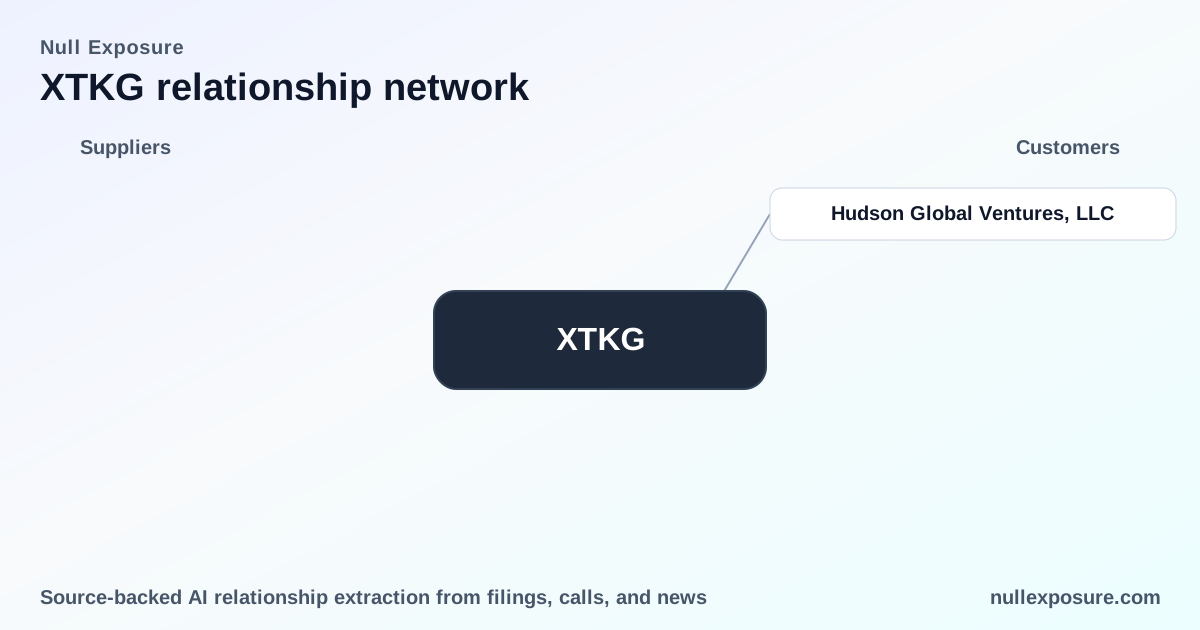
Why the Hudson arrangement matters now The equity purchase agreement with Hudson Global Ventures provides X3 with the right to sell up to $50 million of Class A ordinary shares over a 24‑month period. That commitment converts investor appetite into a standing financing option that materially alters X3’s funding runway and dilution profile: it delivers optional capital access without the immediate cash inflow of a single placement, but it also creates a credible path for substantial share issuance if management exercises the facility.
The financing detail investors should note
- The company disclosed an agreement granting Hudson the option to buy up to $50 million in newly issued shares over 24 months, with an initial issuance of 1,023,337 ordinary shares provided as consideration for the commitment. According to a company disclosure reported on TipRanks, the definitive securities purchase agreement and the initial share consideration were recorded in FY2026 (TipRanks, May 4, 2026).
- A separate market write‑up in Finviz tracked the prospectus supplement that described the Nevada‑based Hudson commitment as signed on Jan. 30 and noted the company’s ability to sell shares at its discretion during the commitment period (Finviz, March 10, 2026).
How to think about X3’s operating constraints and business posture X3’s public financial snapshot presents a company in growth‑funding mode rather than free‑cash‑flow generation. Key company‑level signals:
- Capital dependence: Negative EBITDA and a sizable operating loss indicate reliance on external capital to fund operations and growth. The Hudson facility is consistent with a company prioritizing access to equity liquidity.
- Valuation and investor base: Market capitalization is low relative to trailing revenue, and institutional ownership is minimal (about 4.3%), signaling thin coverage and limited institutional liquidity for the equity.
- Maturity and scale: Revenue of ~$9.6 million and gross margins that produce a positive gross profit show product demand, but operating losses and high volatility in share metrics suggest an immature commercial scale.
- Concentration risks: Lack of detailed customer concentration disclosures in the public summary increases the importance of tracking large customer wins and retention metrics as leading indicators of sustainable revenue.
Relationship log — every record in the public results Hudson Global Ventures, LLC — TipRanks (May 4, 2026) X3 entered a definitive securities purchase agreement in which Hudson committed to purchase up to $50 million of newly issued Class A ordinary shares over a 24‑month period, and the investor received 1,023,337 ordinary shares as initial consideration for that commitment. According to the TipRanks company announcement in FY2026, this agreement formalizes Hudson’s standing capital commitment to X3 (TipRanks, May 4, 2026).
Hudson Global Ventures, LLC — Finviz (March 10, 2026) A prospectus supplement reported by Finviz described the same equity purchase agreement, noting it was signed Jan. 30 and grants X3 the discretion to sell up to $50 million in ordinary shares during the commitment period; this disclosure was the immediate market catalyst for a pre‑market price move reported by financial news outlets (Finviz, March 10, 2026).
Implications for investors and operators
- Dilution vs. optionality: The Hudson facility is structured as optional capital; it provides optionality for management to access material equity proceeds when needed, but that optionality translates to potential dilution if used. Investors should model scenarios where the full commitment is executed and stress‑test per‑share metrics.
- Liquidity management: For an operator with negative EBITDA, the facility removes a near‑term liquidity constraint—but reliance on recurring equity commitments is not a substitute for achieving operating leverage.
- Signal to the market: Securing a named investor facility communicates that there is external capital willing to stand behind the business, which can be a stabilizing factor for a thinly traded micro‑cap stock.
What to watch next (practical catalysts)
- Frequency and magnitude of draws under the Hudson facility, and the pricing mechanics applied to share issuances under that agreement.
- Quarterly operating cadence: top‑line growth, gross margin trends, and progress toward EBITDA breakeven.
- Insider and institutional activity given the current low ownership base; any material ownership shifts would change liquidity dynamics.
- Public filings or prospectus supplements that disclose use of proceeds for specific product investments or M&A.
Bottom line X3 is a revenue generating but unprofitable application software operator that has secured a meaningful equity purchase commitment from Hudson Global Ventures to cover funding needs and provide optional capital over the next 24 months. That arrangement recalibrates the company’s funding playbook—improving runway while embedding potential dilution—so investors must weigh optionality against execution risk and closely monitor issuance activity and operating leverage progress. For ongoing tracking of X3’s counterparties and primary documents, visit https://nullexposure.com/.