Xtant Medical (XTNT): Portfolio-tightening divestitures sharpen a product-led orthobiologics strategy
Xtant Medical operates as a niche medical-device and orthobiologics company that develops, manufactures and sells grafts, implants and instrumentation to spinal and orthopedic surgeons. The company monetizes through direct sales, independent distributors and selective licensing agreements, and is actively reshaping its portfolio by divesting non-core spinal hardware to concentrate capital and management attention on higher-margin biologics and core implants. For investors, the near-term story is cash conversion from strategic asset sales and margin recovery driven by a narrower commercial focus. For deeper company research visit https://nullexposure.com/.
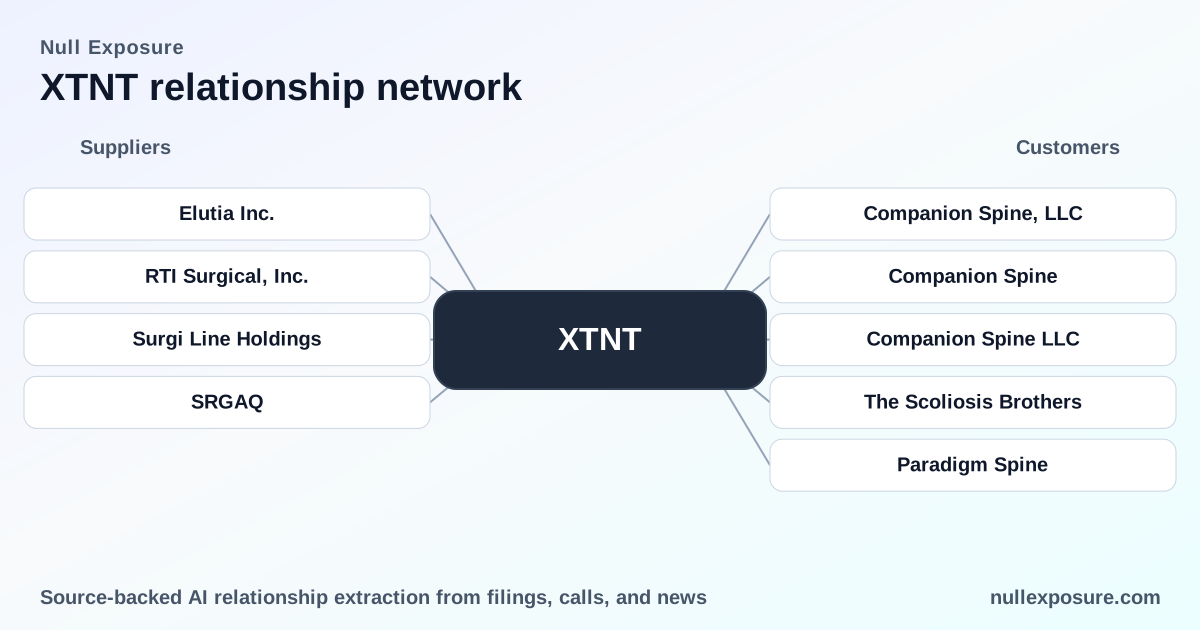
Companion Spine: the buyer that materially altered XTNT’s balance sheet
Companion Spine (Companion Spine, LLC) is the counterparty that acquired Xtant’s non-core Coflex/CoFix interlaminar stabilization assets and the international Paradigm Spine entities. Xtant announced the transaction closed in early December 2025 for an aggregate cash consideration of $21.4 million, with a $10.7 million payment received in late February 2026 that was applied to prepay related indebtedness. According to PR Newswire and Xtant’s filings (March 10, 2026; SEC/press releases cited March 2026), the sale and subsequent receipts materially improved near-term liquidity and reduced portfolio complexity. (Sources: PR Newswire, Mar 10, 2026; Investing.com reporting of the March 2026 releases.)
- Companion Spine paid $21.4 million in total for the Coflex/CoFix assets and Paradigm OUS businesses, with part of the proceeds received in December 2025 and a $10.7 million payment recorded on February 27, 2026, per company announcements and press coverage. (Source: PR Newswire and Investing.com, March 2026.)
- Xtant amended payment timing tied to the transaction, extending a note maturity and adjusting timing on January 15, 2026, as disclosed in company commentary covered by market outlets. (Source: TradingView summary of company update, Mar 2026.)
Paradigm Spine: the international business divested as part of the Companion Spine deal
The international Paradigm Spine entities were included in the Companion Spine transaction and transferred OUS operations to the buyer, effectively removing Xtant’s international hardware footprint for those product lines. Xtant’s press releases and earnings commentary confirm the Paradigm OUS sale closed in December 2025 as part of the aggregate $21.4 million consideration. (Source: PR Newswire/Company release, Mar 10, 2026; Marketscreener coverage, Nov 30, 2025.)
The Scoliosis Brothers: an intermediary/party with recorded consideration payments
Xtant referenced payments from a party labeled “The Scoliosis Brothers” as part of consideration flows tied to a transaction, with approximately $7.5 million received including a $2.5 million tranche described in earnings commentary. That payment history was reported in company call transcripts and investor coverage addressing proceeds and installment receipts associated with divestiture activity. (Source: InsiderMonkey transcript of Q3-2025 earnings call reporting, covered Mar 2026.)
How these relationships change Xtant’s commercial posture
The Companion Spine and Paradigm Spine divestitures converted non-core product lines into immediate cash and a simplified go-to-market structure. The gross proceeds reported — and the staged payments documented in filings and press — de-lever operational complexity and allow management to redeploy capital into orthobiologics and core spinal solutions, which remain the firm’s strategic focus according to FY2025 commentary and FY2026 reporting. (Source: TradingView and RyOrtho coverage of FY2025/FY2026 results, Mar–May 2026.)
Commercial and contractual profile: company-level constraints investors should model
Xtant’s public disclosures and filings reveal a consistent set of commercial characteristics that drive revenue durability and operational risk:
- Contracting posture — licensing and exclusive distributor agreements are material. Xtant disclosed multiple license and manufacturing agreements that assign exclusive, royalty-bearing rights and allow third parties to manufacture and commercialize named products in the U.S.; this is a deliberate route to scale selected product lines without building out full internal distribution. (Source: company disclosure excerpts in FY2024–FY2025 filings.)
- Counterparty mix — access to large channels but distributed exposure. The company reports contracts with major GPOs and penetration into IDNs, signaling large-enterprise distribution access but reliance on intermediaries rather than purely direct sales. This is a company-level characteristic, not specific to any single buyer named in media. (Source: company filing excerpts on GPO/IDN access.)
- Geographic concentration — heavily U.S.-centric revenue with international presence. Approximately 90%+ of revenue is U.S.-derived for recent years, while Xtant maintains sales channels in EMEA, APAC and LATAM via distributors and stocking partners; therefore, international divestitures (Paradigm OUS) reduce complexity but also shrink geographic exposure. (Source: company revenue breakdown, FY2024–FY2025 disclosures.)
- Materiality and segment focus — orthobiologics and spinal implants drive revenue. The company presents orthobiologics as roughly 57% and spinal implants ~42% of the referenced revenue split, indicating these product groups are core to operating performance and valuation relevance. (Source: FY2025 segment revenue excerpts.)
- Roles in the commercial model — licensee/distributor/seller relationships dominate. Public excerpts identify licensing partners, exclusive distributors and independent commissioned agents as primary commercial routes, indicating Xtant functions as both manufacturer and licensor depending on the product. (Source: licensing and distribution excerpts from company reports.)
Investment implications and risks investors must weigh
- Balance-sheet impact: The $21.4 million divestiture proceeds and the $10.7 million payment received in February 2026 meaningfully improve liquidity and reduce leverage near term; investors should mark these cash inflows against the company’s $78.4 million market capitalization and $13 million EBITDA (data through FY2025–FY2026 reporting). (Source: Company financials and press releases, FY2025–FY2026.)
- Concentration risk: With ~90% revenue from the U.S., Xtant retains geographic concentration risk even as it reduces international hardware exposure; reimbursement and hospital purchasing cycles in the U.S. remain primary drivers of top-line volatility. (Source: company geographic revenue disclosure.)
- Commercial complexity vs. scalability: Licensing and distributor arrangements accelerate market access but transfer margin and control to partners; the strategy reduces fixed-cost scale requirements but increases dependence on partner commercial execution. (Source: company licensing excerpts.)
- Portfolio focus: The divestitures signal management prioritization of orthobiologics and core spinal implants — a clearer strategic narrative that supports margin expansion and operational focus, while removing non-core product noise from the income statement. (Source: company investor communications and FY2025 earnings call summaries.)
For a quick company snapshot and to compare Xtant’s counterparties against other medtech deal activity, visit https://nullexposure.com/.
Bottom line
Xtant’s recent transactions with Companion Spine and the related transfers of Paradigm Spine’s OUS operations, along with consideration receipts from parties such as The Scoliosis Brothers, convert non-core assets into meaningful liquidity and sharpen the firm’s strategic focus on orthobiologics and core spinal products. Investors should treat the proceeds as de-risking events that improve near-term cash dynamics, while still modeling U.S. concentration and partner-dependent commercialization as the principal ongoing risks.