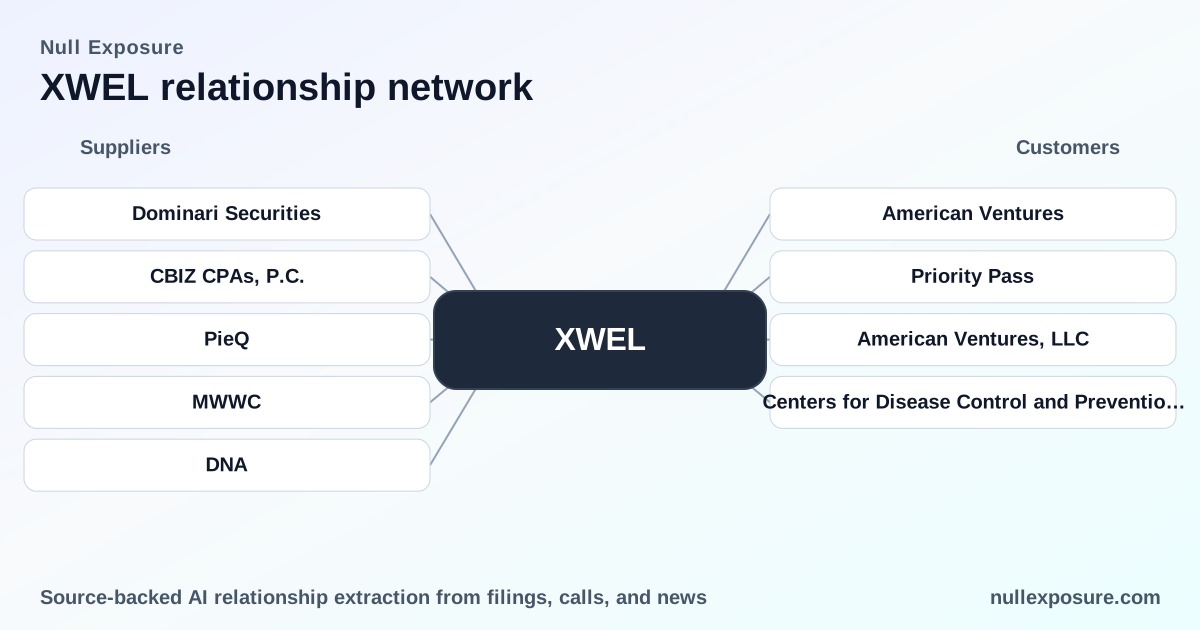
XWELL Inc. (XWEL) — customer relationships that drive resilience and dilution risk
XWELL operates two complementary businesses: airport-facing wellness services (XpresSpa) that monetize walk-in consumer spend and ancillary retail, and biosecurity services (XpresTest) that earn multi-year government and institutional contracts. Revenue comes from retail and service margins at spa locations and from contracted public-health programs; capital needs are being met in FY2026 through a sizeable private placement. This mix creates a dual risk/return profile: steady per-transaction cash from travelers paired with contract-dollar visibility from biosecurity work, offset by negative profitability and capital raises that dilute equity.
If you track counterparty health and contract structure closely, you can separate durable cash flows from episodic financing events — two dynamics that are central to valuation. For deeper signals on counterparty relationships and contract sizing, see Null Exposure’s analysis home page: https://nullexposure.com/
How XWELL makes money and why customers matter
XWELL’s core operating model is service-led and location-dependent. The XpresSpa business captures individual travelers as point-of-sale customers in airports, delivering relatively high-margin personal services and retail. The XpresTest business contracts with government and institutional buyers for traveler-based genomic surveillance and expanded multi-pathogen testing, creating multi-year revenue streams and larger contract sizes that materially impact reported revenue and cash flow. The company monetizes both through per-visit service fees and through fixed-price or milestone-based public contracts.
Capital markets behavior matters: the company lowered near-term liquidity pressure with a $31.3 million private placement in FY2026, changing both ownership and capital structure. That financing event and the contract portfolio together define XWELL’s operating leverage and dilution risk.
Key customer and partner relationships (what investors need to know)
Below I cover every counterparty mentioned in public results and reporting, each with a concise plain-English summary and the source cited in-line.
American Ventures
XWELL entered into a securities purchase agreement that is expected to generate gross proceeds of about $31.3 million, issuing Series H Convertible Preferred Stock as part of a private placement to American Ventures (reported March 2026). This is a near-term liquidity event that materially changes the company’s capitalization. (QuiverQuant press release, March 10, 2026)
American Ventures, LLC
Multiple news outlets describe the purchaser as American Ventures, LLC, a Texas-based real estate investment firm, which agreed to buy approximately 31,333 shares of Series H Convertible Preferred Stock at $1,000 per share, convertible into a substantial number of common shares at a low conversion price — a structural dilution vector for common stockholders. (Benzinga and Mexc coverage, February–March 2026)
Orlando Magic
XWELL executed a multiyear community partnership naming XWELL the official wellness spa of the Orlando Magic, a marketing and brand-extension relationship that increases consumer visibility in a regional market and supports cross-promotional retail and service demand. (InsiderMonkey and related reports, May 2026)
Priority Pass
XWELL extended a collaboration with Priority Pass to provide improved wellness services at XpresSpa sites in U.S. airports, a channel partnership that routes Priority Pass members into XWELL locations and augments foot-traffic and ancillary spend per visit. (Finviz news summary, May 22, 2025)
Centers for Disease Control and Prevention (CDC)
XWELL announced a three-year extension of its Traveler-based Genomic Surveillance Program with the CDC and also disclosed a collaboration involving PieQ to build an AI-driven biosecurity forecasting platform for the CDC, confirming XWELL’s role as a service provider on national biosecurity initiatives and establishing multi-year contract revenue. (Company filing and Reuters coverage summarized on TradingView, April 2025; further reporting in 2026)
What the relationship map implies about XWELL’s operating constraints
The public information yields several company-level operating signals that matter for investors:
- Contracting posture — long-term and partially government-funded. XWELL has extended program work under a three-year contract with a base value around $22.2 million and a maximum ceiling near $24.8 million over the same period, signaling multi-year revenue visibility in the biosecurity segment. This is a company-level contract signal, not tied to a specific external counterparty in the constraint excerpts.
- Counterparty mix — government and individual consumers. The company operates as a service provider to two distinct buyer groups: governments/institutions (biosecurity programs) and individual travelers (spa services). Government awards fund bio-surveillance monitoring activities and introduce public-sector procurement guidelines into operations.
- Geography and scale — global footprint with EMEA exposure. XWELL reported international locations across airports in Dubai, Abu Dhabi, Amsterdam and Istanbul, reflecting EMEA presence alongside North American operations and the attendant operational complexity and currency/exposure considerations.
- Spend band and materiality. The surveillance program extension positions contract size in the $10m–$100m band (evidence: $22.2m base over three years), large enough to move revenue and working capital but not yet at enterprise-transforming scale.
- Relationship role and stage. Public filings classify XWELL’s airport operations as active service provision, operating both company-owned and some franchised locations as of the latest fiscal reporting.
Together, these signals indicate a company that is operationally diversified but capital-constrained: recurring retail traffic provides steady but limited margins, while government contracts provide lumpier, higher-dollar revenue that increases cash-flow visibility but also exposes the firm to procurement and program-renewal risk.
Investment implications: return levers and primary risks
- Return levers: Growth in airport passenger volumes and expanded Priority Pass access directly scale retail/service revenue; successful integration of CDC programs and AI forecasting partnerships can lift biosecurity margins and open further institutional engagements. The $31.3M private placement provides runway to execute both operating and expansion plans.
- Primary risks: Equity dilution from convertible preferred issuance is immediate and material; the conversion economics described in media reports point to a low conversion price and a large potential share count increase. Profitability remains negative, with FY metrics showing operating losses and negative EPS; XWELL needs sustained contract renewals and increased spa throughput to shift margins. Concentration risk exists in the mix between travel-dependent consumer revenue cycles and government procurement cycles.
- Mitigants: Multi-year CDC work and channel partnerships such as Priority Pass diversify revenue sources, while brand partnerships like the Orlando Magic enhance consumer reach.
Bottom line
XWELL is a hybrid operator: consumer-facing spas generate daily cash, while biosecurity contracts deliver multi-year, contract-level revenue that materially affects valuation. Investors should balance the upside from growing travel demand and institutional contracts against dilution and persistent negative margins. For a structured review of counterparty signals and contract-level exposure, visit Null Exposure’s analysis hub: https://nullexposure.com/ — the report pages include relationship-level detail and source tracing for active investors.
Key takeaway: monitor contract renewals, CDC program performance, and the realization mechanics of the Series H preferred issuance; these three items determine whether XWELL’s next inflection is improved operating leverage or further capital dilution.