XMax (XWIN): Customer Relationships and Commercial Footprint — An Investor Brief
XMax Inc. designs, manufactures and sells residential and commercial furniture and monetizes primarily through product sales to distributors, retailers and designers, recognizing revenue at the point of delivery as the principal seller. The company operates on short-term, renewable supplier agreements and standard purchase orders, concentrates nearly all sales in North America, and supplements operating cash with occasional non-core financing activity. For investors and operators, the critical lens is on customer concentration, contract tenure, channel roles, and any capital deployments that sit outside core manufacturing economics. For firm-level monitoring and relationship tracking, see https://nullexposure.com/.
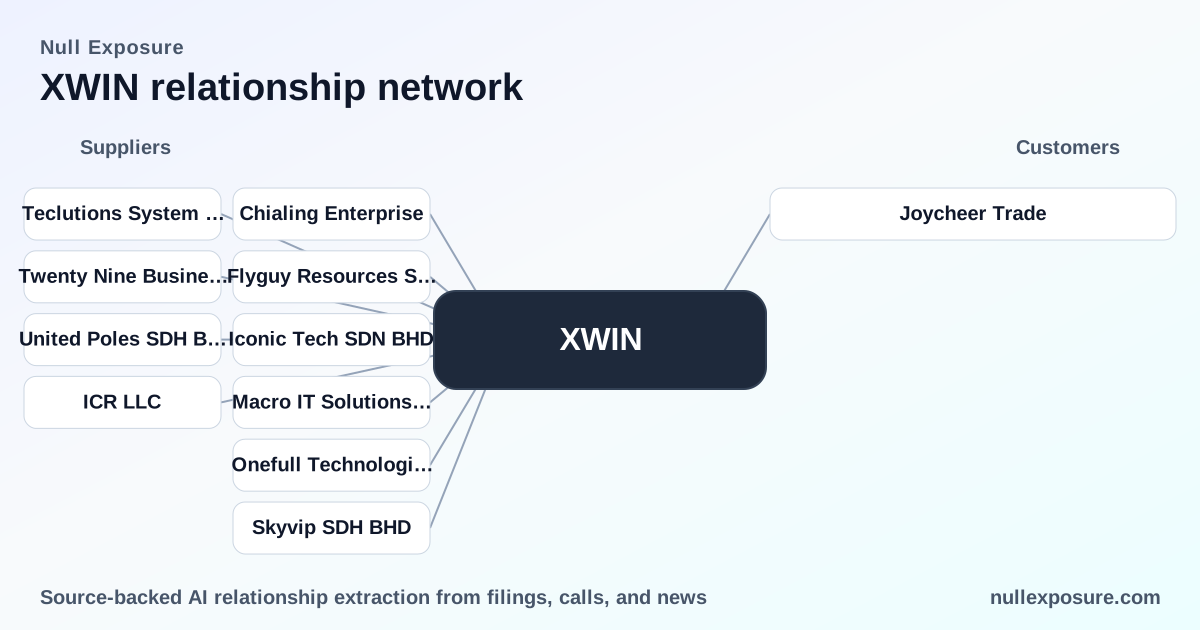
One explicit customer relationship in the public record: Joycheer Trade
XMax provided a $5.3 million loan to Joycheer Trade in FY2026, recorded as a loan agreement rather than a core product sale. This transaction represents a deliberate capital deployment outside XMax’s primary sales model and is disclosed in market reporting on March 10, 2026. (Source: TradingView news report, March 10, 2026 — https://www.tradingview.com/news/tradingview:7d0ce6247d807:0-xmax-signs-loan-agreement-with-joycheer-trade/)
How XMax contracts with customers and how that shapes revenue
XMax sells furniture under short-term, renewable supplier agreements with firm pricing, typically for one-year terms, and fulfills individual orders via standard purchase orders. Revenue is recognized at the point in time when the good is delivered, and XMax reports inventory risk and pricing discretion consistent with acting as principal in the transaction. These contract mechanics create transactional cash flow patterns—predictable order cycles but limited long-term revenue lock-in. (Source: company filings, fiscal years ended Dec 31, 2024–2025.)
Geographic footprint: overwhelmingly North America, APAC presence diminished
The company’s sales are highly concentrated in North America, which accounted for 97.4% of total sales in 2024, up from 79.1% in 2023. Sales to Asia fell to nil for 2024 following a liquidation sale in Malaysia in 2023. This concentration makes XMax’s demand profile tightly correlated with North American retail and housing trends, and reduces geographic diversification as a buffer against regional cycles. (Source: company filings, years ended Dec 31, 2024 and 2023.)
Channel roles and route-to-market: distributors, resellers and retail partners
XMax’s customers are principally designers, distributors and retailers that serve mid-level and upper-mid private label home furnishings. The company positions itself as a principal seller: it holds inventory risk and sets prices, while third parties such as Diamond Bar market and sell items under branded lines to U.S. distributors and retailers. These channel dynamics imply dependency on wholesale and retail partners to drive volumes, and exposure to margin pressure from distribution partners. (Source: company filings and related disclosures.)
Every reported relationship covered: how it matters to investors
- Joycheer Trade — In FY2026 XMax entered a $5.3 million loan agreement with Joycheer Trade, representing a non-operating cash deployment that investors should monitor for credit exposure and impact on working capital. (Source: TradingView, March 10, 2026 — https://www.tradingview.com/news/tradingview:7d0ce6247d807:0-xmax-signs-loan-agreement-with-joycheer-trade/)
This is the single relationship disclosed in the customer-scope results; all other customer signals come from company-level commercial descriptions and geographic disclosures.
Business model constraints that influence partner risk and upside
- Contract tenure and pricing posture: Short-term, one-year renewable agreements with firm product pricing create stable near-term margins but limit long-term revenue visibility and bargaining power to pass through input-cost shocks. (Company disclosure.)
- Geographic concentration: With ~97% of sales in North America for 2024, the company is exposed to domestic retail cycles and U.S. housing/consumer spending variability. APAC sales contracted to nil in 2024, indicating limited regional diversification. (Company disclosure.)
- Channel reliance and role as principal: Operating as the principal with inventory risk gives XMax direct margin control but also ties working capital and inventory cycles to customer demand and distributor throughput; partners such as Diamond Bar function as market channels rather than upstream suppliers. (Company disclosure.)
- Mature customer relationships: Management describes many customer relationships as long-term and strategic, which reduces churn risk but does not eliminate exposure from short contract terms. (Company disclosure.)
- Single-segment exposure: XMax reports a single reportable segment for furniture design and sales, concentrating operational risk in one product family. (Company disclosure.)
Financial posture and what the customer dynamics imply for valuation
XMax’s trailing revenue is modest relative to market capitalization and headline multiples: Revenue TTM ~$16.7M, Gross Profit ~$4.18M, negative EBITDA, and a Price-to-Sales ratio above 30. These metrics signal that market pricing is pricing in significant growth or optionality rather than current operating performance. Given the short-term contracting model and heavy North American concentration, operational execution—inventory turns, distributor sell-through, and working capital management—will determine whether valuation premium is sustainable. (Source: company financials, latest quarter ended 2025-12-31.)
Practical implications for investors and operators
- Track working capital: inventory risk and receivables dominate since XMax acts as principal; the $5.3M loan to Joycheer Trade is an active capital allocation that shifts balance sheet risk and should be monitored for recovery profile.
- Monitor channel health: Distributor and retail sell-through rates and order cadence drive cash conversion; short-term contracts make monthly/quarterly order flow the key operating metric.
- Geographic sensitivity: With nearly all revenue in North America, macro indicators—consumer confidence, housing starts, and retail furniture demand—are leading indicators for sales.
- Governance and capital use: Non-core financing transactions change the risk profile—assess board authorization, collateral, and the strategic rationale for extending loans versus deploying capital in core operations.
For a concise, ongoing feed on XMax customer disclosures and other commercial intelligence, visit https://nullexposure.com/.
Conclusion — key investor takeaways
- Core monetization remains product sales through distributors and retailers.
- Contracts are short-term and transactional, which lowers revenue visibility despite management’s claim of mature relationships.
- Geographic concentration in North America is acute and shapes the company’s cyclicality.
- Non-operating moves (e.g., $5.3M loan to Joycheer Trade) introduce balance sheet credit risk and merit active monitoring alongside inventory and receivables.
Investors should prioritize cadence of orders, distributor sell-through, working capital trends, and any further disclosures of financial arrangements like the Joycheer loan when assessing XMax’s operational health and valuation prospects.