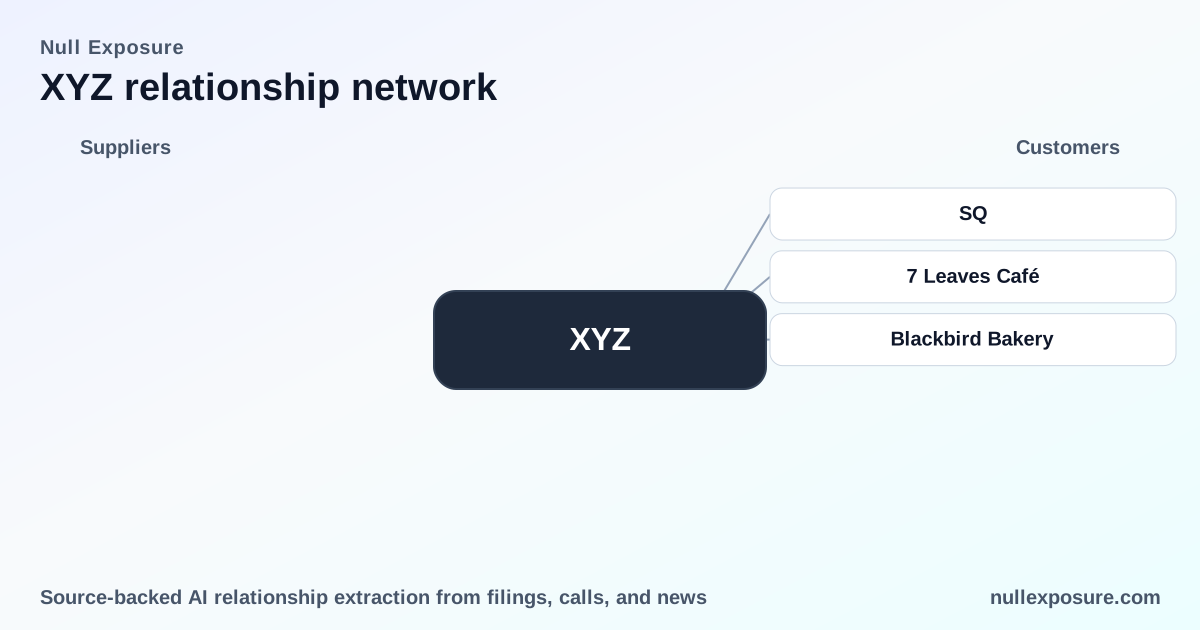
Block, Inc. (XYZ): How merchant relationships drive revenue and where investor focus should be
Block builds integrated commerce and financial ecosystems—Square for merchants and Cash App for individuals—and monetizes through a mix of transaction fees, subscription and service fees, and hardware sales. Square captures a steady stream of usage-based transaction revenue from merchants, layers monthly subscription products for advanced software, and sells terminals and POS hardware via distribution channels; Cash App drives individual engagement and monetizes through payments, optional financial services, and payment rails. For investors, the core thesis is simple: transaction volume growth plus incremental software and financial products expansion determine revenue cadence, while short-term merchant contracts and usage-driven economics set churn and volatility risk. For a consolidated view of Block’s customer footprint, visit https://nullexposure.com/.
What the customer relationships tell us about the operating model
Block’s customer base and contract structure produce a predictable yet usage-sensitive revenue mix. Company disclosures show the firm combines short-term merchant contracts and free software tiers monetized through transaction fees with subscription products that renew monthly and longer-form monthly payment options for larger purchases. This blend creates both recurring base revenue and high operational leverage to payment volumes:
- Contracting posture: Most merchant relationships are short-term or monthly-renewing, with heavier monetization tied to card acceptance and transaction activity; the company also offers longer monthly installment plans for larger payments.
- Revenue mix and sensitivity: A meaningful portion of revenue is usage-based (transaction fees), complemented by subscription and service fees and hardware sales through retailer/distributor channels.
- Counterparty profile and diversification: Sellers skew small business and mid-market, while Cash App targets individual consumers; Block reports geographic breadth with a U.S. concentration but an international merchant footprint.
- Concentration and materiality: Block discloses that no single customer accounted for more than 5% of Square GPV in recent years, signaling low counterparty concentration risk at the customer level while leaving macro and segment concentration as primary risks.
- Business maturity and criticality: The Square ecosystem is mature enough to serve sole proprietors through mid-market sellers; hardware and distribution roles indicate established go-to-market channels that support scale.
These characteristics imply high topline elasticity to consumer spending and merchant volume while offering durable upside from migration to subscription services and cross-sell financial products.
Customer roll call: the FY2026 relationships investors should track
Below are all customer relationships surfaced in the FY2026 coverage, with concise summaries and source references.
The Pancake Parlour — 13 restaurants adopting Square
The Pancake Parlour selected Square as its unified commerce platform for 13 locations to modernize operations and build infrastructure for growth. According to TradingView’s Zacks coverage (May 4, 2026), this is a merchant-level deployment of Square’s unified commerce stack. (TradingView / Zacks, May 4, 2026)
Uber Eats — Square technology integrating internationally
Block will integrate Square technology with Uber Eats on an international basis, expanding the reach of Square’s merchant tools and payments rails beyond in-store commerce. This integration was reported by TradingView in May 2026. (TradingView / Zacks, May 4, 2026)
SQ — transaction revenue concentrated in Square merchant fees
Block earns the majority of its transaction revenue from Square by charging merchant fees for payment processing, reinforcing that Square remains the primary revenue engine for transaction volume. This point was highlighted in TradingView coverage from March 10, 2026. (TradingView, March 10, 2026)
Square — core merchant-facing revenue engine
Square is Block’s merchant-facing business and supplies the core transaction and subscription revenue streams through POS, payments, and platform services. TradingView’s March 2026 analysis reiterates Square’s centrality to Block’s transaction economics. (TradingView, March 10, 2026)
Cinnaholic — nationwide reengagement across 85 locations
Cinnaholic reengaged with Square to power operations across 85 locations, demonstrating Square’s traction in scaling QSR and franchise deployments. This was reported in a Zacks piece syndicated to TradingView (May 4, 2026). (TradingView / Zacks, May 4, 2026)
Uber — Cash App Pay introduced on Uber and Uber Eats in the U.S.
Block will roll out Cash App Pay as a payment option on Uber and Uber Eats within the United States, extending Cash App’s payments footprint into two large mobility and delivery platforms. TradingView’s May 4, 2026 coverage documents this expansion. (TradingView / Zacks, May 4, 2026)
Blackbird Bakery — POS and Kitchen Display System upgrade
Blackbird Bakery partnered with Square to replace an outdated till system, adopting Square POS and a Kitchen Display System, signaling Square’s value proposition in back-of-house modernization for foodservice. Finviz reported this integration in March 2026. (Finviz, March 10, 2026)
Black Seed Bagels — tripled volume after adopting Square
Black Seed Bagels publicly reported a tripling of volume after deploying Square as its unified commerce platform, a testimony to the operational impact Square can deliver at single-brand scale. MarketBeat cited a Businesswire announcement dated April 29, 2026. (MarketBeat / Businesswire, April 29, 2026)
Steak Escape — expanded quick-service restaurant partnership
Square expanded its partnership with Steak Escape, reinforcing demand for Square’s quick‑service restaurant solutions and integration across point-of-sale and payments. This expansion was covered by TradingView in May 2026. (TradingView, May 4, 2026)
7 Leaves Café — platform selected across 44 U.S. locations
7 Leaves Café selected Square’s comprehensive commerce platform to power operations across 44 U.S. locations, demonstrating Square’s ability to win multi-location rollouts in fast-growing chains. Finviz reported the move in March 2026. (Finviz, March 10, 2026)
For broader customer analytics and to compare these deployments across merchant cohorts, visit https://nullexposure.com/.
How these merchant engagements translate into investor-relevant risk and upside
The relationship roster confirms several investment implications:
- Upside drivers: Multi-location rollouts and integrations with platforms like Uber/Uber Eats expand both GPV and cross-sell opportunities for subscriptions and financial products; successful case studies (tripled volume, nationwide rollouts) accelerate sales cycles with similar chains.
- Volatility and churn: The dominance of usage-based transaction fees and monthly short-term contracts exposes revenue to volume swings; however, subscription products and higher-margin services provide margin expansion levers.
- Distribution and hardware: Sales through distributors and retail channels diversify go-to-market but create one-time revenue lumpiness; hardware deliveries are recognized at point of sale, limiting revenue predictability.
- Geographic exposure: Block is primarily U.S.-centric but increasingly global—international integrations like Uber Eats broaden total addressable market while adding regulatory and cross-border complexity.
- Customer concentration: No merchant exceeds 5% of GPV, which lowers single-counterparty risk while leaving the company exposed to macroeconomic cycles that affect many small-business sellers simultaneously.
Bottom line for investors
Block’s merchant relationships in FY2026 demonstrate continued traction with multi-location rollouts and platform partnerships that expand payment options and GPV. The business model combines predictable recurring revenue from subscriptions and active users with high upside from transaction volume expansion, while short-term contracts and usage-based economics create volatility that investors must price. Monitor volume trends, cross-sell adoption rates, and the pace of multi-location deployments as leading indicators of revenue acceleration.
If you want a concise, investor-grade summary of Block’s customer relationships and how they affect risk and revenue models, explore additional analysis at https://nullexposure.com/.