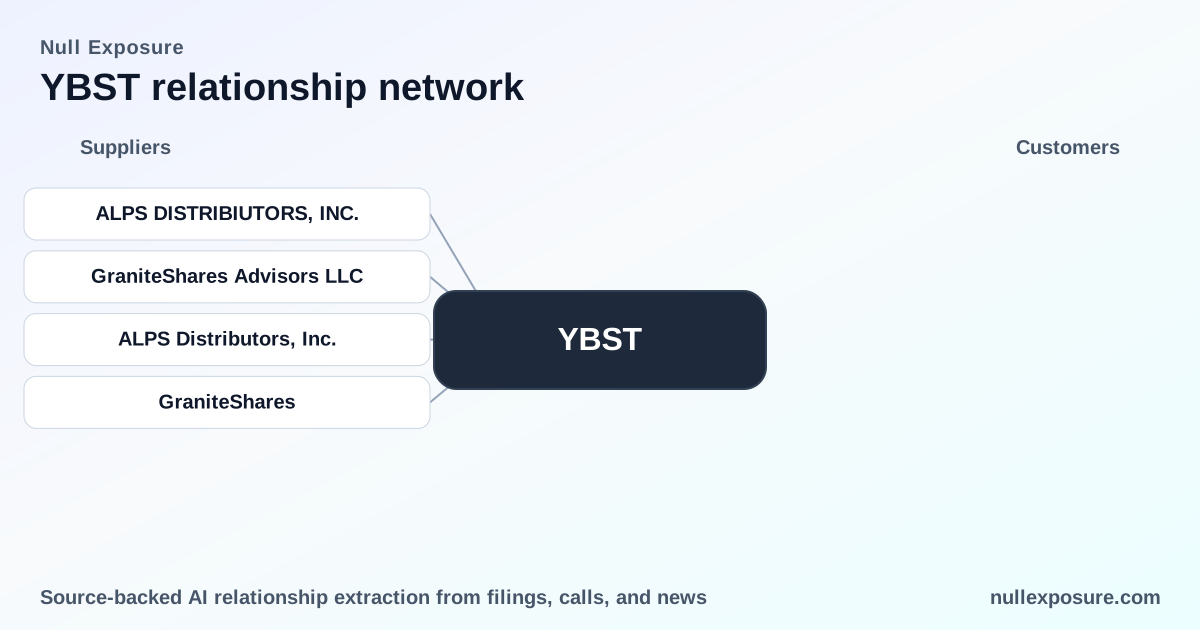
YBST: customer-risk profile and what investors should price in
YBST operates as a contractual manufacturing and supply partner to downstream technology and industrial companies, monetizing through fee-for-service manufacturing agreements and supply contracts that generate recurring revenue and order-based margins. Investor returns will track YBST’s ability to retain critical customers, meet manufacturing timelines and maintain quality controls, because counterparties explicitly disclose YBST as a material operational input in their regulatory filings.
For a focused read on counterparty exposure and disclosure-driven signals, visit the Null Exposure homepage: https://nullexposure.com/
Why a single customer disclosure warrants investor attention
When a buyer lists a supplier in a Form 10‑K as capable of materially affecting its business, that is a concentrated operational signal you cannot ignore. A supplier that shows up in a customer's risk section is effectively a single point of failure for that buyer — and by extension a concentration and operational‑performance lever for the supplier itself. For YBST, that dynamic translates into both commercial leverage and financial risk: the company benefits from deep, possibly high‑margin engagements, but investor returns will be sensitive to order volatility, quality incidents, and contract renewals.
What the filings say about each counterparty
ENVX — manufacturing dependency disclosed in FY2024
ENVX's FY2024 Form 10‑K states that if ENVX "fail[s] to effectively manage our relationship with YBS; if YBS is unable to meet our manufacturing requirements in a timely manner; or if we experience delays, disruptions or quality control problems, it may materially and adversely affect our business, prospects, financial condition and results of operations." This language identifies YBS (covered here as YBST) as a material manufacturing partner whose performance is a business‑critical input for ENVX (ENVX’s FY2024 10‑K).
Source: ENVX Form 10‑K, FY2024.
Operating model signals and company‑level constraints investors should interpret
No structured constraint excerpts were supplied beyond the customer disclosure, so treat the following as company‑level signals derived from the disclosure environment:
-
Contracting posture — supplier with operational obligations. The disclosure positions YBST as a contract manufacturer or fulfillment partner that carries execution risk (timeliness and quality) rather than a purely commoditized vendor. That implies contract terms likely emphasize performance SLAs and quality clauses.
-
Concentration — potentially high for specific buyers. A counterparty putting a supplier in its risk disclosure typically reflects a non‑trivial revenue or capability dependency. Investors should plan scenarios where a single large buyer represents a material share of YBST revenues.
-
Criticality — operationally critical to at least one buyer. The 10‑K wording around material adverse impact signals that YBST’s output is embedded in ENVX’s production path, making YBST operationally critical for that client.
-
Maturity and disclosure depth — sufficient maturity to be disclosed. Inclusion in a FY2024 annual filing indicates the relationship is established and significant enough to be considered a risk factor by the buyer's management and counsel.
These are company‑level takeaways intended to frame diligence and valuation, not legal assertions about contract terms or exact revenue splits.
Investment implications and the near‑term risk checklist
Institutional investors and portfolio managers should translate the above signals into a pragmatic checklist:
-
Concentration exposure: quantify revenue tied to the disclosing buyer(s). A single large client referenced in a 10‑K suggests a meaningful share of orders; value YBST with sensitivity to client loss or demand shock.
-
Operational performance risk: model the impact of shipment delays, yield losses, and quality control issues. These are the precise failure modes called out by ENVX’s disclosure.
-
Contract economics and exit rights: prioritize diligence on contract length, termination triggers, and penalties for missed SLAs. These clauses materially affect downside protection.
-
Counterparty credit and stability: if YBST serves clients whose operations are themselves volatile, order flows can be procyclical; incorporate buyer credit and demand volatility into scenario analysis.
-
Reputational and insurance considerations: being named in a customer's risk section increases public scrutiny; verify YBST’s insurance, quality certifications and remediation processes.
If you want systematic counterparty tracking aligned with these checklist items, Null Exposure’s platform centralizes customer‑disclosure signals: https://nullexposure.com/
How to think about valuation and downside protection
For a supplier with the profile implied here, apply a dual approach to valuation:
-
Base case: assume contract retention but include conservative rollback of order growth if one or two large customers reduce spending.
-
Stress case: model a partial or total contract termination and quantify margin erosion and fixed‑cost absorption. Because customers have highlighted material dependence, downside scenarios are nontrivial and should compress multiples.
-
Upside: operational improvements, diversification of the customer base, or moving up the value chain into design/engineering services would reprice the company higher; absent evidence of diversification, do not assume it.
Bottom line for portfolio managers and operators
YBST is a supplier whose performance is material to at least one public customer’s operations; that embeds both commercial leverage and concentrated operational risk. For investors, the priority is precise quantification: revenue concentration, contract tenure, SLA exposure, and remediation capacity. For operators, the priority is delivery discipline, quality assurance, and clear contractual protections.
For continued monitoring of customer‑level disclosures and to integrate counterparty risk into your investment process, see Null Exposure: https://nullexposure.com/